Kathleen Spivack - Unspeakable Things
Здесь есть возможность читать онлайн «Kathleen Spivack - Unspeakable Things» весь текст электронной книги совершенно бесплатно (целиком полную версию без сокращений). В некоторых случаях можно слушать аудио, скачать через торрент в формате fb2 и присутствует краткое содержание. Год выпуска: 2016, Издательство: Knopf, Жанр: Современная проза, на английском языке. Описание произведения, (предисловие) а так же отзывы посетителей доступны на портале библиотеки ЛибКат.
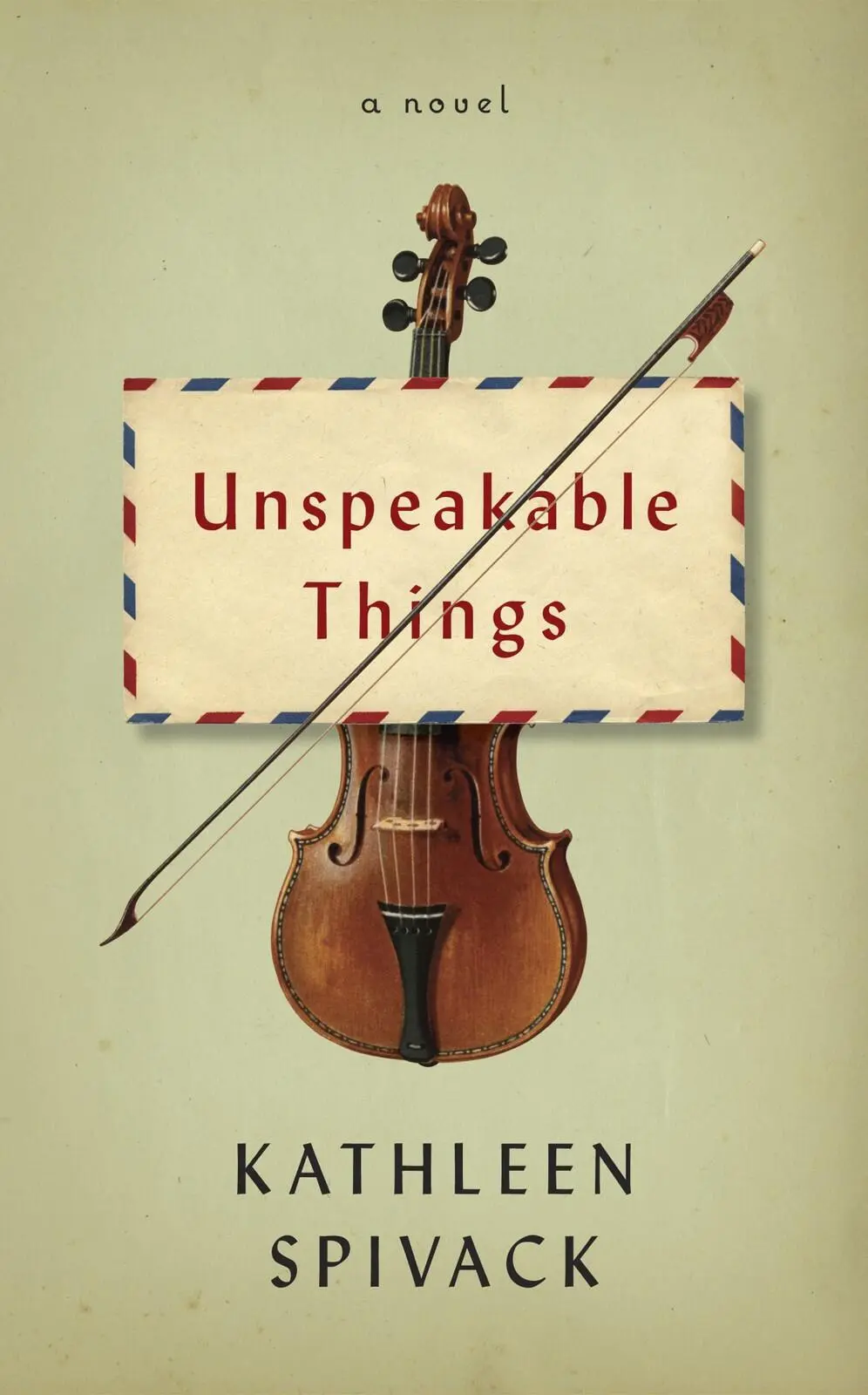
- Название:Unspeakable Things
- Автор:
- Издательство:Knopf
- Жанр:
- Год:2016
- ISBN:нет данных
- Рейтинг книги:4 / 5. Голосов: 1
-
Избранное:Добавить в избранное
- Отзывы:
-
Ваша оценка:
Unspeakable Things: краткое содержание, описание и аннотация
Предлагаем к чтению аннотацию, описание, краткое содержание или предисловие (зависит от того, что написал сам автор книги «Unspeakable Things»). Если вы не нашли необходимую информацию о книге — напишите в комментариях, мы постараемся отыскать её.
and
. A strange, haunting novel about survival and love in all its forms; about sexual awakenings and dark secrets; about European refugee intellectuals who have fled Hitler’s armies with their dreams intact and who have come to an elusive new (American) “can do, will do” world they cannot seem to find. A novel steeped in surreal storytelling and beautiful music that transports its half-broken souls — and us — to another realm of the senses.
The setting: the early 1940s, New York — city of refuge, city of hope, with the specter of a red-hot Europe at war.
At the novel’s center: Anna (known as the Rat), an exotic Hungarian countess with the face of an angel, beautiful eyes, and a seraphic smile, with a passionate intelligence, an exquisite ugliness, and the power to enchant. . Her second cousin Herbert, a former minor Austrian civil servant who believes in Esperanto and the international rights of man, wheeling and dealing in New York, powerful in the social sphere yet under the thumb of his wife, Adeline. . Michael, their missing homosexual son. . Felix, a German pediatrician who dabbles in genetic engineering, practicing from his Upper East Side office with his little dachshund, Schatzie, by his side. . The Tolstoi String Quartet, four men and their instruments, who for twenty years lived as one, playing the great concert halls of Europe, escaping to New York with their money sewn into the silk linings of their instrument cases. .
And watching them all: Herbert’s eight-year-old granddaughter, Maria, who understands from the furtive fear of her mother, and the huddled penury of their lives, and the sense of being in hiding, even in New York, that life is a test of courage and silence, Maria witnessing the family’s strange comings and goings, being regaled at night, when most are asleep, with the intoxicating, thrilling stories of their secret pasts. . of lives lived in Saint Petersburg. . of husbands being sent to the front and large, dangerous debts owed to the Tsar of imperial Russia, of late-night visits by coach to the palace of the Romanovs to beg for mercy and avoid execution. . and at the heart of the stories, told through the long nights with no dawn in sight, the strange, electrifying tale of a pact made in desperation with the private adviser to the Tsar and Tsarina — the mystic faith healer Grigory Rasputin (Russian for “debauched one”), a pact of “companionship” between Anna (the Rat) and the scheming Siberian peasant — turned — holy man, called the Devil by some, the self-proclaimed “only true Christ,” meeting night after night in Rasputin’s apartments, and the spellbinding, unspeakable things done there in the name of penance and pleasure. .
Unspeakable Things — читать онлайн бесплатно полную книгу (весь текст) целиком
Ниже представлен текст книги, разбитый по страницам. Система сохранения места последней прочитанной страницы, позволяет с удобством читать онлайн бесплатно книгу «Unspeakable Things», без необходимости каждый раз заново искать на чём Вы остановились. Поставьте закладку, и сможете в любой момент перейти на страницу, на которой закончили чтение.
Интервал:
Закладка:
Obsessively, the Rat remembered the scenes with Rasputin: the pain, the terror, the excitement. Wildness rose up in her. Each night, she regarded her body, putting her small, wondering hands against the large, passionate handprints burned into her flesh. She thought of Rasputin’s gleaming organ every time she prayed. The Rod of God. She climaxed each time she knelt in church. She bit her lip so none could hear her cries.
As if at a distance, as if it were happening to someone else, the Rat lived through all the later ensuing horror: the complete disappearance of her husband, the flight from Saint Petersburg, the loss of her children. She heard, as in a distant dream, news of the slaughter of the Holy Family. Of Rasputin’s fate, no one knew. But even this did not move her as one would have thought — she merely thought of his large face, the hooded face, the hairy body, and what looked like a tail. And she touched her body and dreamed of the time when she would meet him again.
But something finally cleared in the Rat’s mind when she was reunited with her beloved cousin Herbert and his grandchildren. Dumped unceremoniously on the floor of a large, vacant, echoing space, the New York Public Library, Anna came to. Suddenly, she snapped out of the obsession — that obsession for sexual experience, for union with evil, that had managed to cloud all subsequent suffering. That obsession that had silenced her during her flight through Europe, the long wait in detention camps for passage to the United States. The long, silent wait, while she kept herself sealed in her own thoughts.
The Rat was freed from all this, and although she remembered dimly, as if at a distance, all her losses, once carried home in Herbert’s arms, she returned to herself, as if all were washed away.
The Rat was once again the earnest young girl she had been, arguing seriously with her cousin about the meaning of life. She and Herbert looked at each other as if no time had passed. They did not see the age upon their faces, only the simple joy of being.
Watching Maria and Philip, the Rat knew happiness. She dreamed, and her dreams were gentle ones, not the hot, tortured sexual ones that had carried through the long years of a heavy life.
In this stuffy room, rejoined with the little family, Anna knew once more a simple purity of being. She was content to sit by the window, hearing the sounds of New York rising up, and watching the faint rays of sunlight cross the room. Everything here made Anna happy; she was a simple Rat after all.
Anna watched the little girl in bed beside her, her breath rising and falling as she slept peacefully. Her hair caught the light. Anna drew the bedclothes about them both more snugly. She had entered another time of her life, the easiest time.
Anna adjusted her small aching body. She knew there were modern ways of getting rid of marks. She had heard already that doctors were voluntarily removing tattoos — one did not need to be marked forever. In conversation, Herbert had told her that Felix, their friend from the old days, was one such doctor. Compassionate, humane, Felix treated only the escapees from Europe. The Rat remembered him from the old days, their fierce intellectual discussions. Yes, she would offer to go with Maria to her next appointment with the old doctor, and there she would ask him to help her. Almost regretfully, the Rat stroked her own marred thighs. It would not do to go to her Maker with the mark of evil on her. She knew her time was coming; she was already preparing for it.
Chapter 15 DEAD A LONG TIME
Maria did not know then that she would not be dead a long time. In 1945, when the war ended, she would be ten. Inexplicably, her visits to Uncle Felix stopped before then.
But until that time, each week on Saturday afternoons, Maria was taken to his office, where Uncle Felix would give her “vitamins.” Often before the visits, Maria lay on her cot in the family room, stiffly, passively, refusing to respond to her mother’s pleas. “Maria, put on your coat. It is time to leave now.” Then, more forcefully: “Come, Maria, you must.” Maria tried hard to make herself even more dead; with a little effort, she could almost tune out her mother’s existence.
But inevitably, she didn’t know how, these refusals would end. Larger than death, her young and beautiful mother would win. For her mother was helpless and angry. And it was somehow Maria’s fault.
Years later, Maria was to read about Gandhi and the principle of passive resistance. She had almost invented it, she felt. With just a little more time, she might have perfected it. She read of swamis lying on beds of nails and not feeling anything. She read of people staring at the sun. Maria practiced all this, or the equivalent.
At night, she stared into the darkness of the room and pretended not to hear little Philip when he cried. She found she could tune out the grown-ups when they talked to her. Later, in school, she practiced not moving at all, although sometimes she would blink when her name was called.
Maria practiced being clean. She practiced being good. She was a top student. She practiced being invisible. “How good she is,” the adults marveled. “Maria is always so polite.” Maria liked this; it gave her more time to be herself beneath the facade. But there was no self. Maria practiced and practiced being dead. It would become a useful skill.
Maria felt most herself, that is to say, most dead, when lying on Uncle Felix’s examining table, her hand forcibly pressed to Uncle Felix’s “broken leg.” She let herself float out of her body, up near the walls among the photographs of the angel children. Had they, too, been in this room? She wondered, regarding their grave little faces. They all seemed so clean, so purified. Maria knew that she would join them someday; Uncle Felix was making her ready for that other life. She longed to wear white.
Somewhere in the room, far away, Maria listened to the sounds of water running. Felix washed his hands. Maria lay before him, naked, meek, and sacrificial. She thought of heaven.
Maria encountered another little girl waiting in the entry, a child also accompanied by a nervous, fussing mother. Maria did not want to think about this too much. The two girls would, in passing, lower their eyes in shame and confusion, avoiding each other’s too-careful scrutiny. Did they share the same experience with Uncle Felix? Did the other girl need “vitamins” also? Maria wondered, turning her head in sudden, sharp, unbearable pain.
After her sessions with Uncle Felix, Maria sat outside the door on the little sofa and waited for her mother. Did her mother need “vitamins,” too? Maria heard, through the door, her mother’s hypocritical laugh, and a growl that seemed to come from Uncle Felix. She buried her head in Schatzie’s neck. Sometimes, as the door closed, she saw, in her mind’s eye, her mother’s beautiful slip, her blouse, flung over the top edge of the yellow Chinese screen.
When she was older, her mother stopped going with her to Uncle Felix’s. But this was after Maria’s father, David, had returned to the family. “You’re old enough to go there by yourself,” Maria’s mother said.
Maria was too thin, with deep bluish circles under her eyes, and an anxious expression, which she tried to tame into impassive calmness. She didn’t protest too much, had long since given up protesting. The dead feel nothing, after all, so what did it matter? Meekly, she went.
Felix’s room was always warm, and with a certain voluptuous dread, Maria partook of his rituals. His “broken leg,” her “badness,” all these she accepted. After Felix was finished, he stroked her forehead, her hair. She was his “good girl” then. She felt loved and soothed. Maria imagined that at those times she heard the angels singing. Yet, immediately after, Felix dismissed her with a brusque dislike. She could see she wasn’t good enough yet; and each time, between the visits, Maria was a “bad girl” again.
Читать дальшеИнтервал:
Закладка:
Похожие книги на «Unspeakable Things»
Представляем Вашему вниманию похожие книги на «Unspeakable Things» списком для выбора. Мы отобрали схожую по названию и смыслу литературу в надежде предоставить читателям больше вариантов отыскать новые, интересные, ещё непрочитанные произведения.









Обсуждение, отзывы о книге «Unspeakable Things» и просто собственные мнения читателей. Оставьте ваши комментарии, напишите, что Вы думаете о произведении, его смысле или главных героях. Укажите что конкретно понравилось, а что нет, и почему Вы так считаете.