Kathleen Spivack - Unspeakable Things
Здесь есть возможность читать онлайн «Kathleen Spivack - Unspeakable Things» весь текст электронной книги совершенно бесплатно (целиком полную версию без сокращений). В некоторых случаях можно слушать аудио, скачать через торрент в формате fb2 и присутствует краткое содержание. Год выпуска: 2016, Издательство: Knopf, Жанр: Современная проза, на английском языке. Описание произведения, (предисловие) а так же отзывы посетителей доступны на портале библиотеки ЛибКат.
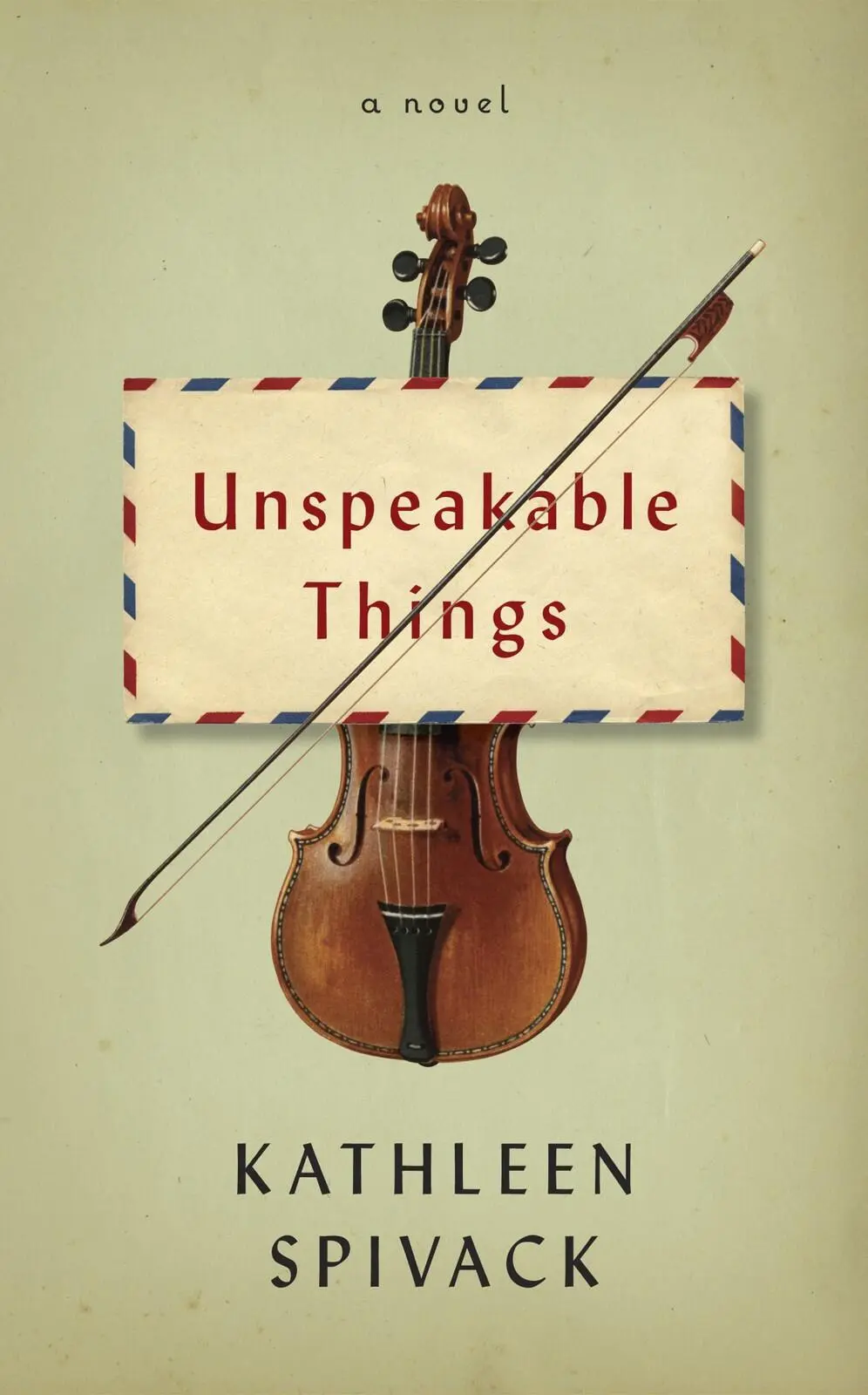
- Название:Unspeakable Things
- Автор:
- Издательство:Knopf
- Жанр:
- Год:2016
- ISBN:нет данных
- Рейтинг книги:4 / 5. Голосов: 1
-
Избранное:Добавить в избранное
- Отзывы:
-
Ваша оценка:
Unspeakable Things: краткое содержание, описание и аннотация
Предлагаем к чтению аннотацию, описание, краткое содержание или предисловие (зависит от того, что написал сам автор книги «Unspeakable Things»). Если вы не нашли необходимую информацию о книге — напишите в комментариях, мы постараемся отыскать её.
and
. A strange, haunting novel about survival and love in all its forms; about sexual awakenings and dark secrets; about European refugee intellectuals who have fled Hitler’s armies with their dreams intact and who have come to an elusive new (American) “can do, will do” world they cannot seem to find. A novel steeped in surreal storytelling and beautiful music that transports its half-broken souls — and us — to another realm of the senses.
The setting: the early 1940s, New York — city of refuge, city of hope, with the specter of a red-hot Europe at war.
At the novel’s center: Anna (known as the Rat), an exotic Hungarian countess with the face of an angel, beautiful eyes, and a seraphic smile, with a passionate intelligence, an exquisite ugliness, and the power to enchant. . Her second cousin Herbert, a former minor Austrian civil servant who believes in Esperanto and the international rights of man, wheeling and dealing in New York, powerful in the social sphere yet under the thumb of his wife, Adeline. . Michael, their missing homosexual son. . Felix, a German pediatrician who dabbles in genetic engineering, practicing from his Upper East Side office with his little dachshund, Schatzie, by his side. . The Tolstoi String Quartet, four men and their instruments, who for twenty years lived as one, playing the great concert halls of Europe, escaping to New York with their money sewn into the silk linings of their instrument cases. .
And watching them all: Herbert’s eight-year-old granddaughter, Maria, who understands from the furtive fear of her mother, and the huddled penury of their lives, and the sense of being in hiding, even in New York, that life is a test of courage and silence, Maria witnessing the family’s strange comings and goings, being regaled at night, when most are asleep, with the intoxicating, thrilling stories of their secret pasts. . of lives lived in Saint Petersburg. . of husbands being sent to the front and large, dangerous debts owed to the Tsar of imperial Russia, of late-night visits by coach to the palace of the Romanovs to beg for mercy and avoid execution. . and at the heart of the stories, told through the long nights with no dawn in sight, the strange, electrifying tale of a pact made in desperation with the private adviser to the Tsar and Tsarina — the mystic faith healer Grigory Rasputin (Russian for “debauched one”), a pact of “companionship” between Anna (the Rat) and the scheming Siberian peasant — turned — holy man, called the Devil by some, the self-proclaimed “only true Christ,” meeting night after night in Rasputin’s apartments, and the spellbinding, unspeakable things done there in the name of penance and pleasure. .
Unspeakable Things — читать онлайн бесплатно полную книгу (весь текст) целиком
Ниже представлен текст книги, разбитый по страницам. Система сохранения места последней прочитанной страницы, позволяет с удобством читать онлайн бесплатно книгу «Unspeakable Things», без необходимости каждый раз заново искать на чём Вы остановились. Поставьте закладку, и сможете в любой момент перейти на страницу, на которой закончили чтение.
Интервал:
Закладка:
Allied with Herbert, his father, outside that soft, delicious circle, David felt as his father often did. Foolish, loving, practical, a taken-for-granted balance to the family.
The Tolstoi Quartet, like everyone else, not seeing the tensions, treated both boys as one. They smiled at David/Michael tenderly, nearsightedly as they left. “Such fine boys,” they said vaguely as Herbert and Adeline stood at the doorway, thanking them. Herbert paid them handsomely. “Good night.” The cries fluttered back into the apple-scented garden. David saw the family house in Vienna, solid, bourgeois; the garden, the garden wall, the street, the streetcars running on curved tracks, taking him and his brother to school each day.
“Good night.” The Quartet struggled into their coats and, embracing their instruments, descended into the soft night. “Fine boys,” they said again mildly as Michael stood pressed against his mother, regarding them gravely with great eyes. David, standing by his father, manfully shook their hands.
As if reading his memories, Adeline sighed now. “Ah, my David. Shall we ever hear such fine music again?”
David shook himself out of the past. “I don’t know, Mother,” he replied, forgetting to lie this time. “I don’t know.”
Both mother and son were silent. The spring air hovered somewhere, wafting to the far-off strains of music. Was it Mozart? No, it was a popular song on a tinny radio, down a gloomy corridor in a place where institutional food was being prepared.
“Well,” said Adeline, for once practical. “We must act ‘as if.’ And for that reason, I am rehearsing, even as I lie here. In case they should need me. In case, indeed, they meant it when they said we would play together in New York. It’s always best to be prepared, son.” The organized maternal side of Adeline, which occasionally surfaced, showed itself now. David felt the old moral lessons starting again.
“Of course,” he replied meekly. Then, more kindly, he said, standing up, “Of course they will play again. And you with them. It will be grand.” He put his hands in his pockets. “But now I must go. And you must practice. I will see that you get the score,” he promised. “And I will be back for the concert, you may be sure.”
“Good-bye,” Adeline replied absently as he quietly left the room. But her eyes were staring at something else, and her fingers were already beginning to move in chord-seeking clawlike gestures upon the folded edge of the sheet. She was humming to herself, humming so quietly that only Michael, lying close to her, pressing his very ashes against her living body, could hear.
Behind him as he left, David felt rather than heard the music going through Adeline’s mind. He was startlingly angry with his father for giving his mother such false hope. But since it was unthinkable to be angry with Herbert, David stopped the thought immediately, hurrying, now running with long, relieved strides through the streets of New York City toward the arms of Grand Central Station, which this time welcomed him joyously. The train was waiting when he arrived at the tracks, waiting just for him. And the old train sang on its rails, singing to the rhythm of Schubert, carrying David back to Washington, where he would spend days, weeks, and longer, hunched like a mole over old newspapers, magnifying glass in one hand, sorting carefully through all the old newspaper ads of Europe for those that advertised, in code, yet proudly, for additives: elixirs that, when ingested, would somehow deliver the attributes someone, a geneticist, for example, might crave.
“Be Smart.” “Get Lucky.” “Think Positively.” “Improve Your Memory.” “Develop Your Muscular Potential.” “Grow Hair in Only Twenty-one Days.” “Learn to Play Music in Twelve Easy Lessons.” “Enlarge Your Bust.” “Become the Master of Your Fate.” “Find True Love.”
These were the kinds of advertisements David scrutinized. What did they offer? What did they really mean? And who was profiting from all this in the end?
Somewhere, right now, people were doing experiments. In Europe, clearly, but the pills and powders that made it possible, the ground-up substances supplying these laboratories, were, David knew now, coming from America.
Chapter 14 RASPUTIN’S MARK
Each night after she had satisfied herself that all the others were sleeping, Anna, the Rat, undressed carefully under the heaped bedclothes in the darkened room. But this morning, she woke early. Spring light moved across the room. But the family slept, Ilse as never before. Herbert had already left. The Rat wondered what time it was; perhaps time to wake Ilse and the children.
Spring caressed Anna’s cheek as she regarded the still-sleeping figure of Maria, tucked in so tenderly beside her. Painfully, the Rat managed to shift herself into an upright position, which is to say a semicurled sitting one. Her spine ached. Anna drew aside the blanket where it weighted her. And in the soft first light of the morning, she peered at her body as she pulled her nightgown aside.
Anna’s spine, curved in a semicircle, condemned her to stare forever at her own lap. Because of this, she always, even to herself, even in the dark, kept herself covered. But now she took a look.
There it was. The handprints were still there. A sulfurous burn of a hand mark, each long finger articulated on her withered white flesh. The hands were etched into the flesh of each upper thigh as strongly as the print of a leaf can etch itself into cement or stone.
“Oh.” She sucked in her breath in dismay.
She forced herself to look closely. The bony, determined fingers, the emblazoned palms, the hands gripped her thighs and moved them forcibly apart. As she looked, a smell of quickly struck phosphorus rose up from her body. She felt herself on fire, scorched again and forever by the rapacious hands of Rasputin.
“Unspeakable things,” she murmured to herself, now tracing the outlines of the cadaverous hands on her body. She ran her own small, soft hands over the large marks. “He did to me unspeakable things.” And even while she said this to herself, even while she experienced anew the shame and horror, a little spasm, the beginnings of wild excitement, began to mount.
The hands flickered into flame; the flame ignited. Anna melted into her memories, confounded of shame and excitement. “Yes!” she cried to her now-dead lover. Unwillingly, yet at the same time gladly, the sigh rose up from her silent body. Rasputin seized her, looking into her beautiful eyes, entering her once more. Her body throbbed around his. And Anna gave way, rapturous and horrified.
“Dear lady…,” Rasputin had said ironically. “Would you do anything to save your husband?”
“Yes,” Anna had replied. “Little fool,” she thought now, looking back.
She saw herself once more in the dark room alone with the Mad Monk, a candle flickering. His savage, sensual face stared at her, the head hooded, partially hidden by his cowl. But nothing could veil his fierce desires.
“Very well,” he had commanded, not even bothering to look directly at the woman as she stood, a supplicant for her husband’s lands and money, a bent figure bowed before him. “You shall be my companion for two weeks. And after that, I shall intercede with the Little Father on your family’s behalf.” How quickly Anna had agreed. Even then her heart had pounded with dread. Her body itself was a hooked question mark. She waited meekly. Rasputin took her roughly by the hand, blew out the candle, and led her through a hall.
A cold wind swirled around them. And suddenly, there was an ignited odor in the air. Perhaps it was the odor of fresh air after lightning; perhaps it was the Devil himself. But always, forever after, no matter how often she washed, the Rat was to perceive that odor. It would accompany her everywhere. Like night fog, it swirled about them, and her body was forever after impregnated with it.
Читать дальшеИнтервал:
Закладка:
Похожие книги на «Unspeakable Things»
Представляем Вашему вниманию похожие книги на «Unspeakable Things» списком для выбора. Мы отобрали схожую по названию и смыслу литературу в надежде предоставить читателям больше вариантов отыскать новые, интересные, ещё непрочитанные произведения.








Обсуждение, отзывы о книге «Unspeakable Things» и просто собственные мнения читателей. Оставьте ваши комментарии, напишите, что Вы думаете о произведении, его смысле или главных героях. Укажите что конкретно понравилось, а что нет, и почему Вы так считаете.