Nicola Gardini - Lost Words
Здесь есть возможность читать онлайн «Nicola Gardini - Lost Words» весь текст электронной книги совершенно бесплатно (целиком полную версию без сокращений). В некоторых случаях можно слушать аудио, скачать через торрент в формате fb2 и присутствует краткое содержание. Год выпуска: 2016, Издательство: New Directions, Жанр: Современная проза, на английском языке. Описание произведения, (предисловие) а так же отзывы посетителей доступны на портале библиотеки ЛибКат.
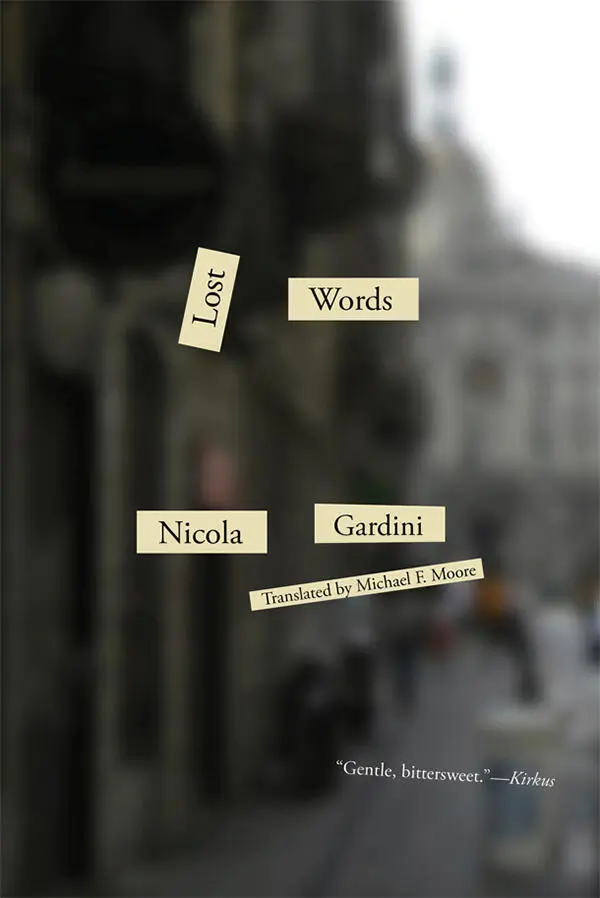
- Название:Lost Words
- Автор:
- Издательство:New Directions
- Жанр:
- Год:2016
- ISBN:нет данных
- Рейтинг книги:5 / 5. Голосов: 1
-
Избранное:Добавить в избранное
- Отзывы:
-
Ваша оценка:
Lost Words: краткое содержание, описание и аннотация
Предлагаем к чтению аннотацию, описание, краткое содержание или предисловие (зависит от того, что написал сам автор книги «Lost Words»). Если вы не нашли необходимую информацию о книге — напишите в комментариях, мы постараемся отыскать её.
Lost Words — читать онлайн бесплатно полную книгу (весь текст) целиком
Ниже представлен текст книги, разбитый по страницам. Система сохранения места последней прочитанной страницы, позволяет с удобством читать онлайн бесплатно книгу «Lost Words», без необходимости каждый раз заново искать на чём Вы остановились. Поставьте закладку, и сможете в любой момент перейти на страницу, на которой закончили чтение.
Интервал:
Закладка:
“Don’t you think you’re exaggerating, Elvira?”
“Not at all. There’s certain things you don’t know. You can’t imagine how many nasty rumors are already circulating about you.”
“About me?”
“Forget I said anything. I don’t want to upset you.”
“But I find it amusing.”
“In the past few years they’ve made my life impossible. I couldn’t even offer a coffee to a poor old lady on the third floor! It bothered the signore ! The loge is not a café, they said. So in the end I had to tell the poor thing to stop coming downstairs — can you imagine! And you’re telling me to invite Terzoli to eat with us?”
“Then maybe it would be better if I didn’t come downstairs, either.”
My mother blanched. “It has nothing to do with you,” she hastened to make light of what she had just said, “This is my home and I can invite whoever I want.”
She knew that sooner or later Ippolito would have to stop coming, but for the moment she didn’t want to think about it. Raising her voice made her feel a little more courageous.
“Let them report me to the building manager. If Signora Aldrovanti even tries to complain, I’ll eat her alive!” Her cheeks became as red as fire. “How could they think I’m not allowed to have guests? What’s wrong with that? No one has the right to criticize me. They’re all envious, that’s what they are: a pack of envious old hens!”
*.
He was distracted, uninterested. I had to repeat each word to him two or three times. He would hit the wrong keys, moaning and groaning.
“Let’s drop everything. This morning I don’t have the head for it. Let’s go out on the balcony for a breath of fresh air.”
We sat in front of the pots of geraniums, side by side, looking out over the countryside, which from up there, in the clear air, seemed boundless. The sun was out, but in my shaded corner I felt cold.
“Do we have much left to do?” I asked.
“No, not very much… We should be done by Christmas.”
He noticed I was shivering, so he pulled the curtain to one side so I would get some sunlight.
“And after that?”
“Luca, did my mother ever speak to you about me?”
My heart skipped a beat. The silence was broken. Finally he was introducing himself as the son of Amelia Lynd! How should I answer him? How could I answer him? If I told the truth, I would only hurt him.
“The Maestra was very reserved,” I replied. “She didn’t like talking about the past.”
He didn’t seem to mind. Deep down it was the answer he was expecting.
“Were you fond of her?”
“Yes, very,” I admitted.
“Me, too… But she didn’t love me, otherwise she wouldn’t have shut me out of her life. She could have dropped me a line, at least before she died. I looked everywhere for a letter. I found nothing… She didn’t even have a photo of me.”
I remembered the letter she had written to me, the letter I cherished, hidden in my Latin book, and for the first time I suspected that it had been addressed to someone else, to her real son. I should’ve run home to get it, I should’ve reread it there with him, but at that moment I couldn’t move. I was in a state of shock. Even dead, the Maestra hadn’t lost her ability to be evasive. Who had I really been to her? And who was I to Ippolito? A stand-in for both? A go-between? By what criteria, for what purpose, had she, the dictionary devotee, attributed meanings to individual human beings?
Now I could clearly see to what extent I was Ippolito and he was me. We were two words that exchanged meanings, and not because we wanted to — as we had presumed to believe — but because she had wanted it to happen that way.
But hadn’t I done the same with him? Hadn’t I started to love him as a surrogate?
For me the time had also come to break the silence. Liberated from the fear of hearing “no,” I asked him to tell me the story of Amelia Lynd.
*.
I took mental note of everything, careful not to interrupt him even once, and when I got home later that night, I started to write down the gist of the story in my English notebook, the right place to conserve these revelations. Who knows, maybe one day I would write a whole book about her…
Her father was English, her mother Italian. They met on a cruise ship while visiting Greece and Turkey. Amelia was born a few months later, in 1897, in Rome, the city of her mother, where she grew up as an only child. Her father later managed to get a transfer from the newspaper where he was working and became the Italian correspondent for many years. Amelia studied in Rome and received her degree in classics. Every now and then she would go to England, to London, to visit her father’s family. They were Jewish, but her father wasn’t religious. The exact opposite. To Amelia he transmitted a strong antipathy toward any form of religion. Her mother, however, was Catholic, relatively observant, but enough of a non-conformist to marry an atheist. They still had a church wedding, but without the Eucharist, out of respect for the husband.
Ippolito, her first and only child, was also born in Rome, the same year that Mussolini came to power. His father died shortly after of tuberculosis. Widowed (in reality, they had never married, but she loved calling herself a widow), she moved to England, leaving the child to be raised by his grandparents. The only time he saw his mother was when his grandfather took him to see her in London.
In the early 1930s, when he was already a teenager, she decided to bring him back with her. So he joined her in England, where he continued the education he had begun in Italy. She was absolutely opposed to her son growing up surrounded by fascists. They lived in England, and other far-away places, for long periods, during which she herself took charge of his education. They spent some time in Palestine. She was interested in living in areas where populations were being formed. Although she sympathized with the Jews, she was very critical of their territorial claims. She slowly broke away from all of her Zionist friends, leaving Ippolito and her to fend for themselves.
At one point they moved to India, where their lives were much easier. There were quite a few Englishmen who wanted to give the country back its independence. New friendships were formed. Ippolito was also better off in India than he had been in England or Palestine. He was becoming a man. He no longer depended entirely on his mother.
When the war broke out they returned to Europe, to Rome. His grandparents fell sick and died in 1940. Amelia sold the house in Rome and emigrated to America, like some of her Oxford friends. Ippolito remained in Rome, but he immediately regretted his decision not to follow her. Without his grandparents he felt like a stranger in the city. The atmosphere was awful. He enrolled at the university, in mathematics, and completed his degree quickly. Then he joined his mother in New York. She wasn’t at all happy there. She hated American materialism. A true Englishwoman, she said there were no secrets in America: everything took place in the light of day — how boring.
Once the war was over, they returned to Italy. This time they found a house in Milan, on Via Manzoni. Amelia was in seventh heaven. She was in love with the country. She was in love with the city. She said that in Milan they were finally living a real life, they were lucky to be witnessing the birth of Italy, or rather of the Italians. She believed in the people — in the factory workers, the housewives, the young people. She believed in the revival and the renewal. She even managed not to despise the Church, which was working so hard to resurrect a demoralized society. For a while they received visits at home from a priest, Father Stefani, whom Ippolito greatly admired.
Читать дальшеИнтервал:
Закладка:
Похожие книги на «Lost Words»
Представляем Вашему вниманию похожие книги на «Lost Words» списком для выбора. Мы отобрали схожую по названию и смыслу литературу в надежде предоставить читателям больше вариантов отыскать новые, интересные, ещё непрочитанные произведения.



Обсуждение, отзывы о книге «Lost Words» и просто собственные мнения читателей. Оставьте ваши комментарии, напишите, что Вы думаете о произведении, его смысле или главных героях. Укажите что конкретно понравилось, а что нет, и почему Вы так считаете.