Nicola Gardini - Lost Words
Здесь есть возможность читать онлайн «Nicola Gardini - Lost Words» весь текст электронной книги совершенно бесплатно (целиком полную версию без сокращений). В некоторых случаях можно слушать аудио, скачать через торрент в формате fb2 и присутствует краткое содержание. Год выпуска: 2016, Издательство: New Directions, Жанр: Современная проза, на английском языке. Описание произведения, (предисловие) а так же отзывы посетителей доступны на портале библиотеки ЛибКат.
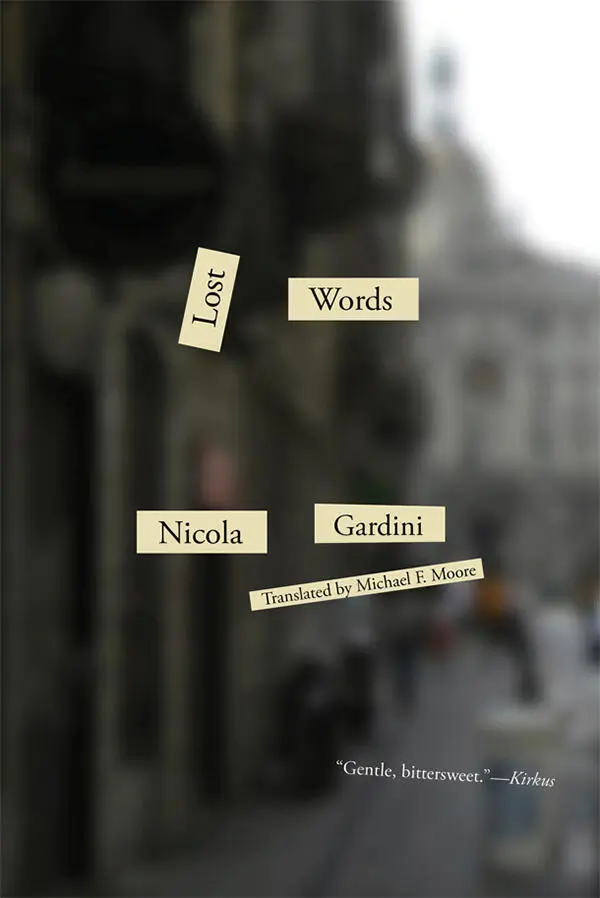
- Название:Lost Words
- Автор:
- Издательство:New Directions
- Жанр:
- Год:2016
- ISBN:нет данных
- Рейтинг книги:5 / 5. Голосов: 1
-
Избранное:Добавить в избранное
- Отзывы:
-
Ваша оценка:
Lost Words: краткое содержание, описание и аннотация
Предлагаем к чтению аннотацию, описание, краткое содержание или предисловие (зависит от того, что написал сам автор книги «Lost Words»). Если вы не нашли необходимую информацию о книге — напишите в комментариях, мы постараемся отыскать её.
Lost Words — читать онлайн бесплатно полную книгу (весь текст) целиком
Ниже представлен текст книги, разбитый по страницам. Система сохранения места последней прочитанной страницы, позволяет с удобством читать онлайн бесплатно книгу «Lost Words», без необходимости каждый раз заново искать на чём Вы остановились. Поставьте закладку, и сможете в любой момент перейти на страницу, на которой закончили чтение.
Интервал:
Закладка:
But Amelia’s enthusiasm did not last long. As on their previous travels, she quickly started criticizing everything and everyone. Even the reconstruction of Italy was proving to be a disappointment. The priests were back in charge of civic life. The Italians were losers, not only because they had not won the war, but also because they did not know how to become the masters of their future.
In 1952, to the great surprise of everyone who knew him, Ippolito entered the seminary. As far as his mother was concerned, he couldn’t have committed a greater error. Their relationship frayed and all communication between them ended after he took his vows. Every now and then he would try to contact her, but his overtures were always rejected. He had betrayed her. She didn’t forgive him even after he left the Church, in 1962. “You’re unforgivable,” she wrote. Fifteen years would go by without another word from her. She wanted nothing more to do with him.
Once in a while she would go back to London, where she still had a house. At one point she sold that, too, because she needed money. She had used up most of her enormous inheritance — traveling, maintaining herself and her child, buying an endless amount of books, paying porters and copyists, donating money to causes that she believed in…
Knowing that she had been reduced to almost total poverty, and was elderly, Ippolito tried to help her. He would send her money, which she never accepted. One evening, on his way home from the Home for the Disabled, he saw the “For Sale” sign on the gate of Via Icaro 15. He decided to buy the apartment where she lived, hoping she would be grateful for this gift, hoping she would forgive him.
*.
In the space of a week almost everyone was back: Signorina Mantegazza with her dog Bella, the Casellis, the Zarchis, the Bortolons, the Paolinis, the Dell’Uomos, the Cavallos, the Di Lorenzos, the Vezzalis, the Lojaconos, Signor Vignola (alone, because his wife and child had gone from the mountains to the seaside).
The only ones missing were the D’Antonios, who were stuck in Naples because of the cholera epidemic, which the television was going on and on about, and the Malfitanos, who for some unknown reason were still in Sicily.
Their suntans, extra weight, rest, and rediscovered contact with their places of origin had changed them. Their voices were clearer, their accents had regained their original fullness, their movements seemed more natural.
But in two or three days they were already back to the way they used to be.
My mother, who’d already seen a drastic reduction in tips from previous years, now noticed that no one had brought her back a souvenir. “It’s better this way,” she said, “I only put that junk on display out of kindness. You know what I’m going to do now? I’m going to throw everything out.”
She didn’t waste a minute. That night, we could finally unfold my bed springs without worrying that something was going to fall.
The D’Antonios and Malfitanos also returned.
Signora Vezzali explained that on the eve of their departure, the parrot, Leopoldo, had disappeared. At first Malfitano hadn’t given it a second thought. Leopoldo would occasionally fly away, especially during vacations. But he would always reappear a few hours later. They waited for him that night, the next morning, and the rest of the week. Meanwhile Malfitano had reported the disappearance up and down Selinunte. They even put up the parrot’s picture all over town. The search lasted for two weeks. Not a trace of Leopoldo. There was no way it could have been an escape (Leopoldo loved his master too much), or a bird-napping: with his pecking and his deafening shrieks, Leopoldo would have made life impossible for anyone who tried to capture him. So he must have been killed. There was no other explanation. Killed and thrown away. The master’s suspicions inevitably fell on the person most interested in getting rid of him: his wife. Leopoldo hated her, as we’d seen on Christmas Eve. Had she, after years of being afraid, decided to kill him, with the complicity of her relatives? But she continued to protest her innocence. Leopoldo had chosen freedom, she kept saying. He had gone to a better place, finding some pine or eucalyptus tree near the sea.
*.
Summer was over. So was the peace and quiet, the magical enchantment, listening to the splashing of the fountain and the chirping of the birds, talking and joking freely with Ippolito, no intrusions, sitting down to tasty meals of spaghetti or rice salad — now it was all just a memory.
Lunch with Ippolito was reduced to a pathetic ritual. Every time we sat down at the table, one of the old hens would stop by with some excuse to stare at what we were eating.
My mother became grumpy, curt, irritable. On my birthday she even avoided placing the ritual gift in my hand. She could feel all the eyes in the building staring down at her and she took it out on Ippolito, as if it were his fault, as if she were expecting him to find a solution. She was itching for a fight, going on and on about how he needed a wife, someone who would take care of him, iron his shirts, cook for him, keep his house in order.
“The world is full of unmarried men— bachelors ,” he argued defensively. “Do you think they all live in squalor, on empty stomachs, in messy houses?”
“If that were the problem, all you’d need would be a cleaning lady! A house isn’t just a hole you live in. Big or small it’s still a hole… A woman, in other words, is a home.”
“I have a home.”
She didn’t want to hear it. “A person gets older… you need companionship. Otherwise what kind of a life is that? Life is already hard enough. Haven’t you ever been in love?”
Ippolito’s jaw tightened. “Of course I have.”
“And you never thought of starting a family?”
“It wasn’t possible. You should’ve understood by now, Elvira.”
But no, she hadn’t understood, and if she had, it didn’t matter: “I don’t believe you. Anything is possible if you want it enough. Obviously you’ve never met the right woman. Me, when I saw my husband I fell in love right away. Right away I knew he was the one for me. We smiled at each other… Can you imagine? We fell in love at the factory, where I was serving him soup. And you know there was no room for fooling around in the factory! We were there to work! I sweated inside my uniform. He would bring home his overalls stained with grease — you could never get rid of the stains… But if love arrives…”
“Well, your husband obviously liked women,” Ippolito said.
It was the first time he had made explicit reference to his sexual proclivities, but not even this stopped my mother. “My husband was only interested in the movies! Starting a family was the last thing on his mind!”
“Elvira, listen to me carefully,” he begged her, forcing himself to stay calm. “I don’t need a wife. You’re convinced that I’m unhappy because I’m not married. You’re wrong. I’m happy with my life, as crazy as that might sound to you — and please, can we change the subject and not talk about this anymore?”
But she refused to budge. “What is life without love?” she insisted, as if the argumentative role that Ippolito usually played had been miraculously handed over to her.
“Nothing.”
“You see? So you agree with me!”
“Of course I agree with you!”
“But you are giving up…”
Ippolito was flabbergasted. “My life has been filled with love and still is! You have a strange idea of love, Elvira.”
“Love is like a fever,” she started to theorize.
“Now you’re a philosopher?”
Not even his sarcasm could stop her. “Love is a fever,” she repeated, convinced of her intuition.
Читать дальшеИнтервал:
Закладка:
Похожие книги на «Lost Words»
Представляем Вашему вниманию похожие книги на «Lost Words» списком для выбора. Мы отобрали схожую по названию и смыслу литературу в надежде предоставить читателям больше вариантов отыскать новые, интересные, ещё непрочитанные произведения.






Обсуждение, отзывы о книге «Lost Words» и просто собственные мнения читателей. Оставьте ваши комментарии, напишите, что Вы думаете о произведении, его смысле или главных героях. Укажите что конкретно понравилось, а что нет, и почему Вы так считаете.