Nuruddin Farah - Gifts
Здесь есть возможность читать онлайн «Nuruddin Farah - Gifts» весь текст электронной книги совершенно бесплатно (целиком полную версию без сокращений). В некоторых случаях можно слушать аудио, скачать через торрент в формате fb2 и присутствует краткое содержание. Год выпуска: 2011, Издательство: Arcade Publishing, Жанр: Современная проза, на английском языке. Описание произведения, (предисловие) а так же отзывы посетителей доступны на портале библиотеки ЛибКат.
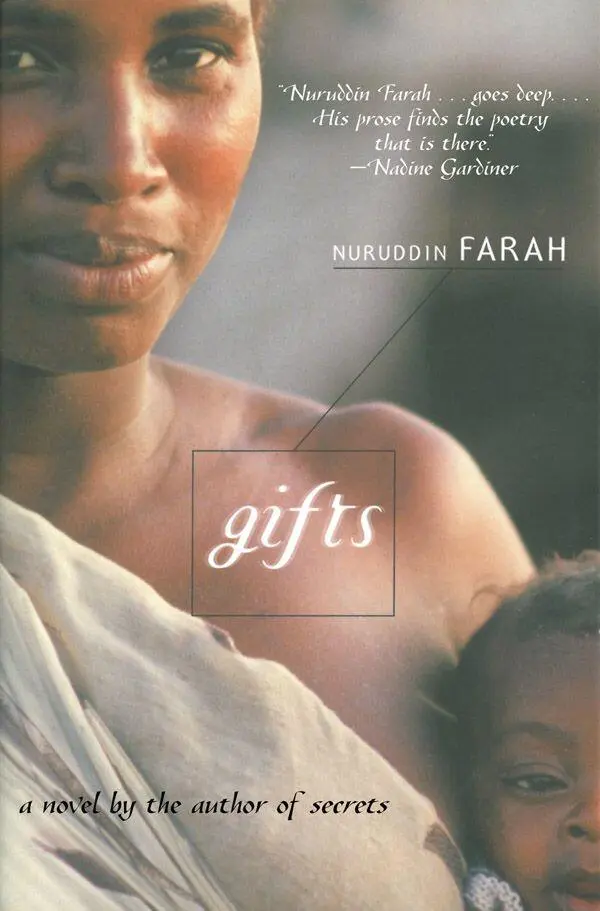
- Название:Gifts
- Автор:
- Издательство:Arcade Publishing
- Жанр:
- Год:2011
- ISBN:нет данных
- Рейтинг книги:3 / 5. Голосов: 1
-
Избранное:Добавить в избранное
- Отзывы:
-
Ваша оценка:
Gifts: краткое содержание, описание и аннотация
Предлагаем к чтению аннотацию, описание, краткое содержание или предисловие (зависит от того, что написал сам автор книги «Gifts»). Если вы не нашли необходимую информацию о книге — напишите в комментариях, мы постараемся отыскать её.
Gifts — читать онлайн бесплатно полную книгу (весь текст) целиком
Ниже представлен текст книги, разбитый по страницам. Система сохранения места последней прочитанной страницы, позволяет с удобством читать онлайн бесплатно книгу «Gifts», без необходимости каждый раз заново искать на чём Вы остановились. Поставьте закладку, и сможете в любой момент перейти на страницу, на которой закончили чтение.
Интервал:
Закладка:
“It’s possible he may be coming shortly, to visit.”
She half-rose from the armchair, “Visit me?”
“That’s right.”
She felt tongue-tied, unsure how to react to the news. She would never forgive herself if she said something ridiculous, and nothing wise seemed to come to mind. She listened to the music with only half her brain, music that was consciously oriental, not Arabic. No, it had a whining tune, far eastern. She leaned forward and said eagerly, “Has he written to you, Mire, that he will come shortly?” And in her heart she hoped that Abshir hadn’t.
“He’s vacationing in Greece and met a friend of mine whom I spoke with on the telephone today — it’s my friend’s birthday. It was she who told me that he said he was planning to visit you,” said Mire.
Suddenly they were toasting, her brother’s name occurring in the brief wishes of caafimaad. Her hand unsteady, she dropped her drink and spilt some of it on her dress. She got up, in discomfort; she would have been grateful for the privacy of a bathroom, or some room with a door that she could bolt from inside. It had become difficult for her to breathe, this sudden excitement was much too much. She was hot behind her ears, her armpits wet like a peed-on mattress. Bosaaso showed her where the washroom was.
She didn’t emerge until she heard, “Dinner is served, Mada!”
Good breeding whispered in Duniya’s ears for her not to confess openly that she did not have a name for the dish she was eating, anathema to devout Muslims who insist they identify every ingredient of the foods they touch or consume. Mire was sensitive enough to suspect that Duniya’s traditional reserve might account for some of the unease on her face. However he didn’t speak either to her or Bosaaso: he looked from one to the other, hoping, maybe, that his friend would assure Duniya that she wasn’t eating pork.
Meanwhile Duniya was thinking about something that worried her: her knocking things over, spilling drinks, kicking her toes sore. The fact that this was becoming routine with her, almost boringly predictable, rankled in her mental picture of herself. Had she lost control of a certain brain nerve, causing imbalance both in mind and body? She did not like being associated with leaving falls, crashes and wreckages in her wake. Why, shapes were becoming vague in her vision. Walls at times retreated. Her hands would bend athletically at the wrist, strong like a javelin thrower’s. She reminded herself that in Somali mythology the cosmos balances on the horns of a bull, a beast that is forever staring at a cow tied to a pole right in front of him. It is said the bull’s body loses equilibrium whenever his love, the cow, turns its eyes elsewhere, and this physical shift is responsible for the earthquakes around the world. Was she, Duniya, subduing the universe by breaking things into bits?
“Do you know the name of the dish we’re eating?” Bosaaso asked.
It took time for the words to reach her mind and make sense. She felt the weight of their stares and knew she had done something that displeased them. She hadn’t touched her food. She decided to turn it to her advantage, decided to draw perverse pleasure from showing her ignorance: this usually went down well with the generality of men who received with delight any confirmation that women did not know as much as them. But it might also help her regain her misplaced self-confidence which she would then show off, like wounds sustained in a battle. She said, “What’s it called, this dish?”
“Moussaka,” said Mire.
And immediately Bosaaso interjected, “These, as you can see,” using his fork to demonstrate, “are layers of minced meat, that is aubergine, topped with a layer or two of parmesan cheese.”
Duniya then said, abrasively rubbing her recovered self-confidence, “Moussaka is such a beautiful name that I bet if the dish ever became popular in Somalia some mother would name her daughter Moussaka.” She might have been setting the future theme of a conversation on the subject of name-giving.
“Would you name your daughter Moussaka, Mire?” asked Bosaaso.
“ I wouldn’t,” responded Mire, “but I am sure some women might.”
Bosaaso said to Mire, “You recall the girl in our town who was called Makiino — the bastard form of the Italian macchina? I remember thinking how weird for a mother to name her daughter after such a contraption. But, in retrospect, I can see it made sense. For one thing, the machine did the job faster and more efficiently than any person. For another, it reduced the hours of labour, minimizing exhaustion. In addition, it made the woman forward-looking, since the notion introduced her to a larger universe where machines were scientifically and culturally an integral part of one’s daily life.”
“There was this other girl, wasn’t there?” Mire said. “Her mother had named her Aasbro, do you remember? Another called her daughter Omo after the detergent powder, in recognition perhaps of the usefulness of such an item; or Lay loon, a corruption of ‘nylon,’ maybe because she had very smooth skin.”
“We know a man, don’t we, Mire,” Bosaaso said, “who presented his bottom first at birth and was given the name Daba-keen, a descriptive phrase of the breech position in which he had been bom?”
Duniya ate in silence, remembering her mother’s reasons for naming her only son Abshir. He had been a blessing, she would say, in boastful recall of how well he had done at school and university Now Abshir was planning to visit her, Abshir whom she hadn’t seen for years, whom she had last called on during a brief trip to Rome.
Mire said to her, “Do you have any idea why you were given your name? Let me tell you that I was named for my grandfather, and of course you know the story behind Bosaaso’s nickname.”
Duniya hoped Mire could see in her eyes the pleasure that news of Abshir’s arrival had given hen Self-conscious and half-choking on her emotions, she said, “I was my mother’s only daughter and the last-born, so I presume I meant the world to her.”
Bosaaso might have been a parent ladling out encouragement to a shy child. “Which is what Duniya means: the world,” he said.
“The cosmos,” said Mire, with interpretative exactitude.
Then they talked at length of traders, Arab and European, wandering the African continent, propagating their faith, making gifts of their deities and beliefs (like present-day foreign aid), presents that the Africans accepted with little question.
Bosaaso asked of no one in particular, “Can you think of a Somali concept comparable to the modern notion of cosmos, in Arabic ‘Dunya’? You see, there’s the Arab contention that they gave us the notion of cosmos by offering us not only their Islamic belief but sharing with us their world-view on which we’ve constructed our subsequent understanding of the workings of the globe.”
“What was in it for the Arabs to give us their world-view, together of course with an Allah-created cosmos, which contradicted our traditional belief systems?” asked Duniya.
Bosaaso’s face darkened as he tried to think of what to say.
“Duniya does have a point,” said Mire, “although to my mind the essential difference between African traditional beliefs and the Judaeo-Christian and Islamic credo is bound up with mystic proportions of a centrally created cosmos. The starting-point is this: who or what do we worship? In the case of the Somali who deifies crows, the answer is clear: Somalis defer to death, crows being associated with the ending of life, a termination of this existence. What the Judaeo-Christian and Islamic systems offer is a forward-looking, reward-offering, life-after-death rationalization, a credo in which you are guaranteed paradiasical delights after death.”
Читать дальшеИнтервал:
Закладка:
Похожие книги на «Gifts»
Представляем Вашему вниманию похожие книги на «Gifts» списком для выбора. Мы отобрали схожую по названию и смыслу литературу в надежде предоставить читателям больше вариантов отыскать новые, интересные, ещё непрочитанные произведения.

Обсуждение, отзывы о книге «Gifts» и просто собственные мнения читателей. Оставьте ваши комментарии, напишите, что Вы думаете о произведении, его смысле или главных героях. Укажите что конкретно понравилось, а что нет, и почему Вы так считаете.