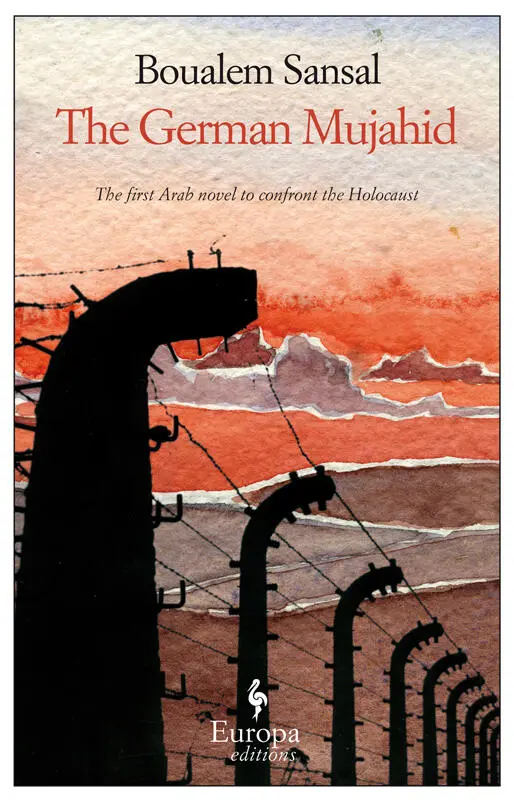
Boualem Sansal - The German Mujahid
Здесь есть возможность читать онлайн «Boualem Sansal - The German Mujahid» весь текст электронной книги совершенно бесплатно (целиком полную версию без сокращений). В некоторых случаях можно слушать аудио, скачать через торрент в формате fb2 и присутствует краткое содержание. Год выпуска: 2009, Издательство: Europa Editions, Жанр: Современная проза, на английском языке. Описание произведения, (предисловие) а так же отзывы посетителей доступны на портале библиотеки ЛибКат.
- Название:The German Mujahid
- Автор:
- Издательство:Europa Editions
- Жанр:
- Год:2009
- ISBN:нет данных
- Рейтинг книги:4 / 5. Голосов: 1
-
Избранное:Добавить в избранное
- Отзывы:
-
Ваша оценка:
The German Mujahid: краткое содержание, описание и аннотация
Предлагаем к чтению аннотацию, описание, краткое содержание или предисловие (зависит от того, что написал сам автор книги «The German Mujahid»). Если вы не нашли необходимую информацию о книге — напишите в комментариях, мы постараемся отыскать её.
is a heartfelt reflection on guilt and the harsh imperatives of history.
The two brothers Schiller, Rachel and Malrich, couldn't be more dissimilar. They were born in a small village in Algeria to a German father and an Algerian mother, and raised by an elderly uncle in one of the toughest ghettos in France. But there the similarities end. Rachel is a model immigrant — hard working, upstanding, law-abiding. Malrich has drifted. Increasingly alienated and angry, his future seems certain: incarceration at best. Then Islamic fundamentalists murder the young men's parents in Algeria and the event transforms the destinies of both brothers in unexpected ways. Rachel discovers the shocking truth about his family and buckles under the weight of the sins of his father, a former SS officer. Now Malrich, the outcast, will have to face that same awful truth alone.
Banned in the author's native Algeria for of the frankness with which it confronts several explosive themes, The German Mujahid is a truly groundbreaking novel. For the first time, an Arab author directly addresses the moral implications of the Shoah. But this richly plotted novel also leaves its author room enough to address other equally controversial issues; Islamic fundamentalism and Algeria's "dirty war" of the early 1990s, for example or the emergence of grim Muslim ghettos in France's low-income housing projects. In this gripping novel, Boualem Sansal confronts these and other explosive questions with unprecedented sincerity and courage.
The German Mujahid — читать онлайн бесплатно полную книгу (весь текст) целиком
Ниже представлен текст книги, разбитый по страницам. Система сохранения места последней прочитанной страницы, позволяет с удобством читать онлайн бесплатно книгу «The German Mujahid», без необходимости каждый раз заново искать на чём Вы остановились. Поставьте закладку, и сможете в любой момент перейти на страницу, на которой закончили чтение.
Интервал:
Закладка:
I went into Birkenau and let myself be guided by instinct. I tried to forget everything I knew, I wanted to know what it felt like to step into this camp for the first time, knowing only its monstrous reputation. It was difficult, it was impossible, I knew too much, I had spent so much time studying this place, I could have moved around it with my eyes closed, the map was burned onto my brain. I could have moved around like a diligent soldier, anxious to get from A to B to execute his orders promptly. I could retrace his footsteps, walk boldly as he did, wrapped up in a thick greatcoat against the blizzard: bringing a wounded worker from the infirmary to his workstation; dragging some human wreck to Bunkers I and II, where French Jews were gassed; picking up the daily productivity reports from one of the four ultra-modern complexes — the famous K II, III, IV and V, marvels of extermination designed, they say, by Himmler himself, to function both as gas chambers and crematoria — and dashing back with it to the SS Administrative Building, allowing myself a quick visit to the Kapos’ brothel to see the new arrivals or, out of morbid curiosity, peeking through the window of the experimental clinic run by Carl Clauberg, or the one run by the sinister doctor Josef Mengele, the Frankenstein of monozygotic twins, swing by the laboratory where chemical engineers like my father — who, given he was a SS- Hauptsturmführer by then, was probably in charge — worked on their magic potions, their treatments for “lice”; everywhere in fact, except the baleful area of Block 11, where lunatics unlike any on earth experimented with tortures and methods of execution that were bizarre even in Auschwitz. I could just as easily move from the parade ground to where the prisoners assembled at dawn and lead a group to wherever they were assigned to do forced labour.
I’ve learned to follow my father in my mind: I could have wandered around the Lager as though I had grown up here. There is not a single detail of his working day I have not imagined. Papa was a methodical man, regular as a metronome, he spent his whole life obsessed with timing things. Our life in Aïn Deb was regulated by his watch. While my childhood friends needed only a ray of sunshine, a sudden whim to go from place to place, there I was, champing at the bit, watching the big hand on the house clock, waiting for my fifteen minutes of freedom.
I found myself standing in front of the K Complexes, my father had probably worked on the development of K IV, he may even have inaugurated it. Why that one in particular? The dates fit. My father was posted to Auschwitz-Birkenau between January and July 1943, work on the complexes began early in 1942 and was completed in late 1943. By the time he arrived here my guess is that the first two were already operational and the third was in the testing phase, the foundations were probably still being dug on K V. In fact, I knew this was true, I had read so many books, so many survivor accounts, I knew all there was to know. This is why I know that papa was working under the orders of the first Kommandant of Auschwitz, the sinister SS- Obersturmbannführer Rudolf Höß, who would later be arrested by the Allies in Bavaria living under an assumed name; he would be tried and sentenced to death by the Polish Supreme National Tribunal in 1947 and hanged in front of one of the Kremas of his beloved Auschwitz. In the summer of 1943, when my father was taking up his new post in Buchenwald, Höß would be replaced by Arthur Liebehenschel and Richard Baer. The first would be arrested and executed in ’48 with the creepy Kommandante of the women’s Lager in Birkenau, Maria Mandl and her deputy, “The Beautiful Beast” Irma Grese, whom papa probably flirted with between shifts. Richard Baer died in prison awaiting trial in 1963. Josef Mengele, known as the Angel of Death, escaped via the Franciscan ratline in Italy, and took off first for the clear air of Perón’s Argentina then to Paraguay and Brazil to invest his part of the immense Mengele family fortune, live it up and die a natural death in 1979 at the age of 68 somewhere in Brazil, leaving behind him the myth of an Übermensch whom even death could not touch. When asked, “Why does your father not turn himself in?” in an interview in New York, Mengele’s son replied, “That has nothing to do with me, that’s his business.” If I’d been his son, I would have turned him in and would have demanded to testify at the trail as one of his victims.
The further I have gone on my journey — which I wanted to be instinctive, the better to penetrate the mystery — the more I understood the implacable system that regulated this place down to the last second. I was a prisoner of what I knew. I was trapped in my books, my technical reports. In reality things did not work like that. Behind the cold logic of the Machine was the savage mystery of death which pervaded the camp, the cruel laws of random chance which, here more than anywhere else, stalked the prisoner’s every step, watched him, made certain that the selection for this task, this punishment, fell to him, which decided that illness should strike him rather than another, which meant instant death; things conspired magically such that trivial incidents snowballed to become great catastrophes which jammed this splendid, unstoppable Machine, panicking the Bonzen, humiliating them, unleashing reprisals, terrible fury, wanton acts, unending punishments; there were the days and nights of privation; there was the mystery of time, stretching out to infinity until it broke the will, destroyed all hope, even all regret, then suddenly contracting, choking the world, making every movement seem hurried, a pitiless garrotte that made each minute weigh more heavily, each second more uncertain; and there was the weather, its shifting moods, its tortures, its sudden fevers; there was the lack of privacy, the shame and the animal instincts that accompanied it; there was the hunger, endless, frantic; the smells that turned your stomach; there was the terrible loss of awareness that made the prisoner his own worst enemy, each having signed a pact with hunger, with the instinct to survive, with madness , and there were the thousand tiny everyday events which could at any moment turn to tragedy; my God, the tragedy that might result from a stolen shoe, a cap lost in the dead of winter, one glance too many at an officer, a second of inattentiveness, a bowl shattering, a twisted ankle, a bout of dysentery or lumbago, an infected wound; there was the gruelling preoccupation with constantly having to look busy, to never raise suspicion; there was the turmoil you carried around in your head all day, all night; there were the suppurating fears, the endless questions, the morbid moments of elation, the childish fears, the excruciating needs, the impossible dreams, the fleeting memories of another life in a world where the sun existed, where day and night were a mercy shared with others. A trivial thing could mean death, could make life unbearable, everything was uncertain, everything doomed to failure, to darkness, to decay. It must have been so bad that we hoped this splendid, unstoppable machine would keep on turning. Perhaps we even prayed to God to forget us and to watch over the Beast. Ensure she had her dead so she might gorge herself on them and leave us in peace. When everything runs well, we might snatch a moment of peace here and there. When everything runs smoothly, we can bide our time and die in peace.
My mind too is filled with mysteries. One of them haunts me, I think about it all the time, it is the mystery of the survivor. How is it possible to live after the camps? Is there life after Auschwitz? Of all the accounts I’ve read, particularly those written in the heat of the moment, when the camps were liberated and during the first war trials, not one expressed hate or anger, not one clamoured for revenge. I didn’t understand, I don’t understand. It is a mystery to me. Calmly, shyly, these women, these men, simply explained what it had been like, answered the questions asked of them by investigators, by judges. “My name is X, I arrived in the camp on such and such a day, month, year. . I was posted to the clothing workshop. . yes, I knew prisoners were being gassed. . yes, I was beaten by the Kapos . . I witnessed punishments. . one day they had us all assemble for the execution for five prisoners accused of stealing a remnant of material. . another day, a friend of ours, Y, threw himself against the electric fence, we were all beaten for not stopping him. . He wanted to kill himself, we could understand that.” What about you? “Me? I was lucky, I was posted to ‘Canada.’” Can you tell us what you mean by “Canada”? “That was the name for the huge warehouses near the camp where they sorted through the belongings of new arrivals, we’d put all the money in one pile, jewellery in another, and we would sort the clothes and make large bundles of them that the trucks took to the station. The work was exhausting, but it’s wasn’t so bad. . Canada was like paradise for those who had to slog away outside in the cold and the mud.” I read and reread the books of the famous survivors of Auschwitz — Charlotte Debo, Elie Wiesel, Jorge Semprun, Primo Levi — and I didn’t find a single word of hatred, the hint of a desire for revenge, the least expression of anger. They simply described their day-to-day life in the camp with all the detail they could remember, and this is their artistry, they related what they saw, what they heard, what they smelled, what they touched, the heaviness and the tiredness in their backs, their legs. They replicated it as a camera replicates an image, as a tape recorder replicates a sound. When they talk about their torturers, they say, “Officer X said this or that on such a day at such a time.” When they talk about their companions, they say, “So-and-so said this, he did that, one morning he was gone, we never saw him again.” Why this detachment? Where is the rage? Where is the hatred, the cry for revenge, where is the longing to destroy everything, to reject humanity, to turn your back on God, to run and keep on running, to stop listening? The experience of the camps is unlike any other, all the noise in the world cannot drown out the suffering that rose up from this place. This is how we talk about it, like a sunless day that by chance was visited upon the world. We talk about pure evil, about the incalculable suffering it inflicted on us. “Kuhn is out of his senses. Does he not see Beppo the Greek in the bunk next to him, Beppo who is twenty years old and is going to the gas chamber the day after tomorrow and knows it and lies there looking fixedly at the light without saying anything and without even thinking anymore? Can Kuhn fail to realise that next time it will be his turn? Does Kuhn not understand that what has happened today is an abomination, which no propitiatory prayer, no pardon, no expiation by the guilty, which nothing at all in the power of man can ever clean again. If I was God, I would spit at Kuhn’s prayer.” This is the only note of anger I can find in Primo Levi’s book If This Is a Man . He notes that nothing, not prayers, not pardon, not the expiation of the guilty, nothing that is within man’s power to do can ever make this right, nothing more. I don’t understand. In my own way, I am a survivor, but I cannot find the words, I have not the strength within me to express my rage, my shame, my hate, and I know that nothing can ever stanch the longing for revenge I carry inside me. To discover that you are the son of a murderer is worse than being a murderer yourself. The murderer has his justifications, he can hide behind language, he can deny, he can brag, he can take responsibility for his crime and proudly face the gallows, he can claim he was only following orders, he can run away, change his identity, find new justifications, he can mend his ways, he can do anything. What can the son do but enumerate his father’s crimes and drag that millstone with him all through life? I hate my father, I hate this country, the system that made it what it was, I hate humanity, I hate the whole world, I hate all the famous people who coldly wrote their books describing what my father did as though it were a job, nothing more, a job he was being paid to do, they stripped him of what humanity he might still have had and portrayed him as a witless automaton obeying the orders of the Führer, I hate them for sparing him, for not hating him as one should hate a tormenter, for not insulting him, I hate them for their detachment, I hate them for their restraint. I know my father — he was aware of what he was doing, he was a man of conviction, a man of duty, he deserves all the anger in the world. You are scum, Hans Schiller, you are the vilest murderer that ever lived, I loathe you, I despise you, I would have your name obliterated, I would have you burn in hell until the end of time and those you gassed come and spit in your face! You had no right to live, you had no right to give us life, I want nothing to do with this life, this nightmare, this unending disgrace. You had no right to run away, papa. I have to take it upon myself, I will pay for you, papa. May you be cursed, Hans Schiller. I sat down and, like a camp prisoner who has witnessed too much in a single day, I cried waterless tears.
Читать дальшеИнтервал:
Закладка:
Похожие книги на «The German Mujahid»
Представляем Вашему вниманию похожие книги на «The German Mujahid» списком для выбора. Мы отобрали схожую по названию и смыслу литературу в надежде предоставить читателям больше вариантов отыскать новые, интересные, ещё непрочитанные произведения.








Обсуждение, отзывы о книге «The German Mujahid» и просто собственные мнения читателей. Оставьте ваши комментарии, напишите, что Вы думаете о произведении, его смысле или главных героях. Укажите что конкретно понравилось, а что нет, и почему Вы так считаете.