Katy Smith - Free Men
Здесь есть возможность читать онлайн «Katy Smith - Free Men» весь текст электронной книги совершенно бесплатно (целиком полную версию без сокращений). В некоторых случаях можно слушать аудио, скачать через торрент в формате fb2 и присутствует краткое содержание. Год выпуска: 2015, Издательство: HarperCollins, Жанр: Современная проза, на английском языке. Описание произведения, (предисловие) а так же отзывы посетителей доступны на портале библиотеки ЛибКат.
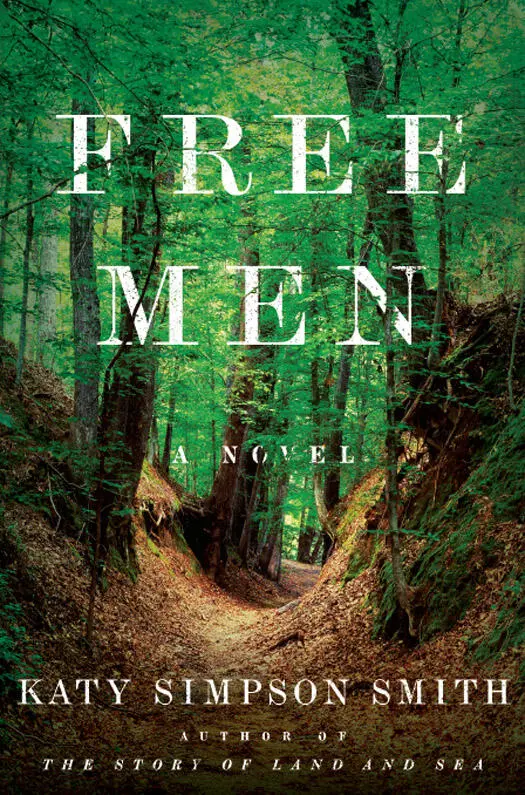
- Название:Free Men
- Автор:
- Издательство:HarperCollins
- Жанр:
- Год:2015
- ISBN:нет данных
- Рейтинг книги:4 / 5. Голосов: 1
-
Избранное:Добавить в избранное
- Отзывы:
-
Ваша оценка:
Free Men: краткое содержание, описание и аннотация
Предлагаем к чтению аннотацию, описание, краткое содержание или предисловие (зависит от того, что написал сам автор книги «Free Men»). Если вы не нашли необходимую информацию о книге — напишите в комментариях, мы постараемся отыскать её.
comes a captivating novel, set in the late eighteenth-century American South, that follows a singular group of companions — an escaped slave, a white orphan, and a Creek Indian — who are being tracked down for murder.
In 1788, three men converge in the southern woods of what is now Alabama. Cat, an emotionally scarred white man from South Carolina, is on the run after abandoning his home. Bob is a talkative black man fleeing slavery on a Pensacola sugar plantation, Istillicha, edged out of his Creek town’s leadership, is bound by honor to seek retribution.
In the few days they spend together, the makeshift trio commits a shocking murder that soon has the forces of the law bearing down upon them. Sent to pick up their trail, a probing French tracker named Le Clerc must decide which has a greater claim: swift justice, or his own curiosity about how three such disparate, desperate men could act in unison.
Katy Simpson Smith skillfully brings into focus men whose lives are both catastrophic and full of hope — and illuminates the lives of the women they left behind. Far from being anomalies, Cat, Bob, and Istillicha are the beating heart of the new America that Le Clerc struggles to comprehend. In these territories caught between European, American, and Native nations, a wilderness exists where four men grapple with the importance of family, the stain of guilt, and the competing forces of power, love, race, and freedom — questions that continue to haunt us today.
Free Men — читать онлайн бесплатно полную книгу (весь текст) целиком
Ниже представлен текст книги, разбитый по страницам. Система сохранения места последней прочитанной страницы, позволяет с удобством читать онлайн бесплатно книгу «Free Men», без необходимости каждый раз заново искать на чём Вы остановились. Поставьте закладку, и сможете в любой момент перейти на страницу, на которой закончили чтение.
Интервал:
Закладка:
“Just a deer,” I say.
He pulls his eyebrows down and nods: yes, of course he understands.
“You did nothing wrong.”
I SIT THE night watch and watch the night turn. The pig sounds of my sleeping companions braid into the echoes of the lovesick barred owl and the twangs and thrums of the earliest tree frogs, men calling out for women. The cookfire is still churning through the piled ash; smoke coils at eye level and vanishes. I should be more careful, but I know already we have not moved fast enough. I have a creeping sense that the man who was sent to find us is following us, is on this western spur. But I have learned to think the worst. I spread water on the ash.
I lean my head against the sapping bark and, my eyes open, imagine Polly in her calico dress, her phantom coming to me across the distance.
It’s ten days ago, and she’s asking if I love her. “Am I not beautiful?” she says, stepping back from the shaded underbelly of a magnolia into the slant sun. Her black eyes have gold thrown in them. I have known that body since it was shapeless as a sapling. I slide the back of my hand down the smooth of her arm. When she dances, her toes dig into the earth. There are times she doesn’t want me to touch her, but now I can. I used to think that love was need, but now that she’s sunk out of my plan, I find I want her. I want to tell her how well I’m doing in spite of her, how I’ve made my money back in a night. But this is ten days ago, and she dances close and kisses a line across my forehead, down to one ear, and I think I’ve always wanted her.
The empty purse still lies beside the pit beneath my bed, and Oche must know, my mother must know. My uncle, turning in the sky, his back still holed, is waiting. It’s too late to undo crimes; the criminals must keep adjusting. I’ve now killed a man, but I’ve shot no one in the back. The path must stay the same: justice, despite the mistakes I have made. I will start this journey a hundred times before I allow myself to fail. Power is an ugly thing — to be conquered, not deserved. Yes, it is like a woman.
In the woods now with hope, it is not Seloatka’s twisted face that fills the space before me, not my uncle’s one-eyed wink, but Polly, whose love was always part of something darker. She lies down and snakes her long body around my back and rests her head on my knee, her eyes gazing at my eyes. I stroke her hair, which knots around my fingers, and she sings a song. She puts me to sleep in these last moments before the sun returns, and I curse her name.
WE’RE CLOSE. BOB complains of hunger, though he has eaten twice what the white man has. He isn’t walking as fast as he was, and sometimes when he speaks his eyes can’t seem to find us. I can’t tell what is the pain and what is his mind, reacting against the creek. We turn north at the dead white oak towering over the spread of open grass, its empty limbs reaching out, wanting always to be a sign for someone. Their feet drag behind me. The silver sometimes seems not worth bearing, but if we didn’t have it we wouldn’t be running, and if we weren’t running, where would we be going?
Cat asks, “Have you been here before?”
“No,” I say, surprised, thinking again of Oche.
He takes in the oak and the field and Bob, coming slowly behind us. “I thought I saw her.”
“Who?”
“My wife. I thought maybe they came here.”
“Women?”
He shakes his head. “Ghosts.”
Bob catches up, asks what we’re saying. I think Cat will fall back into silence, but he looks at the other man with more concern than I’ve seen him show.
“Are you ready not to see her again?”
We’ve all stopped now, and the question Cat’s asked hangs between them. Bob can’t make it out. If I knew our theft would turn us mad, I would not have done it.
“Your wife,” Cat says.
And before I understand what’s happening, Bob’s fist has shot out and slammed Cat in the shoulder, the same one that holds an injury on Bob, and though Cat shudders back and opens his mouth once, he doesn’t cry out. There is a recognition between them that something has broken, a politeness, on the other side of which might lie a deeper attachment. Bob walks on without apologizing, his face still twisted, and Cat holds his shoulder and follows him.
It isn’t a woman I see the ghost of in this field but Le Clerc, who is slow and measured but who, I now feel, hasn’t stopped following.
HER HOUSE COMES like a pond out of nowhere. A low wood cabin under shingles and a trough to the side with a roof over it. This is a house a white man built and she curled into like a snail. Bob is nervous, asking if she’ll turn him in, want to keep him for her own, asking could he stay outside. I knock. No answer. We wait, Cat drifting to a peach tree fat with buds. Both men now touch their shoulders from time to time. I start around back and the others follow, but when we see her crouched in the garden, shrouded in a billow of dress and apron, her white hair hidden beneath a dun-colored cap, I hear Cat suck his breath and turn away. Bob stops in a half panic, not knowing where the white man’s going, and then I’m alone in the garden with her and her face turns to me like a dark bowl, rimmed in cap.
“Son,” she says, speaking English. In her hand is a white carrot no larger than a thumb.
“I’ve come from the Muskogee towns. We’ve a man with us who’s been shot. He needs something for the wound. Tell me if you want us to move on.”
“Psh. Come help me up. Look at you, standing on ceremony.” She puts the carrot half in her mouth and raises her bony hand. A dark bird resting atop a shrunken pile of linen.
Inside, she puts a pot on the hearth for coffee and makes me sit in her one cane chair while she snatches up the odds and ends of living alone, making the room orderly. Stockings off her bed and shoved under, a spiderweb brushed from the window ledge, a crust of bread on the table tossed through the back window. She pours me a bitter cup and then raps twice on the front window.
“You!” she shouts, presumably at my companions. “Get in here!” Her hand jerks violently toward her as if to manually pull them in.
The door creaks open, and Bob pokes his head an inch inside.
“It’s all right,” I say, but she is already at the door, yanking it open, Bob tumbling through.
“Sit, sit, sit. You and the scaredy one.” She sticks her head outside and yells again.
When Cat comes in, I can see an awe in his eyes that restores some of the handsomeness his face must have had. Something in this woman is recognizable to him. His breathing is deep now.
The three of us sit on the floor so she can have the chair but she folds her legs and floats down to us, ballooning, her head a small darting brilliance on the sack of her body.
“Tell me.” She pats her knees once. She looks from my face to his face to his face, hoping to see the story there.
AFTER SHE WASHES out Bob’s wound with water and whiskey and swaddles it in a green plaster, we spend the afternoon in her garden pulling weeds, and in the meadow around the house clearing limbs downed by the last thunderstorm, and in the woods calling sooee to her hogs, some of which return. Bob fills the trough with water and brushes the leaves from their bristle-black backs. She sidles up behind us to see how we’re getting on, making the other men jump. The clouds jostle each other and tumble down low. I told her we should stay in the house, that there were men behind us, that I could sometimes smell Le Clerc, but she took one look down the trail we’d come from and said, “They’ll keep,” and then handed me a hoe. “And anyway, we’ve got guns.”
Cat comes up from the back slope of the meadow to show a bone he found.
Читать дальшеИнтервал:
Закладка:
Похожие книги на «Free Men»
Представляем Вашему вниманию похожие книги на «Free Men» списком для выбора. Мы отобрали схожую по названию и смыслу литературу в надежде предоставить читателям больше вариантов отыскать новые, интересные, ещё непрочитанные произведения.








Обсуждение, отзывы о книге «Free Men» и просто собственные мнения читателей. Оставьте ваши комментарии, напишите, что Вы думаете о произведении, его смысле или главных героях. Укажите что конкретно понравилось, а что нет, и почему Вы так считаете.