Katy Smith - Free Men
Здесь есть возможность читать онлайн «Katy Smith - Free Men» весь текст электронной книги совершенно бесплатно (целиком полную версию без сокращений). В некоторых случаях можно слушать аудио, скачать через торрент в формате fb2 и присутствует краткое содержание. Год выпуска: 2015, Издательство: HarperCollins, Жанр: Современная проза, на английском языке. Описание произведения, (предисловие) а так же отзывы посетителей доступны на портале библиотеки ЛибКат.
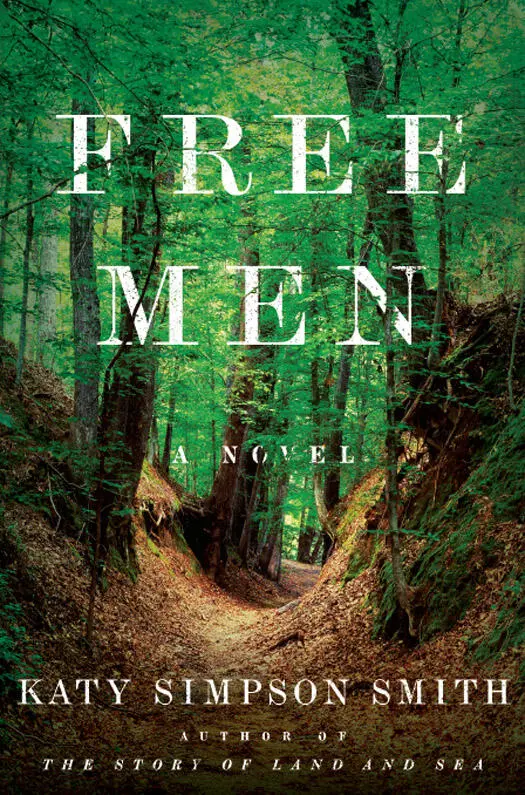
- Название:Free Men
- Автор:
- Издательство:HarperCollins
- Жанр:
- Год:2015
- ISBN:нет данных
- Рейтинг книги:4 / 5. Голосов: 1
-
Избранное:Добавить в избранное
- Отзывы:
-
Ваша оценка:
Free Men: краткое содержание, описание и аннотация
Предлагаем к чтению аннотацию, описание, краткое содержание или предисловие (зависит от того, что написал сам автор книги «Free Men»). Если вы не нашли необходимую информацию о книге — напишите в комментариях, мы постараемся отыскать её.
comes a captivating novel, set in the late eighteenth-century American South, that follows a singular group of companions — an escaped slave, a white orphan, and a Creek Indian — who are being tracked down for murder.
In 1788, three men converge in the southern woods of what is now Alabama. Cat, an emotionally scarred white man from South Carolina, is on the run after abandoning his home. Bob is a talkative black man fleeing slavery on a Pensacola sugar plantation, Istillicha, edged out of his Creek town’s leadership, is bound by honor to seek retribution.
In the few days they spend together, the makeshift trio commits a shocking murder that soon has the forces of the law bearing down upon them. Sent to pick up their trail, a probing French tracker named Le Clerc must decide which has a greater claim: swift justice, or his own curiosity about how three such disparate, desperate men could act in unison.
Katy Simpson Smith skillfully brings into focus men whose lives are both catastrophic and full of hope — and illuminates the lives of the women they left behind. Far from being anomalies, Cat, Bob, and Istillicha are the beating heart of the new America that Le Clerc struggles to comprehend. In these territories caught between European, American, and Native nations, a wilderness exists where four men grapple with the importance of family, the stain of guilt, and the competing forces of power, love, race, and freedom — questions that continue to haunt us today.
Free Men — читать онлайн бесплатно полную книгу (весь текст) целиком
Ниже представлен текст книги, разбитый по страницам. Система сохранения места последней прочитанной страницы, позволяет с удобством читать онлайн бесплатно книгу «Free Men», без необходимости каждый раз заново искать на чём Вы остановились. Поставьте закладку, и сможете в любой момент перейти на страницу, на которой закончили чтение.
Интервал:
Закладка:
IN THE MORNING, Bob is silent. We eat in silence, he goes into the woods to do his business and returns in silence, and when I point us onward, he says nothing, just follows. Cat now leads him on the trail, and the white man’s face has changed from sorrowful to troubled. Ashamed of his own cowardice at the creek, perhaps. I know what it is to be a coward, and I fear it’s nobler than shooting a gun. Sleep has changed us, a day too late.
For those two days on the western trail, am I hoping someone finds us? I am missing my mother again, and wanting to erase what I’ve done, and feeling the press of the coins on my back like something sacred and good. I’ll be using this to do something right. But I also want someone to stop us, to take us in, to unclench the choices from our hands so we don’t have to make them. I don’t say anything, because Bob and Cat say nothing, and we march on together because in this moment that’s the simplest decision.
Once I ask if his shoulder is hurting worse.
“It’s a bad shoulder,” he says. “We’ve done bad.”
I don’t know whether we should walk quickly or take the time to clear our tracks, to brush branches in animal patterns where our feet have gone. We cross a few hills but mostly flatland, and the burned stretch grows green again farther west. The dogwoods curve over the hummocks, white-saucered, and the redbuds are just lighting their winter branches with pink. The land smells like it’s been reborn. I look for the signs to the woman’s house that Oche made me remember. Signs again.
That first day I left my home, my town, I walked straight south, past Seloatka’s house and the council house and the ball field, not looking at the women on their way to the fields or the men smoking pipes in the square, my one thought to control the anger on my face. Of course it wasn’t anger at all, which is the only emotion young men claim, but despair, embarrassment. I wished Polly hadn’t taken my horse, but if I had been on a horse someone would have asked where I was going. In marching away from my family, I thought of money first: the deer I would kill, the skins I would take to Pensacola on my own back, the purse I would make from a wild boar’s belly to hold the coins, the chiefs I would sway to my side, the bloodless war we’d fight. All I needed was money.
Now the money is on my back, my sweat and its sweat mingling. I was going to wed, become the married nephew of the sonless chief of the town, the next in line. But that plan rested on Polly, who stole it from me. I am not concerned. The ground is shifting as if the snakes holding us up were shedding their skins. Powerful men live in this country who have no Muskogee mother, thin ties to clan. It is not so hard to imagine a day soon when my money will be worth more than my name, and I can buy relationships with traders, travelers, the government of whatever white country folds around our thousand-year hunting ground. All this story asks of me is patience. To forget the rage of what I’ve seen and the shame of what I’ve done. To stop loving Polly. Polly with her beautiful skin. It was wrong of me to love a dead man more than her.
In the walking, without the low music of Bob observing the ironies of his past, I find I can hold on to a calm, the same stillness I felt on the first hunt when my body grew a creature’s quiet. This is my body moving, I say, these are my feet walking away from my village, toward my village, away from Polly who broke my trust, toward Polly who is limb-lovely and no different from me, both thieves.
I sometimes turn to make sure they too are calm, are not liable to dash off screaming to left or right. These men, they are as strangely faced as two lost fawns. One, honeyed brown, with hair bunched and clinging to the dry scraps of broken leaves, his shoulder turning yellow. The other with eyes washed the color of the sky when its blue is paddled out by the heat of late summer. If they were not here and I was not guiding them away from their fates, I might have crawled into a hollow and wept for myself. When will our hunters find us?
Day turns into night turns into day. I keep counting them in my head: Kirkland, his son, his nephew, Colhill, two servants. Six men, surely some with wives. Some with powerful bodies, powerful kin. It will warn a man against walking richly into the wild.
When I first understood Thomas Colhill’s face, the Polly in it, there was a space in which I spoke nothing and no other sounds were made, and I was already wondering where the grackles went that moments ago were flocked and chattering in the oak. He met my stare unflinching but mild. This was a ball I didn’t know how to throw. He was Polly and a traitor. He was the echo of my love that was not love and my wrath that could not find its home. I didn’t know if she cared for him or wished him dead. Who will tell her? And what will she think?
Bob calls out at dusk. I first think it’s his shoulder, but he is pointing into the prairie, where a form has pressed a gap into the grasses. Our minds are worn, eager to see something simple. I say it’s an old deer bed, or a hawk’s dust wallow. Cat is already upon it, looking down with his new puzzlement, as if the whole world was wearing a new dress. A deer, its body splayed over the sharpness of the broken bluestem and broomsedge. Cat moves to stand near Bob, who bends down to brush its fur. The eye is open and empty, and the throat has a tear in it. A blur of flies circles its back half, which has been shorn of skin and meat, opening a window onto a white ribcage, the curve of a pelvic bone, a filmy sack of innards.
“Nothing to eat there, huh?” Bob asks.
I look at its front legs, still whole, stretched in a gallop.
Cat moves, red-eyed, behind Bob. A firefly begins beaming in the twilight, and then two. I could get a scrap of skin from this body, maybe a quarter, and though it couldn’t be sold, I could make it into a belt or a sheath for one of these men. I’ve watched Oche cleaning skins with women enough to know what steps to take to prevent rot and maggots. It’s as if I want them to remember me, though why would I? We’re together only as long as it takes to erase the scent, to plot our safety, to save the black man’s arm before it falls off, and then we’ll spin away, each of us carrying our own guilt.
I thought Cat had tried to drown himself that night, that he had slipped into the creek to slip away, and I didn’t blame him. Even as I was using my knife on human bodies, fighting to keep their knives away, fighting for these bags that are little more than signposts to a future, I thought, Yes, let him slip away; there is nothing of life that is good, and maybe we should follow. But when the night was quiet again, the bodies still, the slaves in the trees silent and awed, we called for him and he bobbed up from the water like a bubble of hope.
“A wolf, probably,” I say, turning from the carcass.
“And just eaten the back half?” Bob hops over the high grasses after me. His flailing startles a flock of sandhill cranes, who beat up into the sky with an angry rattle, their red caps catching the last light. The brass of their voice is louder even than our bags. Bob’s tongue is awake again. “Maybe it wasn’t hungry, or was a young one with a little stomach. Somehow it doesn’t seem so bad if it’s a young one. Makes me think of how hard it is to feed a litter of little ones, especially when the food goes rotten so fast or they don’t give you much of it. I’ve a daughter who’s so greedy she’ll eat green fruit off any bush she finds, and then keeps Winna up all night with her aching.”
His voice gets swallowed by the swish of our legs through grass. I hang back to let him walk ahead, and I match paces with Cat. I put my hand on his shoulder so he turns his face to me. The blue of his eyes burns through the wet of tears.
Читать дальшеИнтервал:
Закладка:
Похожие книги на «Free Men»
Представляем Вашему вниманию похожие книги на «Free Men» списком для выбора. Мы отобрали схожую по названию и смыслу литературу в надежде предоставить читателям больше вариантов отыскать новые, интересные, ещё непрочитанные произведения.








Обсуждение, отзывы о книге «Free Men» и просто собственные мнения читателей. Оставьте ваши комментарии, напишите, что Вы думаете о произведении, его смысле или главных героях. Укажите что конкретно понравилось, а что нет, и почему Вы так считаете.