Katy Smith - Free Men
Здесь есть возможность читать онлайн «Katy Smith - Free Men» весь текст электронной книги совершенно бесплатно (целиком полную версию без сокращений). В некоторых случаях можно слушать аудио, скачать через торрент в формате fb2 и присутствует краткое содержание. Год выпуска: 2015, Издательство: HarperCollins, Жанр: Современная проза, на английском языке. Описание произведения, (предисловие) а так же отзывы посетителей доступны на портале библиотеки ЛибКат.
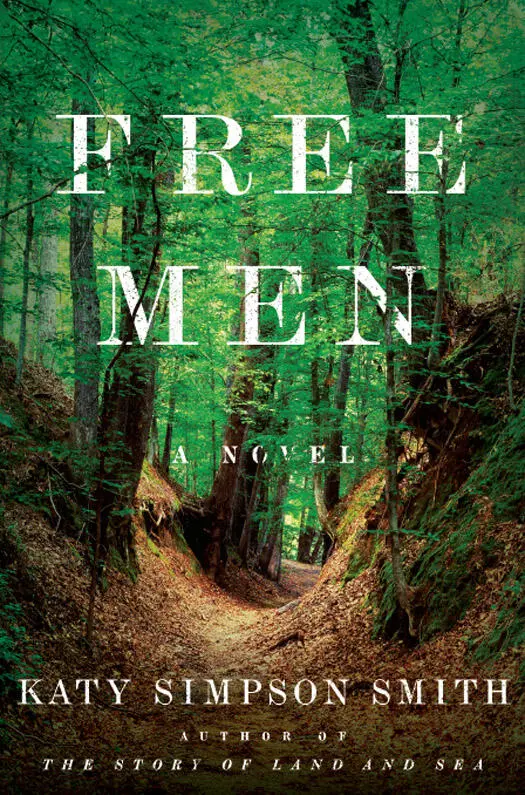
- Название:Free Men
- Автор:
- Издательство:HarperCollins
- Жанр:
- Год:2015
- ISBN:нет данных
- Рейтинг книги:4 / 5. Голосов: 1
-
Избранное:Добавить в избранное
- Отзывы:
-
Ваша оценка:
Free Men: краткое содержание, описание и аннотация
Предлагаем к чтению аннотацию, описание, краткое содержание или предисловие (зависит от того, что написал сам автор книги «Free Men»). Если вы не нашли необходимую информацию о книге — напишите в комментариях, мы постараемся отыскать её.
comes a captivating novel, set in the late eighteenth-century American South, that follows a singular group of companions — an escaped slave, a white orphan, and a Creek Indian — who are being tracked down for murder.
In 1788, three men converge in the southern woods of what is now Alabama. Cat, an emotionally scarred white man from South Carolina, is on the run after abandoning his home. Bob is a talkative black man fleeing slavery on a Pensacola sugar plantation, Istillicha, edged out of his Creek town’s leadership, is bound by honor to seek retribution.
In the few days they spend together, the makeshift trio commits a shocking murder that soon has the forces of the law bearing down upon them. Sent to pick up their trail, a probing French tracker named Le Clerc must decide which has a greater claim: swift justice, or his own curiosity about how three such disparate, desperate men could act in unison.
Katy Simpson Smith skillfully brings into focus men whose lives are both catastrophic and full of hope — and illuminates the lives of the women they left behind. Far from being anomalies, Cat, Bob, and Istillicha are the beating heart of the new America that Le Clerc struggles to comprehend. In these territories caught between European, American, and Native nations, a wilderness exists where four men grapple with the importance of family, the stain of guilt, and the competing forces of power, love, race, and freedom — questions that continue to haunt us today.
Free Men — читать онлайн бесплатно полную книгу (весь текст) целиком
Ниже представлен текст книги, разбитый по страницам. Система сохранения места последней прочитанной страницы, позволяет с удобством читать онлайн бесплатно книгу «Free Men», без необходимости каждый раз заново искать на чём Вы остановились. Поставьте закладку, и сможете в любой момент перейти на страницу, на которой закончили чтение.
Интервал:
Закладка:
He reaches out for her open hand and holds it in the space between them. He smooths the pink palm with his thumb and then leans close to inspect the lines and scars there. She lets him, as one would humor a child.
“Your hands are even smaller than hers,” he says.
She turns hers over and enfolds his, giving it a squeeze. “Let’s see if I have something here,” she says, hoisting herself up, showing beneath her extravagant skirts that she is shoeless. She bustles into a corner of the kitchen where a stack of rolled and folded papers seems to slide with every loud sound. After shuffling through them, she pulls out a long white scroll and brings it back to Cat, pinning down its corners with a few stones from her windowsill.
“There we are. Now this is us here,” she points, “and this is the trail you fellows came down, and fast, I’m betting. Now,” and she snakes her finger up and to the right like it was traveling in a boat on a river, “way up here is the Carolinas, north and south, and there’s Camden somewhere in this woody part. That’s where you want to go.” She looks up at his face to see if he’s understanding the distance.
He slows his fingers across the map, feeling for mountains.
“Where are your parents, son?”
“Her parents are dead.”
She pulls his hand away from the map. “No, yours.”
“Hers died in a cart on the way to see her. Said it wasn’t her fault.”
“Was she driving the cart?”
“No.”
“Well, there you have it.”
He leaned into a whisper. “But she was bleeding out. I might have stitched her up.”
“That’s maybe a half fault at best, certainly not a whole one. And what can you do now?”
“Suffer.”
“No, no, what can you really do? Bring her back? Throw yourself off a tall tree? Crawl into her grave? Think for a minute, son.”
He waits, his hand still draped on her knee where she left it, the map between them. Beside me, Bob has drifted into a doze on the floor. Her voice alone makes us feel blameless. I am proud that I know what can and cannot be done. Though the creek muddled me briefly, and though Polly still has no solution, I need only keep on the same path I’ve been walking; my plans make sense. There is a difference between killers and leaders, though both may take men’s lives. I am neither yet, but I must tell myself there’s a difference so that I can keep following the good path, in hopes of ending up at a good end. Life keeps going, and no man is lost until the end. I must remember to tell Cat this. He is not yet lost.
“Who is still living?” she asks him.
Bob snores lightly with a smile. Cat looks around the room, taking us in. The woman, the once-slave, myself.
“Wash yourself of that,” she says. “Give yourself a good washing. Do only what can be done.” She stands up, pulls him up beside her, takes him to the basin in the corner of the room. She tilts his head above the bowl and pours a jug over his hair, and then digs her fingers into his scalp, pulling out the wet tangles. I expect him to protest, but he stands limply. She is not gentle with him. “Guilt is a dead weight,” she says. “Get it on out. Hup, hup.” His head jerks with each rough motion of her hands. He murmurs something that sounds like a white man’s prayer. Our father .
When she is done, he stands up straight, his hair smooth and plastered against his skull. She holds her tiny face in her hands with pride.
“Feel nicer?”
Bob has woken up with all the splashing. “What’s he getting the fine treatment for?” he asks me. “I wouldn’t mind a scrub.”
Cat, with wide-open hoping eyes, formally kneels on the ground. “I don’t want to have done what I did,” he says.
Bob snorts and shakes his head. “All you did was go swimming.”
“I don’t want to have done it.” Cat is still gazing up at the woman.
“We’ve got a half dozen bodies on our souls,” Bob says, “and you just went paddling around that creek like it was a summertime swim hole.” He pulls his knees up, looks at the woman to convince her. “We’re the ones who killed them all, who got shot for it. He didn’t touch them. He who’s probably the murderer they’re looking for, who knows how to murder, and him even carrying the gun. Just went swimming!” His laugh is uneasy.
I am seeing all this sideways, my head down on the quilt, and I see how much Cat’s jawline is like Bob’s, how their elbows both jut. Their waists meet their hips in a skinny bend. Everyone’s shoes are collapsing.
The woman folds herself down on the floor and pulls Cat’s head into her lap, fidgeting her fingers through the last knots in his hair, and he lets her do this and closes his eyes as he collapses into the puddle of her skirts, beneath which is just a pile of thin bones.
“I let people die,” he says.
“Shh,” she says. “I know.”
Bob sighs and settles down again.
We fall asleep in crooked shapes on the floor.
IN THE MORNING, the woman — wearing the same dress, unwrinkled, but capless — pulls the crows from beneath the bed and sets their ruffled bodies on the table and with the strength of someone younger, she tears the birds to pieces. She pulls their wings until they pop darkly and rip free; she twists their heads off, the brimstone paste sending a foul burned smell through their open throats; she yanks at their feet until they come off like fleshy twigs in her hands. Then with grace she gathers the broken pieces and takes them into the garden, where she ties them to sticks with twine and plants them around her fresh stalks of young corn.
She washes her hands from the barrel of rainwater and makes us a pan of fried potatoes for breakfast. The salt smells like everything is all right in the world, or at least in this embrace of a house. When she changes Bob’s bandage, we see that the hole in his skin is starting to scab. Cat touches it.
“What’s it to be, my bandits?”
We are lazily sprawled around the house, waiting for the next task she assigns us. I blink at her slowly, thinking I will offer to find us fresh meat for dinner tonight, something wilder than her hogs.
“I can’t keep you forever. A bunch of highwaymen and a spinster like me, how do you think the neighbors would gossip? No, sons, I’ve my own business to be about.” She digs in her shelves now, pulling down new powders and ground roots.
Bob is the first to sit up. “I don’t mind,” he says. “It’s time enough for us to be heading on.” He looks at Cat. “Time for me, that is. Right? My shoulder’s fixed, or will be, so— This is how we said it would be.” He stands up and starts sorting his belongings, scooping out a small hand of silver for the woman pounding a poultice in her bowl. “I thank you much for what you’ve done.”
“So you’re just splitting up like strangers?”
“That’s what we are,” I say.
Bob turns to me, determined. “If you go back and take over your town or whatever it is you hope to do, and if you find yourself trading down Pensacola way and you see my woman on my master’s land, tell her that I’m free now, that I know what it is now, that if it means death, I’ll pay. And tell her I’ll come for her.” He looks at Cat again. “And you. There is no crime so black that God don’t see the goodness in us, though it be deep and buried.”
Cat rises and takes Bob’s wrist in his hand and then drops it. He says something so quiet we make him say it again. “I’m not ready.”
“You’ve got the map, don’t you? Aren’t you going to give that letter to the captain’s lady and woo her, or serve her, or bed her, or whatever the plan is?”
“I want to do that after.”
“After what?” I ask.
“Bob,” he says. “Probably can’t buy a farm without a white man’s X. I can do that.”
Читать дальшеИнтервал:
Закладка:
Похожие книги на «Free Men»
Представляем Вашему вниманию похожие книги на «Free Men» списком для выбора. Мы отобрали схожую по названию и смыслу литературу в надежде предоставить читателям больше вариантов отыскать новые, интересные, ещё непрочитанные произведения.








Обсуждение, отзывы о книге «Free Men» и просто собственные мнения читателей. Оставьте ваши комментарии, напишите, что Вы думаете о произведении, его смысле или главных героях. Укажите что конкретно понравилось, а что нет, и почему Вы так считаете.