Katy Smith - Free Men
Здесь есть возможность читать онлайн «Katy Smith - Free Men» весь текст электронной книги совершенно бесплатно (целиком полную версию без сокращений). В некоторых случаях можно слушать аудио, скачать через торрент в формате fb2 и присутствует краткое содержание. Год выпуска: 2015, Издательство: HarperCollins, Жанр: Современная проза, на английском языке. Описание произведения, (предисловие) а так же отзывы посетителей доступны на портале библиотеки ЛибКат.
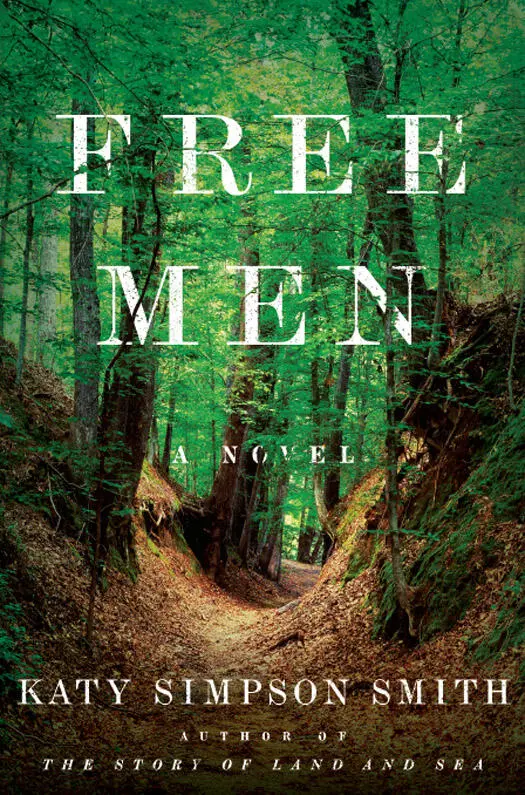
- Название:Free Men
- Автор:
- Издательство:HarperCollins
- Жанр:
- Год:2015
- ISBN:нет данных
- Рейтинг книги:4 / 5. Голосов: 1
-
Избранное:Добавить в избранное
- Отзывы:
-
Ваша оценка:
Free Men: краткое содержание, описание и аннотация
Предлагаем к чтению аннотацию, описание, краткое содержание или предисловие (зависит от того, что написал сам автор книги «Free Men»). Если вы не нашли необходимую информацию о книге — напишите в комментариях, мы постараемся отыскать её.
comes a captivating novel, set in the late eighteenth-century American South, that follows a singular group of companions — an escaped slave, a white orphan, and a Creek Indian — who are being tracked down for murder.
In 1788, three men converge in the southern woods of what is now Alabama. Cat, an emotionally scarred white man from South Carolina, is on the run after abandoning his home. Bob is a talkative black man fleeing slavery on a Pensacola sugar plantation, Istillicha, edged out of his Creek town’s leadership, is bound by honor to seek retribution.
In the few days they spend together, the makeshift trio commits a shocking murder that soon has the forces of the law bearing down upon them. Sent to pick up their trail, a probing French tracker named Le Clerc must decide which has a greater claim: swift justice, or his own curiosity about how three such disparate, desperate men could act in unison.
Katy Simpson Smith skillfully brings into focus men whose lives are both catastrophic and full of hope — and illuminates the lives of the women they left behind. Far from being anomalies, Cat, Bob, and Istillicha are the beating heart of the new America that Le Clerc struggles to comprehend. In these territories caught between European, American, and Native nations, a wilderness exists where four men grapple with the importance of family, the stain of guilt, and the competing forces of power, love, race, and freedom — questions that continue to haunt us today.
Free Men — читать онлайн бесплатно полную книгу (весь текст) целиком
Ниже представлен текст книги, разбитый по страницам. Система сохранения места последней прочитанной страницы, позволяет с удобством читать онлайн бесплатно книгу «Free Men», без необходимости каждый раз заново искать на чём Вы остановились. Поставьте закладку, и сможете в любой момент перейти на страницу, на которой закончили чтение.
Интервал:
Закладка:
“The Carolinas,” Cat says.
“What day?”
Cat shakes his head. The man keeps turning the pages.
“Your mother’s name? No? What about yours?”
“Prudence,” Bob says.
“Lovely. Here it is, then.” The man’s eyebrows crunch together. “No, no, this isn’t the right path for you at all.”
“What’s it say?”
“Shh. The twins are meant to guide you, but this time of year finds them in another part of heaven altogether.”
“Twins?”
“Come,” I say, trying to walk on.
“Hold on, now, which way am I supposed to go?”
The man closes the paper and fans his own face. “Only a sixpence, boy.”
Bob opens his mouth as if to say, We have sixpence and more! , but Cat grabs his arm and pulls him forward, and we walk quickly on while the woolly paper man clucks his tongue loudly.
“I just wanted to know,” Bob says.
WE MAKE THE western spur by afternoon. There have been recent burns; the sun cuts through the canopy and the collapsed underbrush and into our eyes. Young palmettos stretch out from the soot. We are obvious here, three fast walkers with loud bags amid a low charred scrub. Bob shouts out whenever a muscle twinges in his arm. According to Oche, the woman’s house is two days on, and another few miles on a northern branch. She lived in a village next to ours for many years, but was not born Muskogee, may not have had any Indian blood. She was dark and small-nosed and always had white hair, though she never seemed to age. In that village, she sat in council meetings near the front like a man, and captives would be brought to her to learn their fate. This one she’d lightly touch and send off to the Bird clan, a daughter to make up for the son lost at war; this one she’d grip by the shoulders and send off to be killed; this one she’d hold in her lap and tie strands of rope around his wrists and pat his bottom when he walked away, sent off to be sold into slavery. When she tired of her role, she took herself and her pots and a bag of seeds into the woods to start a lonelier life. There were stories of a brave past, some kind of warrioring, but I never knew where she came from. Perhaps she was a captive girl from another tribe, or a Spanish servant, or a colonist’s daughter. As children, we knew somehow that she, a village away and not quite of our world, floated above the prejudices of our own kin. We saw her during Green Corn, at ball play between towns. Oche said if I ever needed saving, I should find her. I am finding her.
The land is still charred where we bed down for the night, so I build a small fire; its smell is no different from the earth-smell here. We cook a rabbit and I find some roots beneath the ash that are still whole and good. Cat finds a spot beside Bob, his body a cocoon, his head near Bob’s knee as if that were the real fire. Bob is hungry for the meat, but shakes his head when I offer him cooked roots. He gives his share to Cat. When Bob belches, he excuses himself. Our bags sit just beyond the circle of firelight. My muscles still tremble with the rush of blood, and I can see the jerks of the others’ limbs; we haven’t calmed yet. There hasn’t been time to think.
“What’ll you do with yours?” Bob asks. “You have plans for the money? You’re already free, right, you’re not bound up in any way? Don’t need to buy yourself?”
“You don’t need to buy yourself either.”
“No, that’s right, I took what was mine. This is for the next part of life, the setting up of a house and taking care of a big piece of land with some crops on it — corn, probably, no sugar. I hear it’s too dry out there for rice or much.” He pauses. “You think I still deserve it?”
I can’t respond.
“Have you done it before, what we did? Is it easy to forget? Or maybe you just put it away like all the other things you have to put away.”
What I have tried to put away are other men’s deeds. Years spent seething against men I considered evil. What is the worst thing I have ever done?
“Did you leave anyone behind?” I ask. My family. “Someone to purchase?”
He shifts his legs as if to unfold them and stretch them out, but sees that Cat is there and settles back into place. He seems to know his knee is comfort. He raises his bandaged arm up instead, twisting his hand at the sky, one way and then the other. “What about you, is that woman you mentioned some kind of family?”
“I have a mother and a brother,” I say, “and cousins. A father too, but he’s not the same to us as he is to your people.”
“No, not my people either.”
We look at Cat.
“I’m sorry I made you do it,” Bob says. “If I made you do it, go after that money.”
I shake my head.
“I wanted it so bad,” he says, “something got in my eyes that I couldn’t blink back. And there we were, all three of us wanting things, and the men — well, you seemed to know them and knew they weren’t worth being friendly with, the way you froze up, it was like a sign, and then the way we’d all been wanting things.”
I nod. Wanting too much.
“Are you sorry?” he asks.
I roll out the skin on which I sleep. Lie down so the last sparks from the fire fly up before Bob’s face, and Cat disappears altogether, just a pile of clothes hazy through the smoke. Pull up my blanket.
“I’m not sorry I did it,” he says, “because we were just saving ourselves, first with the money and then when they woke, they would’ve killed us if we hadn’t killed them. We didn’t kill anyone who wasn’t trying to kill us. You know that? Look here, they shot me in the arm and probably wished it was the heart. I tell you, you just think of all my people, all your people, who’ve been cut down for nothing, not even so men can be better but so they can be richer, and richness just twists their hearts so after all that, they’re worse men than they were. And what about us? Now we can make better people of ourselves, and we will, and isn’t that something to justify — to justify— We’ve done everything right for so long, and we’ve — well, maybe not you, but me — I’ve lost most everything good and never done a thing bad. Never . And what have I lost? Isn’t this a sign that we deserve it? That God is watching and doesn’t mind?”
I can’t see his mouth moving for the sparks. Cat stands up, moves away from the fire, stutters into the darkness. His arms are wrapped around his stomach. I can’t think of what to say to Bob or how to read signs that are not from the natural world. I don’t know what deserving means. I wait until Cat is finished heaving up whatever little he ate and crawls back to his patch of dirt. I don’t sit up; if I see these men in any sort of clarity, I fear I’ll turn on myself for everything I’ve failed to do correctly. As it is, I don’t know how to distinguish us, and in the haze of smoke, with the burned smell muffling everything we say, we are a strange and indestructible creature. Many-headed, various, the good in our hearts — put together — weakly outweighing the bad.
“It’s a stone past,” I say. “It’s over.”
Bob doesn’t believe this, I don’t believe this, but there’s nothing else to say. “So tomorrow we’ll try not to shoot anyone, that’s what you’re saying?”
“Go to sleep.”
“You might want to get your gun back from Cat here. To my mind, I’m thinking now he’s the only one of us hasn’t killed yet, and him being the murderer all along. You still got that gun, Cat?”
He doesn’t answer. I turn onto my stomach, dig my feet into the soft ash of the ground, hide my hands in the late winter leaves. I am no longer afraid of Seloatka now that we both are villains, I am not afraid of losing Polly or loving Polly, I do not fear the tracker who’s now already on our trails, who soon will spot our six-footed steps, but I am afraid of the ghost children. Those haunted little souls who come soft out of the night and brush the skin, breathe through the tiny hairs. I’m not afraid of death but of the dead.
Читать дальшеИнтервал:
Закладка:
Похожие книги на «Free Men»
Представляем Вашему вниманию похожие книги на «Free Men» списком для выбора. Мы отобрали схожую по названию и смыслу литературу в надежде предоставить читателям больше вариантов отыскать новые, интересные, ещё непрочитанные произведения.








Обсуждение, отзывы о книге «Free Men» и просто собственные мнения читателей. Оставьте ваши комментарии, напишите, что Вы думаете о произведении, его смысле или главных героях. Укажите что конкретно понравилось, а что нет, и почему Вы так считаете.