T. Boyle - Water Music
Здесь есть возможность читать онлайн «T. Boyle - Water Music» весь текст электронной книги совершенно бесплатно (целиком полную версию без сокращений). В некоторых случаях можно слушать аудио, скачать через торрент в формате fb2 и присутствует краткое содержание. Год выпуска: 1983, ISBN: 1983, Издательство: Granta Books, Жанр: Современная проза, на английском языке. Описание произведения, (предисловие) а так же отзывы посетителей доступны на портале библиотеки ЛибКат.
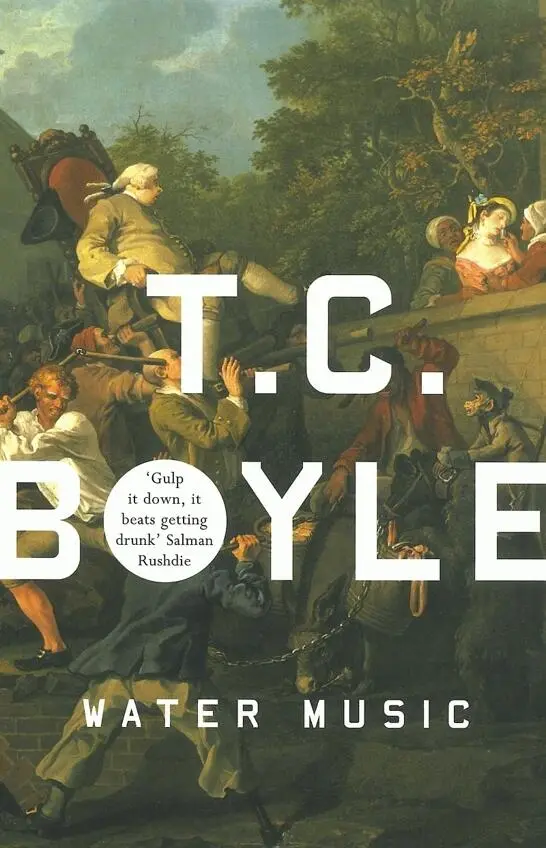
- Название:Water Music
- Автор:
- Издательство:Granta Books
- Жанр:
- Год:1983
- ISBN:9781862071551
- Рейтинг книги:3 / 5. Голосов: 1
-
Избранное:Добавить в избранное
- Отзывы:
-
Ваша оценка:
Water Music: краткое содержание, описание и аннотация
Предлагаем к чтению аннотацию, описание, краткое содержание или предисловие (зависит от того, что написал сам автор книги «Water Music»). Если вы не нашли необходимую информацию о книге — напишите в комментариях, мы постараемся отыскать её.
Water Music — читать онлайн бесплатно полную книгу (весь текст) целиком
Ниже представлен текст книги, разбитый по страницам. Система сохранения места последней прочитанной страницы, позволяет с удобством читать онлайн бесплатно книгу «Water Music», без необходимости каждый раз заново искать на чём Вы остановились. Поставьте закладку, и сможете в любой момент перейти на страницу, на которой закончили чтение.
Интервал:
Закладка:
Immediately a call goes up from the rear of the press. “Speak up, lad: we canna hear ye.”
“I said that I’ll say a few words,” the explorer shouts, already at a loss for what to say next. A hush falls over the crowd. The explorer can hear the hurried footsteps of the latecomers, stifled shouts, doors slamming in the distance. “I–I’m glad to be back home at Selkirk”—a cheer goes up—”among my friends, and I—”
“Tell us about the black nigger cannibals!” someone shouts.
“Aye!” adds another. “Did they torture ye?”
“Cattul!” a powerful voice peals. “Wot sort o’ cattul has they got over there?”
“—I really hadn’t intended to make a speech,” Mungo stammers to a renewed roar, beginning to feel as if he were running for office, “. . you see I’d been meaning to come in quiet like so as to see my loved ones first. .”
“Hoooo! He’s a hot-blooded mon, all right!”
“It’s Ailie he’ll be wantin’ to see, no mistaking.”
The hoi polloi take up the refrain, joyous, mindless, pullulating with excitement—”Ailie! Ailie! Ailie!”—and the next moment the explorer is swept up on their shoulders and carted off in triumph. Through the square and down the street, the crowd swelling, dogs barking, someone strangling a set of pipes and another beating a snare drum. And all the while the crowd chanting “Ailie! Ailie! Ailie!”
Before he can resist or even fully comprehend what’s happening, he finds himself set down before the gate at Dr. Anderson’s house, his bags at his feet, fifty or sixty people cheering at his back. Suddenly the front door swings open and there she is, Ailie, in a bonnet and housedress, sleeves rolled up, staring out in bewilderment at the brouhaha in her front yard. The crowd lets loose at the sight of her, surging toward an emotional orgasm, some primitive hysterical sense of completion demanding that they join the two principals. Arms are raised, the cheers are deafening, the pipes turn to a strathspey and a whole section of the crowd launches into a mad jig.
The gate has been unlatched. There’s an arm on Mungo’s shoulder, someone gives him a gentle nudge and then he’s walking up the path toward her, the cheers like waves breaking on a beach, Ailie tiny, silken-haired, her lips and eyes beckoning like the promise of water at the far end of an expanse of desert. Three and a half years, all those nights of scorching need and seductive dream, his feet on the front steps, something else in her eyes now, some amalgam of recognition, hurt and surprise, something proud and belligerent in the face of the crowd. “Ailie,” he whispers, at the summit of the steps, his arms spread wide.
“Take her up in yer arms, lad!”
“Kiss her!”
The noise is tumultuous, apocalyptic.
He looks into her eyes. They say no. They say Fve waited too long. They say Penelope be damned.
She shuts the door in his face.
♦ THE LONG ARM ♦
He gels drunk that first night back. Stinking, puking drunk. Somebody has to send up to Fowlshiels for his brother Adam to come on down and take him home. The next morning he wakes in the back room of his boyhood home in a welter of younger brothers and sisters. He has a violent headache. His bones feel hollow. He thinks of Ailie and feels sick. Suddenly the door bursts open and his mother swoops into the room and buries herself in his arms, crying over him as if he were a corpse. His brother stands in the doorway, a short, dark-haired figure beside him. For one wild moment he thinks it’s Ailie — Ailie softened by a night’s reflection, Ailie come back to him. It is Zander.
After a breakfast of milk brose, bannocks, fried eggs and rashers, fresh-baked bread, finnan haddie, potatoes, onions, small beer and tea (his mother thought he was looking peaked), he trundles his way down to the river with Zander and settles himself in the long grass opposite Newark Castle. It is warm. The sun hits the river with a slap before it is filtered to softness in the trees. A grasshopper balances on every blade of grass, a butterfly on every flower. Mungo plucks a heather leaf and chews it. After awhile he turns to Zander. They’ve been talking village gossip — who’d married whom, who’d died, got rich, went off to fight the French. Neither has mentioned Africa, or Ailie. “So she thinks I’ve deserted her?”
Zander is sifting pebbles through his fingers. He answers without looking up. “She does. She went through an awful lot when you were lost in Africa and nobody’d heard from you — a hell of an awful lot. But then when you came back to London and never made it up to see her. . well, she felt you didn’t care.”
“But I had no choice in the matter — surely she can see that?”
“She’s not a man, Mungo. What does she know of duty and commitment?
But listen, give her time — she’ll come around. She loves you.”
The explorer looks up glumly at the ruined walls of the castle. He knows every chink and crevice. As boys, he and Adam refought the Border Wars there, capturing the battlements, putting the invisible enemy to flight, dreaming dreams of glory. “I went through alot too, Zander. Death and disease, starvation, imprisonment. I watched my guide die before my eyes and I was powerless to do a thing.”
“We know it, Mungo. And it’s only natural you should have a period of readjustment. But she told me if you want her you’ve got to start at the beginning.”
“Court her all over again?”
Zander nods. Then he turns to the explorer, his face suddenly animated. “But listen. Tell me what it was like over there.”
♦ ♦ ♦
That afternoon, head splitting, throat dry and stomach broiling with acid, the explorer again mounts the front steps of the Anderson house. He is wearing a freshly starched cravat and a new sergdusoy jacket, his boots are polished and he carries a clumsily wrapped package under his arm. A maid in apron and clogs answers his knock and shows him in. She must be new, he is thinking, when Douce Davie comes bounding up the hallway.
The explorer goes down on one knee and holds his hand out. “Here Davie,” he calls, clucking his tongue, “good boy.” The dog pulls up short, inhales a snarl or two and shows his teeth. Slam, the maid is gone. Mungo rises awkwardly. The dog begins to bark.
There is the sound of hurried footsteps, then a door opening at the far end of the hallway. It is Dr. Anderson, big, wide-nostriled, a new beard appended to his face like some lush species of aquatic growth. He wraps his arms around the explorer like a lover and presses him to his body. “Mungo!” he whispers, his voice quavering, “ye’ve come back to us then.”
The explorer is embarrassed. When the doctor loosens his grip, Mungo backs off a pace and nods his head. “Aye,” he mumbles. This sets off a renewed paroxysm of hugging, patting and hand pumping on the doctor’s part, while the terrier paws at the explorer’s legs, yipping in protest. Mungo feels as if he’s just taken the ball downfield and drilled the winning goal into the net. “Well, well,” the doctor booms, “step into the parior and let’s have a look at ye.”
Mungo follows him into the famihar room, a wave of warmth and nostalgia washing over him, and then stops short. What is this? The walls are cluttered with odd black-and-white drawings — squares and rectangles in a beehive arrangement, oblate spheroids, circles within circles — drawings that approach a crude geometry, as if the artist has intended something that falls midway between the aesthetically pleasing and the mathematically precise. Then he notices the cherrywood desk in the corner. A new Cuff microscope stands in its center, gleaming like an icon. Mungo is about to ask his old friend and mentor if he’s taken up microscopy when the doctor turns to hand him a glass of claret. “Bon santé!” he barks, “and me hearty congratulations. Ye’ve brung fame and glory to Selkirkshire and I’m damned proud of ye for it.”
Читать дальшеИнтервал:
Закладка:
Похожие книги на «Water Music»
Представляем Вашему вниманию похожие книги на «Water Music» списком для выбора. Мы отобрали схожую по названию и смыслу литературу в надежде предоставить читателям больше вариантов отыскать новые, интересные, ещё непрочитанные произведения.









Обсуждение, отзывы о книге «Water Music» и просто собственные мнения читателей. Оставьте ваши комментарии, напишите, что Вы думаете о произведении, его смысле или главных героях. Укажите что конкретно понравилось, а что нет, и почему Вы так считаете.