T. Boyle - Water Music
Здесь есть возможность читать онлайн «T. Boyle - Water Music» весь текст электронной книги совершенно бесплатно (целиком полную версию без сокращений). В некоторых случаях можно слушать аудио, скачать через торрент в формате fb2 и присутствует краткое содержание. Год выпуска: 1983, ISBN: 1983, Издательство: Granta Books, Жанр: Современная проза, на английском языке. Описание произведения, (предисловие) а так же отзывы посетителей доступны на портале библиотеки ЛибКат.
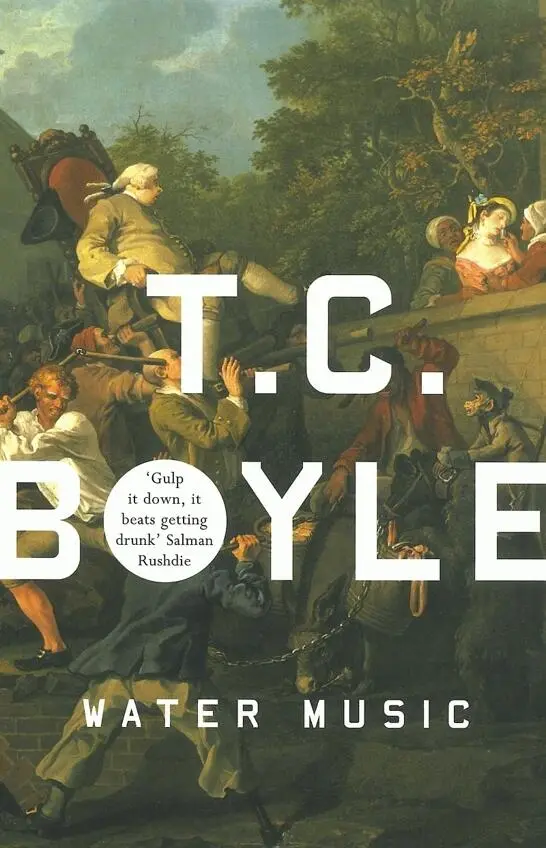
- Название:Water Music
- Автор:
- Издательство:Granta Books
- Жанр:
- Год:1983
- ISBN:9781862071551
- Рейтинг книги:3 / 5. Голосов: 1
-
Избранное:Добавить в избранное
- Отзывы:
-
Ваша оценка:
Water Music: краткое содержание, описание и аннотация
Предлагаем к чтению аннотацию, описание, краткое содержание или предисловие (зависит от того, что написал сам автор книги «Water Music»). Если вы не нашли необходимую информацию о книге — напишите в комментариях, мы постараемся отыскать её.
Water Music — читать онлайн бесплатно полную книгу (весь текст) целиком
Ниже представлен текст книги, разбитый по страницам. Система сохранения места последней прочитанной страницы, позволяет с удобством читать онлайн бесплатно книгу «Water Music», без необходимости каждый раз заново искать на чём Вы остановились. Поставьте закладку, и сможете в любой момент перейти на страницу, на которой закончили чтение.
Интервал:
Закладка:
It’s an agony. But an agony that must end, will end — is ending, page by page. He looks up from his work, the fantasy playing before him, Ailie at the door of her father’s house, a stirring in his trousers, taking her now out into the garden, flowers and the scent of lilac. . but then it all dissolves and he’s gazing down at the sheet before him, letters coming into focus, dotted i ’s and slithering s ’s, words running across the page like troops, forming ranks, recalcitrant and hostile, boxing him in, staring him down, defeating him.
♦ THE HOMECOMING ♦
The London coach, on the last leg of its journey to Edinburgh, rattles into Selkirk at 4:00 p.m., in a vortex of swirling leaves, dust and hair. Flowers flash beside gates and walls, sheep step out of the way and gaze up with their stupid baffled sheep faces, moths and butterflies scatter like confetti, an ancient dog lifts his head and then slaps it back down in the dirt, volitionless. For a moment everything is still, as if held in suspension. The sun hangs overhead like a lantern, the essence of new grass and apple blossom narcotizes the air, the clack and whir of the wheels have a quelling, hypnotic effect on the passengers.
Mungo breathes deep, craning his neck to peer out the window over the accumulated bulk of an Edinburgh-bound matron and her antediluvian but robust mother. What he sees, in snatches, is endlessly fascinating. Three and a half years of change, both subtle and arresting — cracks in foundations, new walls and hayricks, hedges trimmed back from the road, a barn charred by fire. He leans farther, mesmerized, nostalgia sweeping him up as each landmark leaps out at him like a silent benediction — the old Hogg place set in a clump of birch, alderman’s gate, the Russells’ pea patch — his eyes gone soft with it all, leaning and looking until he’s literally hanging over matron and mother like some sort of molester. “I say there, what’s the matter with you? You, Sir — back off or I’ll holler out to the coachman.” Three and a half years.
The mood carries him into town, houses glancing by as if in a dream, trellises hung with ivy, the MacInnes girl bent over the well in a sunburst of daffodil and tulip, bees humming, cats napping, everything as orderly and serene as a page out of Oliver Goldsmith. But then a mongrel bitch with a strange stiff mane darts out of an open gate and throws herself at the wheels in a paroxysm of ferocity, yabbering at the coach as if it were packed with raw meat. The driver cracks his whip at the animal and she backs off, whimpering, but already the coach is going too fast, horses spooked, pedestrians shouting, disaster in the air. The accident is abrupt as a scissor cut: the coach veers close to a man on horseback, the horse shies, the rider is thrown. Two hundred feet up the street, nearly in the dead center of the village square, the coachman gets his team under control and brings the vehicle to a halt.
The first on the scene are smudge-faced boys, a horde of them, running with abandon, converging like flies on a shattered cider jug. Next the passersby, and shopkeepers, then just about everyone within earshot — crofters, wetnurses, sweeps and charwomen, cobblers, flaneurs, the Reverend MacNibbit. It seems that the rider — an old man in kilt and tarn o’shanter — has been flung into the middle of a cart full of trout and salmon wrapped in wet leaves. The fishmonger is beside himself with shock and grief, the old man in tartans is cursing like a professional, and the fishmonger’s wife has begun a high-pitched tirade against exorbitant taxes, the price of coal and the Presbyterian Church. There is a moment of confusion punctuated by angry shouts and catcalls, and then a bearded man catches the horse by the bridle and calms it, while another helps the old man from the fishcart. Someone laughs. Willie Baillie, drunk as usual, declaims a few snatches of a dirty limerick. And then, inevitably, someone spots Mungo.
It is old Cranstoun, his face raptured and keen, hurrying along the street with his cane, straining forward to get some sense of what all the commotion is about. He bobs past the stalled coach in a sort of three-legged canter, but then suddenly pulls up stock-still and turns to gawk at the vehicle as if he’s just seen an apparition. For a long moment he just stands there, the milky old eyes taking in the matron, her voluminous mother and the tall fair-haired hero peering out the window behind them. Slowly, degree by degree, the old man’s expression works itself round from surprise to elation, and then he’s hustling for the door of the coach, all the while bellowing like some sort of mental defective with his hair set afire: “Be gad if it isn’t the explorer! It’s Mungo! Mungo Park come home to his people!”
Mungo had hoped to slip into town as inconspicuously as possible. He hadn’t written Ailie for a month. No one knew he was coming. His plan, impulsively formulated, was to surprise her. The work on the abridged version of Travels in the Interior Districts of Africa had finally been completed — after a period of protracted torture that seemed Alighierian in its proportions — and he was free to spend the next several months in Scotland, relaxing, fishing, preparing the final version of the book, making love. He was particularly enthusiastic about this last prospect. Since he’d seen the error of his ways and given up the Baroness, his passion for Ailie had grown hotter and hotter. So hot in fact that he’d had trouble sleeping through the misty London nights. Spring came and went. Edwards badgered him. Sir Joseph ruled him with an iron hand. Then it was June. The abstract was finished on schedule and he was on his way to Scotland to lighten his fiancée’s heart.
But life isn’t always so simple.
For one thing, the crowd gathers round the coach so precipitously you’d think old Cranstoun had yelled: “Guineas! Fresh-minted guineas, free for the taking!” For another, the look in their eyes says that they’re not about to let Mungo off with anything less than a full-scale celebration and the good, rousing, whisky-washed, old-time hullabaloo the occasion demands. There is rapture on every face. Wondering hands reach out for the explorer, the matron and her mother look puzzled and offended, old Cranstoun stands at the open door like a footman. “Huzza!” shouts the crowd as a geyser of hats and wigs shoots high into the air, and now Jamie Hume is leading them in “For He’s a Jolly Good Fellow” and Nat Cubbie is calling for a speech.
Mungo steps down from the coach to a roar of applause. He looks every inch the martyred hero, sallow, still a bit gaunt, the imprint of suffering and the indomitable will to conquer etched into his face. If anything, the past few months at his desk have taken more out of him than all the hopeless disease-ridden months of privation in Africa. But who’s to know that? All the crowd sees is their darling, grinning shyly, one of the greatest men Selkirkshire has ever produced, discoverer of the Niger, conqueror of Africa, why they watched him grow up! “Mungo!” they howl. And: “Speech!”
The explorer raises his hands on a roar and brings them down to a hush of expectation. There must be three hundred people in the street and more coming. Old friends, faces he grew up with. Finn Macpherson in a cobbler’s apron, grinning as if he’s just been named next in line for the Crown, Mistress Tullochgorm, Robbie Monboddo in a cleric’s collar, Georgie Scott. He doesn’t want to give a speech. He wants to burst in on Ailie, sweep her up in his arms. He wants to hike up to Fowlshiels and show his mother what her son has made of himself. But here are all these expectant faces looking up at him as if he could change water to wine or raise the dead or something. “All right,” he shouts, and then in a lower voice: “I’ll do my best.”
Читать дальшеИнтервал:
Закладка:
Похожие книги на «Water Music»
Представляем Вашему вниманию похожие книги на «Water Music» списком для выбора. Мы отобрали схожую по названию и смыслу литературу в надежде предоставить читателям больше вариантов отыскать новые, интересные, ещё непрочитанные произведения.






Обсуждение, отзывы о книге «Water Music» и просто собственные мнения читателей. Оставьте ваши комментарии, напишите, что Вы думаете о произведении, его смысле или главных героях. Укажите что конкретно понравилось, а что нет, и почему Вы так считаете.