T. Boyle - Water Music
Здесь есть возможность читать онлайн «T. Boyle - Water Music» весь текст электронной книги совершенно бесплатно (целиком полную версию без сокращений). В некоторых случаях можно слушать аудио, скачать через торрент в формате fb2 и присутствует краткое содержание. Год выпуска: 1983, ISBN: 1983, Издательство: Granta Books, Жанр: Современная проза, на английском языке. Описание произведения, (предисловие) а так же отзывы посетителей доступны на портале библиотеки ЛибКат.
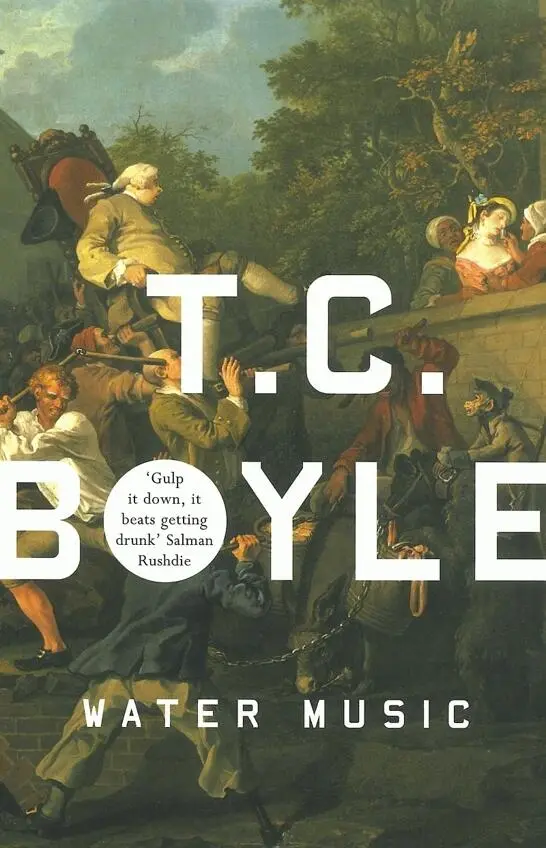
- Название:Water Music
- Автор:
- Издательство:Granta Books
- Жанр:
- Год:1983
- ISBN:9781862071551
- Рейтинг книги:3 / 5. Голосов: 1
-
Избранное:Добавить в избранное
- Отзывы:
-
Ваша оценка:
Water Music: краткое содержание, описание и аннотация
Предлагаем к чтению аннотацию, описание, краткое содержание или предисловие (зависит от того, что написал сам автор книги «Water Music»). Если вы не нашли необходимую информацию о книге — напишите в комментариях, мы постараемся отыскать её.
Water Music — читать онлайн бесплатно полную книгу (весь текст) целиком
Ниже представлен текст книги, разбитый по страницам. Система сохранения места последней прочитанной страницы, позволяет с удобством читать онлайн бесплатно книгу «Water Music», без необходимости каждый раз заново искать на чём Вы остановились. Поставьте закладку, и сможете в любой момент перейти на страницу, на которой закончили чтение.
Интервал:
Закладка:
Now she’s even more puzzled.
It seems to be some sort of carving — wood or stone. She turns it over in her hands. Smooth, black. So black it seems to drink in light and swallow it. At first she can make no sense of the thing, but then as she traces the thickly carved lines it comes to her: a woman. Ponderous, disproportionate, her head the size of an acorn, sagging dugs, abdomen and nates distended to cruelly absurd proportions. She looks closer. The woman’s feet are like trees, each toe a bole. And what’s this? Tortuous, secretive, black on black, a snake winds its way up her leg.
Ailie stares down at the figurine for a long while, lost in the pure rich glossy blackness of it, and then she begins to shiver. A night breeze lifts the curtains. Naked, she sets it down on the table and moves for the wardrobe and her nightgown. Outside the crickets stir.
♦ CHILD OF THE CENTURY ♦
In the summer of 1799, while Napoleon was slipping out of Egypt and Nelson was embroiled in Italian politics, Ailie Anderson changed her surname to Park. Less than a year later — in June of 1800—her first child was born. Dr. Dinwoodie performed the delivery, her father and Mungo sharing a nervous pint of whisky in the front room. It was a boy. So big he nearly split her in two. They named him Thomas.
Mungo held the infant in his arm, the eyes yellow with mucus, fingers creased and reddened as if they’d washed ten thousand dishes, the head a slick bulb of vein and tissue. Ailie’s father proposed a toast. “To the child of the century!”
Ailie couldn’t quite believe the whole thing. After all those years of fear and uncertainty, all the interminable days and weeks and months of waiting, he was back. Less than two years after he’d appeared on her front porch, all but a stranger, she was Mrs. Mungo Park, mother of his child. Each morning she woke beside him, each night sat down with him to supper. He was hers. She was absorbed with the thought of it, saturated to the very tips of her fingers with pride and satisfaction. The microscope gathered dust.
Of course, they had had their problems.
The first year after his return had been an admixture of hope and disillusionment, in equal parts. For six months Mungo lived at Fowlshiels, working on his book from morning till late in the afternoon. Then he would ride into Selkirk and spend the evening with her. They strolled along the river and watched the leaves spin down from the trees, rode out to visit Katlin Gibbie and danced a strathspey in her parlor, built a fire in the woods and roasted salmon on a spit. They grew to know one another again. It was like it once was.
But then the pull of Africa exerted its influence yet again. At Christmas Mungo took the coach to London and was gone five and a half months — while he and Edwards put the finishing touches to Travels in the Interior Districts of Africa . The book came out in May. It was an immediate and resounding success. A second edition was ordered. And then a third. African clubs and associations sprang up all over the continent. He wrote her every day.
In August she married a famous man. Packed up her books and microscope and moved to Fowlshiels — temporarily. Mungo was up in the air. Offers were coming in so fast it took half his time and energy just to reject them. The government wanted him to survey Australia, Banks was holding out for a second expedition to West Africa, others wanted him to lecture, write articles, collect plants, head up expeditions to Greenland, Borneo, Belize. “I don’t want to settle down in our own place just yet,” he told her.
She asked him what he meant.
“I mean I don’t know where we’re going to be. We could just get moved in and then have to pack up and leave.”
She’d been afraid of something like this all along. “You don’t mean to say you’re going to leave a wife pregnant with your first child and go off and disappear for another three and a half years? Disappear and maybe never come back? Good God, man, we’re just married and already you want to leave me a widow?”
“Ailie. We , I said we . Sir Joseph has been talking about the government’s setting up a colony on the Niger — we’ve got to, if we’re going to beat the French to it. They’d want me — us — to run the place. Think of it.” His eyes had gone out of focus, distant and hazy. “Think of what we could do if we lived right there on the Niger — think of the territory I could cover, the discoveries I could make!”
“I do not want to live in Africa,” she said, but he wasn’t listening, didn’t hear a word, didn’t even see her. No, he was talking to someone else, talking to himself, selling Africa, a place of color and life and extravagant nature, where the rivers were choked with gold and the earth was so fertile you didn’t even need to cultivate it.
Nine months later, when Thomas was born, they were still at Fowlshiels.
♦ ♦ ♦
Now, the first child weaned and a second on the way, she sits on the porch at that same Fowlshiels, sipping at a cup of coffee, an open book in her lap. Summer, 1801. Nothing has changed. There’s a war on with France. Prices have gone crazy. People are emigrating in droves. Mungo is still waiting.
Since he finished the book he’s had alot of time on his hands. Two years’ worth. He fishes. He hunts. He takes long solitary hikes through the hills, sometimes spends an overnight in the woods with Zander. Since his father’s death and Adam’s move to India, he helps his brother Archie look after the farm. He is silent, morose. Once he didn’t show up for dinner and she found him down by the river, staring into the water. He was dropping pebbles in, one at a time, and counting to himself — one thousand, two thousand, three thousand. It’s how I used to figure the depth of streams in Africa, he said. Then he smiled for the first time in a week: Important to know when you’ve got to wade across them. He wakes in a sweat sometimes, shouting out in a strange language. His sexual appetite is astonishing. He says he’s happy.
Still, when the London mail comes in, he’s first in line. Looking for an envelope with the government seal — or Sir Joseph’s. Inevitably he is disappointed. The news has been bad. The government has diverted its attention to the war. Sir Joseph feels that the time is not right to go ahead with a second expedition, the French are making inroads in West Africa. .
Ailie is worried. What will happen if the war ends or Sir Joseph reconsiders or the French stop making inroads? She looks up at the steady green sweep of the hills and sees instead a seething jungle. The fetus moves inside her. Somewhere, from deep in the house, the child of the century begins to cry.
PEEBLES
Peebles.
There’s no other answer for it.
Yes, Peebles. She’ll speak to him when he gets back.
♦ ♦ ♦
It is late afternoon when she spots him emerging from a stand of larches at the far end of the field, Zander at his side. The sun is low in the sky, cold and milky, and shadows ravel out from the trees. Deep, menacing, blue-black shadows, stretching across the field like fingers, reaching out as if reluctant to give up the burden of her husband and brother. She loses them for a moment, but there — the flash of Mungo’s hair as he glances into the sun, the familiar loping stride, Zander struggling to keep up. A moment later they’re coming up the cart path.
“Hello,” she calls.
They wave in response.
“Thirsty?”
“Aye.”
By the time they reach the porch she has two tankards of ale set out for them. They fling themselves down on the wooden chairs with the easy animal grace of men who have just performed some prodigious feat. Zander’s collar is soaked through with sweat. His nose is sunburned.
Читать дальшеИнтервал:
Закладка:
Похожие книги на «Water Music»
Представляем Вашему вниманию похожие книги на «Water Music» списком для выбора. Мы отобрали схожую по названию и смыслу литературу в надежде предоставить читателям больше вариантов отыскать новые, интересные, ещё непрочитанные произведения.











Обсуждение, отзывы о книге «Water Music» и просто собственные мнения читателей. Оставьте ваши комментарии, напишите, что Вы думаете о произведении, его смысле или главных героях. Укажите что конкретно понравилось, а что нет, и почему Вы так считаете.