T. Boyle - Water Music
Здесь есть возможность читать онлайн «T. Boyle - Water Music» весь текст электронной книги совершенно бесплатно (целиком полную версию без сокращений). В некоторых случаях можно слушать аудио, скачать через торрент в формате fb2 и присутствует краткое содержание. Год выпуска: 1983, ISBN: 1983, Издательство: Granta Books, Жанр: Современная проза, на английском языке. Описание произведения, (предисловие) а так же отзывы посетителей доступны на портале библиотеки ЛибКат.
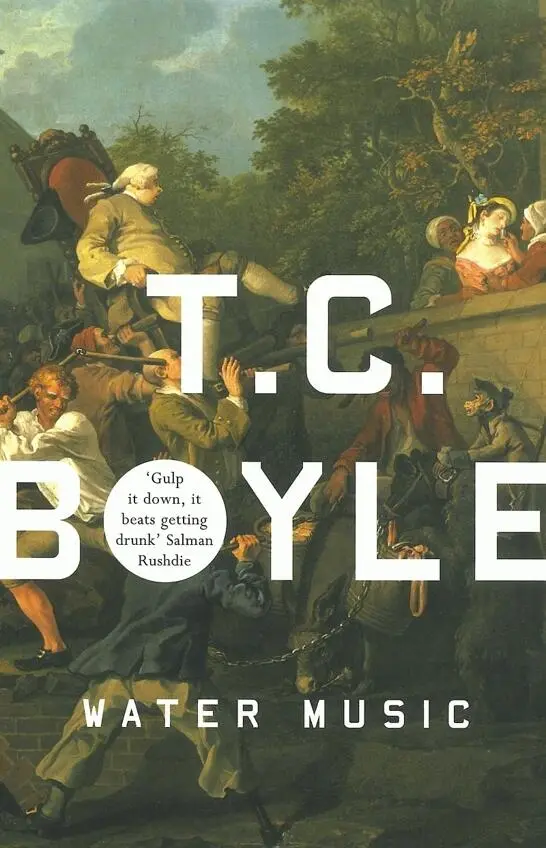
- Название:Water Music
- Автор:
- Издательство:Granta Books
- Жанр:
- Год:1983
- ISBN:9781862071551
- Рейтинг книги:3 / 5. Голосов: 1
-
Избранное:Добавить в избранное
- Отзывы:
-
Ваша оценка:
Water Music: краткое содержание, описание и аннотация
Предлагаем к чтению аннотацию, описание, краткое содержание или предисловие (зависит от того, что написал сам автор книги «Water Music»). Если вы не нашли необходимую информацию о книге — напишите в комментариях, мы постараемся отыскать её.
Water Music — читать онлайн бесплатно полную книгу (весь текст) целиком
Ниже представлен текст книги, разбитый по страницам. Система сохранения места последней прочитанной страницы, позволяет с удобством читать онлайн бесплатно книгу «Water Music», без необходимости каждый раз заново искать на чём Вы остановились. Поставьте закладку, и сможете в любой момент перейти на страницу, на которой закончили чтение.
Интервал:
Закладка:
Ned sat there, chilled through, watching the pigeons scrabble in the gutter. After awhile he picked himself up wearily and started down the street. For St. Bartholomew’s.
♦ ♦ ♦
“Come on,” Quiddle hisses, “let’s get it over with.” And then he disappears behind the wall, the brief sharp clatter of the shovels like a hole poked through the night.
Reluctantly, Ned slides out of the cart, flapping his arms to keep warm. There is the scent of freshly turned earth on the air, and something else too — something like the smell of wet leaves or earthworms drowned in a rainstorm. The absolute blackness of the night is appalling. Ned shuffles around a minute, squinting into the gloom and fighting an impulse to whistle. The skin around his eyes and ears seems to have shrunk, tugging back at his hairline as if it were elastic. Good God, he thinks, and then he’s up and over the wall.
There had been a funeral in the Islington churchyard earlier that day. A family of four. Murder/suicide. In despair over a life of rags and potatoes, the Mrs. had seasoned her spouse’s porridge with arsenic trioxide and then smothered the children as they lay sleeping on their shuck mattresses. She kept a vigil over the bodies until dawn, and then forced the blade of a wood saw over her wrists, time and again, until she lay down beside them and bled to death. Delp had read about it in the morning paper.
If anything, it’s even darker on the far side of the wall. What now? Ned wonders, when Quiddle’s voice suddenly leaps out of the void at him—“Pssst: over here”—and he finds himself diving for the shrubbery, rattled to the bone, a stray branch whipping at his face, the crush of dead weed, and then that terrible stillness again. Lying there in the dark, feeling foolish, he begins to feel more strongly than ever that there are better ways of spending a cold winter’s night. His inner eye briefly flashes on white arms, sleeping dogs, mugs of ale and wild leaping extravagant fires. But to the business at hand: slowly, cautiously, as if a thousand eyes were on him, he rises to his feet and is startled half out of his wits by the shovel thrust into his hands. “Knock off your fooling and let’s get on with it,” Quiddle rasps, and then they’re moving, Ned concentrating on the vague glint of baldness at the back of Quiddle’s head as they make their way between pale headstones and looming dark monuments, crucified Christs and wingspread angels of death.
“Horace,” Ned whispers, “this is ridiculous. It’s ghoulish, unchristian, against all the laws of God and man. Couldn’t we tell Delp we got lost and never found the place?”
The bald spot moves on, dipping here, bobbing there. Quiddle’s only response is a sort of chuckle, so low and throaty it would frighten a hyena.
Then all at once they’re stopping, Quiddle down on one knee it seems, scratching about in the half-frozen earth. “This is it,” he says, his voice wrestling with nerves, susurrus and a tendency to crack into falsetto. “Try not to make too much noise with the shovel.”
Ned tries not to. He gingeriy slips the spade into the pool of blackness at his feet, feeling for soft earth. Quiddle is beside him, shoveling stealthily — Ned can hear the whisper and whine of his shovel and the accelerated chuff-chuff-chuff of his breathing. They work in silence for a long while, dipping deeper for their loads, Quiddle periodically kneeling to strike a match and check their progress. Finally, with a dull thud, Ned’s shovel makes contact with something solid. “That’ll be it,” Quiddle whispers, digging harder now, sweeping along the length of the coffin with the edge of his shovel.
Ned has stopped digging. At the first touch of metal and wood an involuntary shudder galvanized his body, as if the handle of the spade were a lightning rod and the rough planks charged with electricity. He stands there, looking into nothing, temples pounding, throat dry, listening to Quiddle’s knife as it pries at the lid of the coffin, thinking what next, what next, and waiting with a dumb stricken revulsion for his companion to light the next match. He can see them already, the poisoned husband, the smothered children, the mutilated wife sitting up in her bloody shroud and shrieking out with a wild desperate laugh.
But wait: is he hearing things? A rustling in the bushes at the base of the wall? Muffled footsteps? The walking dead? “Horace: what was that?”
Quiddle, breathing hard, forces back the lid of the coffin, wood splintering with a groan of protest: eeeeeeeee. “What was what?”
“That sound. Out there.”
Quiddle pauses, the bald spot motionless in the dark. A profound silence settles over the churchyard. Nothing moves. It is as still and dark and bleak as the back side of the moon. “Listen,” Quiddle says finally, “you keep it up and we’ll both be in a state. Now get on down here and give me a hand with this stiff.”
Ned drops the shovel with a clatter and eases down at the edge of the pit, feeling his way gingerly, catching his breath in case there’s an odor, his whole body revolting against the task at hand. Quiddle has propped the corpse up, stiff as a log, and is struggling to maneuver it toward Ned when suddenly a great crashing weight descends on Ned from the rear and impels him face forward into the coffin. Quiddle sprawls, the corpse totters, Ned cries out and the presence at his back — it is warm, possessed of arms and legs — grunts like a rooting pig. And then all at once a blinding light is shining in their faces and a voice snarling: “That’s royt: dig away, Quiddle. It’ll spare me the effort.”
Dirk Crump is standing over the pit, a lantern in one hand, pistol in the other. His accomplice is atop Ned, Ned is atop Quiddle, and Quiddle is wedged into the corner with the cadaver. As if in protest, the corpse’s hand is thrust straight out of its shroud, the raw ragged gashes slanting across the wrist, flesh gone gray, nails battered and black. “All royt Billy, ye’ve done well,” Crump says, “—come out of it now.”
It is then that Ned gets his first look at the accomplice and realizes with a start that he’s staring into the pale green unbelieving eyes of Billy Boyles. “Billy?” he says. But Boyles is backing away from him, his face working, eyes collapsed in on themselves with terror and disbelief. Then his mouth opens, a hole black as the night. “Run!” he shrieks, alternately clawing at the edge of the coffin and blessing himself, Ned reaching out to pacify him and Boyles screaming again, his voice pinched and raw with terror, the voice of spitted babes and animals skinned alive. Crump drops the lamp in shock and bewilderment, light dashing out on the ground in a spray of hot oil and the quick inevitable night rushing in to swallow it. There is the sound of scrambling, hands and feet tearing at the earth. Crump shouting out an obscenity and then Boyles’ traumatized shriek again: “Run for God’s sake, run — it’s a haunt!”
The snarl of the pistol is almost anticlimactic.
♦ WORDS ♦
Sir Joseph Banks, at fifty-five, is a hub of power and influence. President of the Royal Society for the past twenty years, Honorary Director of the Royal Botanic Gardens, Knight Commander of the Bath and member of the Privy Council, he is the doyen of the British scientific community, a distinguished botanist whose collection ranks among the best in Europe, founding member of the African Association, former explorer and eponym of a number of South Pacific landmarks, the man to whom the government turns for consultation on nearly every scientific matter, from the most effective way of preserving breadfruit on the H.M.S. Bounty to the disposition of explorers in the Tropics.
Though born to wealth and privilege, it was in the role of explorer that he first caught the public eye. In the late sixties and early seventies he circumnavigated the globe with Captain Cook, and was so successful in promoting his own role in the expedition that he was named President of the Royal Society shortly thereafter. He is self-righteous and proper, autocratic, insatiably curious, a manipulator, collector, seedsman, hobnobber, pacesetter, publicity hound — but above all else an explorer grown too old for exploring. And so, like the ex-athlete turned to coaching, he is mentor to his geographical missionaries. He is a man of taste, refinement and connection, a man of dedication and perseverance, a man who can make the entire country sit up and listen. At the moment, however, it is all he can do to keep from shouting.
Читать дальшеИнтервал:
Закладка:
Похожие книги на «Water Music»
Представляем Вашему вниманию похожие книги на «Water Music» списком для выбора. Мы отобрали схожую по названию и смыслу литературу в надежде предоставить читателям больше вариантов отыскать новые, интересные, ещё непрочитанные произведения.








Обсуждение, отзывы о книге «Water Music» и просто собственные мнения читателей. Оставьте ваши комментарии, напишите, что Вы думаете о произведении, его смысле или главных героях. Укажите что конкретно понравилось, а что нет, и почему Вы так считаете.