T. Boyle - Water Music
Здесь есть возможность читать онлайн «T. Boyle - Water Music» весь текст электронной книги совершенно бесплатно (целиком полную версию без сокращений). В некоторых случаях можно слушать аудио, скачать через торрент в формате fb2 и присутствует краткое содержание. Год выпуска: 1983, ISBN: 1983, Издательство: Granta Books, Жанр: Современная проза, на английском языке. Описание произведения, (предисловие) а так же отзывы посетителей доступны на портале библиотеки ЛибКат.
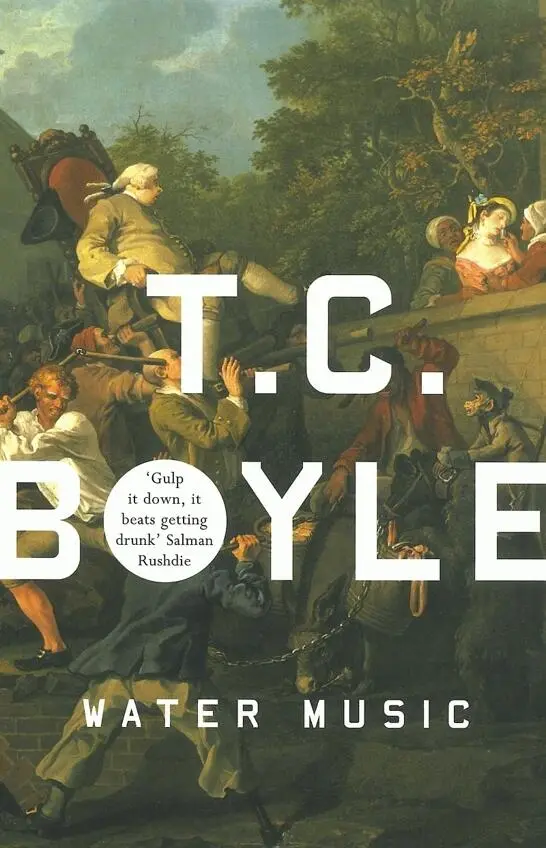
- Название:Water Music
- Автор:
- Издательство:Granta Books
- Жанр:
- Год:1983
- ISBN:9781862071551
- Рейтинг книги:3 / 5. Голосов: 1
-
Избранное:Добавить в избранное
- Отзывы:
-
Ваша оценка:
Water Music: краткое содержание, описание и аннотация
Предлагаем к чтению аннотацию, описание, краткое содержание или предисловие (зависит от того, что написал сам автор книги «Water Music»). Если вы не нашли необходимую информацию о книге — напишите в комментариях, мы постараемся отыскать её.
Water Music — читать онлайн бесплатно полную книгу (весь текст) целиком
Ниже представлен текст книги, разбитый по страницам. Система сохранения места последней прочитанной страницы, позволяет с удобством читать онлайн бесплатно книгу «Water Music», без необходимости каждый раз заново искать на чём Вы остановились. Поставьте закладку, и сможете в любой момент перейти на страницу, на которой закончили чтение.
Интервал:
Закладка:
“Ohhhhh — I gets it. You’re in disguise, then. Am I royt? Eh, Ned? Am I royt? Layin’ low, is it?”
Ned glances round, takes hold of Boyles’ arm and leads him down a back alley. A dead dog lies in the dirt beside a broken parasol. Out on the Mall, people of ton clip by in carriages. “How did you know it was me, Billy?”
“You kiddin’? I’d spot you a mile off, Ned Rise. A little foot-draggin’ and a false nose isn’t goin’ to help you any. I conned you plain as day.”
So much for the mantle of invisibility. “Listen, Billy. You can’t let on that you’ve seen me. If Mendoza and Smirke and the rest found out about it—”
“They’d eat you alive, Neddy. Mendoza come lookin’ for you the next mornin’, and Smirke cursed you up and down for a week after his public yoomiliation. Ha! You should of seen that, Ned — Smirke in the pillory. I let him have it with half a dozen rotted turnips and a dead cat. Gorry, it was good fun.”
But Ned’s not listening. He turns his back preoccupied, and digs deep in his knee breeches, fumbling about for crown and shilling, fishing for hush money.
“I’ll say this for him, though,” Boyles coughs, blowing a wad of bloody sputum into a rag of a handkerchief,” he felt heartsore about cursin’ you after he found out you was drownded. He set up the house for you, Ned — three times! And Nan and Sal — you should of seen ‘em carry on.
The two of ‘em went out and nicked black bonnets and screens and all to sorrify their faces, and then they threw a armful of geraniums into the river for memory of you. . no, you didn’t go to your grave unmourned, be assured of that, Neddy.”
Ned swings round and holds up a coin. “For you, Billy,” he says. “For your discretion. You never saw me, right? I’m dead and gone, right?”
“You can count on me, Ned. I won’t breathe a word.”
♦ ESCAPE!♦
Mungo wakes with a headache. He has been drinking sooloo beer — a.k.a. bobootoo das —juggler of legs, scrambler of minds. He has been drinking sooloo beer and he is not quite certain where he is. A cellar certainly. He recognizes the yellow earthen walls, the roots and rhizomes, the cane ceiling, the ladder. Yes. No doubt about it. A cellar. He raises himself wearily to his elbows and discovers an empty calabash between his legs and a flocculent head across his ankle. The head belongs to Johnson, who is sprawled over the floor with his cronies in a farrago of limbs and feet, his great belly rising and falling like some elemental force of nature. All five are snoring serenely, teeth whistling, lips vibrating, tonsils flapping in the breeze.
It occurs to him that it must be morning, since the blackness he experienced earlier has now given way to the sort of soupy crepuscular light one expects of crypts, wine cellars and other damp and unsalubrious places. He rubs at a spot on his neck where something has bitten him during the night, and glances up as a glossy black scarab struggles across the floor with a ball of dung the size of an apple. He is sitting there, propped on his elbows, watching the beetle and waiting patiently for his head to clear, when the first cry sounds from above. It’s more a gasp actually, an insuck of surprise, tailed almost immediately by a prolonged wail, plaintive and despairing. Then a hurried exchange of voices — monosyllables thrown back and forth like tennis balls — the sound of feet rushing on the bamboo floor above, silence. The explorer cocks his head and gradually becomes aware of a whole undercurrent of noise emanating from beyond the house, out in the streets. A hum, building now to a roar — it seems as if the very earth is alive with it. He’s puzzled. Is it an earthquake? Stampede? Another sandstorm?
Ever curious, the explorer rises and crosses to the ladder, Johnson’s head slapping down behind him with a dull thump. Just as he steps on the first rung, however, a flap opens in the ceiling above and he finds himself confronted with a bony posterior and a pair of naked soles, descending. The explorer backs off as a shrunken little man makes his way down the ladder, slow and oblivious, dangling in the air like an arthritic spider. At the base of the ladder the little man plants his feet, turns round, and then starts back violently at the sight of the explorer.
He is old, this little man — ancient, antediluvian. His hair is white and corrugated, his face lined like a river delta. He is five foot nothing, ninety-five pounds, looks as if he’s been carved from a shadow. Around his neck a throttled chicken, stiff with rigor mortis, dangles from a cord. There is an awkward moment as explorer and gnome stand there toe to toe, the little man turning his big slow rolling eyes to the explorer, then looking away again, something between astonishment and indignation caught in the web of his face. He looks up once more, then turns away as if dismissing an apparition, bends to one of the sleeping men and begins piping in his ear. ‘‘M’bolo rita Sego!” he hoots. ‘‘M’bolo bolo Sego!”
The effect is instantaneous: Johnson and his retinue start up in unison, clutching at their chests and bugging their eyes, while the old man claps his hands and narrates a shrill tale of doom (Mungo is no linguist, but he can pick up repeated phrases like “cannibal,” “child-skinner” and “Tiggitty Sego”). An instant later the five beer-drinkers are wringing their hands, running into one another and fighting for the ladder.
In his anxiety to escape, Johnson brushes past the explorer, who takes the opportunity to seize his arm. “What’s up, Johnson? Is it Sego?”
The others are licking up the ladder like ants on a stick, while the old man teeters round the room scattering feathers. From above: the roar of cumulative panic.
“Quick!” shouts Johnson, tearing away like a crazed beast and clambering over the old man. “He’s going to put Jarra to the torch!” Johnson hesitates at the top of the ladder. “No prisoners,” he whispers.
♦ ♦ ♦
Outside, it’s a scene from Milton or Dante: weeping and wailing, self-flagellation, misdirection, panic, loss of faith. Mothers run childless, children motherless. There is smoke and dust in the air, the rush of blood. One old man stands in the street whipping his ancient milch cow because it cannot heave up from the ground under the weight of the panniers slung over its shoulders. Another carries his wife, who carries her dog, who carries a scrap of cloth in its mouth. All over people are running and shouting, a mad urgency in the atmosphere, kicking through the drifts and rubble left by the storm, gathering sacks of grain, driving cattle: fleeing the little mud-walled village on the Woobah, the village where they were born.
The explorer, always somewhat slow to react (something in the genes), stands in the midst of all this sorrow and confusion wondering what to do. He can’t very well join the exodus, as his horse and bags (restored to him at Fatima’s insistence) were lost in the storm — and how far could he get on foot? Besides, Johnson’s disappeared, and the Moors certainly wouldn’t. . but wait a minute — where are the Moors? It suddenly occurs to him that he hasn’t laid eyes on a Mussulman in the last twelve hours at least. . and then, even more suddenly, an insidious thought begins poking at the periphery of his brain — the very thought that was about to step out of the wings and announce itself last night when a weathered hand passed him the calabash: here at long last is his chance!
♦ ♦ ♦
What has transpired in Jarra is really quite elementary as the politics of war go. Ali, at some time during the night, experienced a crisis of divided priorities: his own best interest came into conflict with that of the Jarrans, who are, after all, merely Kafirs. After an evening of feasting and good-natured raping and extorting, he ordered ten of his men to select the three hundred fattest cattle from among the Jarran herds and to drive them into the wood where they’d be sheltered from the storm. This, he reasoned, was in his own best interest — merely protecting his investment. The Jarrans felt that Ali’s move was ultimately in their best interest as well, as it constituted his acceptance of their payment in advance for his services. Three hundred cattle are alot to lose, but not when you consider the alternative — i.e., losing the entire herd, as well as your goats, crops, huts and daughters to the raging and mindless Tiggitty Sego, known far and wide for his bloodlusting and vindictive nature.
Читать дальшеИнтервал:
Закладка:
Похожие книги на «Water Music»
Представляем Вашему вниманию похожие книги на «Water Music» списком для выбора. Мы отобрали схожую по названию и смыслу литературу в надежде предоставить читателям больше вариантов отыскать новые, интересные, ещё непрочитанные произведения.





Обсуждение, отзывы о книге «Water Music» и просто собственные мнения читателей. Оставьте ваши комментарии, напишите, что Вы думаете о произведении, его смысле или главных героях. Укажите что конкретно понравилось, а что нет, и почему Вы так считаете.