T. Boyle - Water Music
Здесь есть возможность читать онлайн «T. Boyle - Water Music» весь текст электронной книги совершенно бесплатно (целиком полную версию без сокращений). В некоторых случаях можно слушать аудио, скачать через торрент в формате fb2 и присутствует краткое содержание. Год выпуска: 1983, ISBN: 1983, Издательство: Granta Books, Жанр: Современная проза, на английском языке. Описание произведения, (предисловие) а так же отзывы посетителей доступны на портале библиотеки ЛибКат.
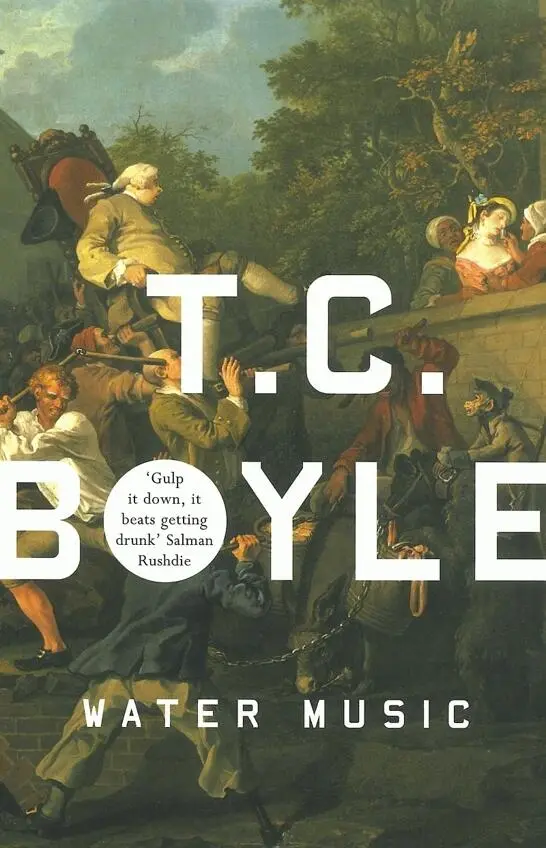
- Название:Water Music
- Автор:
- Издательство:Granta Books
- Жанр:
- Год:1983
- ISBN:9781862071551
- Рейтинг книги:3 / 5. Голосов: 1
-
Избранное:Добавить в избранное
- Отзывы:
-
Ваша оценка:
Water Music: краткое содержание, описание и аннотация
Предлагаем к чтению аннотацию, описание, краткое содержание или предисловие (зависит от того, что написал сам автор книги «Water Music»). Если вы не нашли необходимую информацию о книге — напишите в комментариях, мы постараемся отыскать её.
Water Music — читать онлайн бесплатно полную книгу (весь текст) целиком
Ниже представлен текст книги, разбитый по страницам. Система сохранения места последней прочитанной страницы, позволяет с удобством читать онлайн бесплатно книгу «Water Music», без необходимости каждый раз заново искать на чём Вы остановились. Поставьте закладку, и сможете в любой момент перейти на страницу, на которой закончили чтение.
Интервал:
Закладка:
But late that night, after the storm had abated, another factor entered the equation: Ali learned that Sego’s armies, taking advantage of the weather, had marched to within striking distance of Jarra, and that from there they planned an early morning attack. This intelligence precipitated Ali’s crisis of priority. Since he’d already collected his virgins and his cattle, he reasoned that he was satisfied — and that by fighting the Kaartans he would certainly derive no further satisfaction, and in fact ran the risk of losing what he’d already gained. He didn’t agonize long over the decision.
Within minutes the tents were struck, his men mounted. They rode through the night, nineteen ex-virgins under their arms, driving the cattle before them. By the following evening they would be back at Benowm.
♦ ♦ ♦
“Free at last!” thinks the explorer, jubilant in a slough of despond. A woman scuttles by, her life balanced in the earthen jar perched on her forehead. Mungo wants to dance with her, sing a song of deliverance, roar like a lion burst from his cage. “Hee-hee!” he laughs, tossing his hat as a group of stunted children dart past, swift, dark and furtive as rats. He kicks up his heels and begins whistling “Oh whare hae ye been a’ day, my bonnie wee croodlin’ dow?” as an old woman claws at the door of her hut, sobbing and pleading with the two men who tug at her arms. He flows along with the crowd, a silly grin on his face, as children cry for their mothers, cripples grope in the dust and women frantically snatch up provisions for the road. His plan is to head east with the refugees — horse or no horse — toward Bambarra. And the Niger.
On the far side of the village his conscience catches up with him, and he suddenly finds himself hoisting children, loading litters, pounding grain, prodding goats. The Jarrans, too harried and distraught to think twice, accept his hands and shoulders and then look up at him as if he were transparent. A cow here, a lost child there, wives and husbands reunited on the road, they begin to move — passing the eastern gates, fording the Woobah, struggling up the distant rise, the town lying desolate at their backs. Things are beginning to run smoothly, the stragglers closing ranks, the whiners and shriekers running short of breath, when suddenly a fearsome rumor shoots through the crowd: Sego is coming! Sego! The crowd falls silent, momentarily stunned, while a heavyset woman in a babushka pushes her way through, broadcasting the news: “He burned Wassiboo during the night! Roasted children! Drank blood!”
This information is followed by a series of gasps and moans, and then finally by a long generalized screech like the screech of hogs scenting the butcher’s block. Then they’re off like the start of a marathon: heels and hoofs flying, dust rising in billows till it filters out the sun. “So this is mass hysteria,” thinks Mungo, drawing back from the scene, until suddenly, as if he’d just wakened from a dream of falling, it seizes him. His pupils dilate, his breath comes in bursts. And then all at once he’s running, bolting like a spooked mare, throwing aside the lame and halt, kicking at livestock, clawing for position. When he thinks to look back the field is already behind him and he’s steaming up a hill past the fleetest of the teenage boys, loping athletes and spear carriers, running for his life, running for his liberty, running for all he’s worth.
But then he rounds a bend and stops dead in his tracks — there, mounted astride his stallion like a colossus, is Dassoud, the reins of the explorer’s horse in his hand. Beside him, perched dolefully on the doleful blue ass, is Johnson. Johnson shrugs his shoulders.
Dassoud gestures toward the waiting saddle, then slips the scimitar from his belt and points northward — in the direction of Benowm.
“Better climb aboard,” says Johnson.
The explorer hesitates, crestfallen. The cries of the refugees echo round him; he can’t seem to catch his breath.
“I’m tellin’ you, Mr. Park, he means business.”
As if on cue, Dassoud cuts the air with a titanic swipe of his sword.
Something like a grin creases his lips.
Mungo mounts the horse.
♦ ♦ ♦
An hour later, and miles from the road to Bambarra, the three horsemen are picking their way down a rocky slope littered with the remains of oryx and bushbuck, when suddenly Johnson reaches into his toga, produces a silver-plated dueling pistol and shoots Dassoud’s charger in the left eye. The horse rears back, beating its head from side to side as if it were trying to clear its ears, and collapses atop the Chief Jackal. “Let’s make tracks!” shouts Johnson, frantically lashing the backside of his ass as Dassoud heaves up from beneath the dead horse. The explorer doesn’t have to be asked twice. He kicks his heels deep into Rocinante’s flanks and the animal breaks into a halfhearted canter, its lungs heaving like a bellows filled with water. Meanwhile, Dassoud strips off his sandals and jubbah , touches his toes four or five times, and takes off after them, scimitar clenched in his teeth.
Johnson jogs over the rocks on his balky blue ass, Mungo bears down on his stumbling nag. Ahead, an unbroken plain studded with scrub. Behind, Dassoud, leaping hazards like a panther. “If we can m-m-make the p-plain we’ll hav-have him!” Johnson cries. Mungo holds on, and prays. Dassoud is no more than twenty feet away, running like a bandit. Ten feet, five — but now the smooth, hard-packed earth of the plain drums under hoof and they begin to draw away from him. He falls back twenty feet, then fifty, and Mungo begins to cheer. Johnson looks worried. “Why so glum?” the explorer calls.
“You see the way that sucker is runnin’?”
Mungo glances over his shoulder. Dassoud has dropped back nearly a hundred yards now. His face is set, the light fixed in his eyes. He is a naked man, muscled like a statue, running against his heart and lungs, the sun and the plain. “What of it?”
“He goin’ to catch up with us, that’s what.”
The explorer’s horse gears down from a canter to a walk, staggering from one lame leg to another, the saddlebags clacking like maracas. The ass cranes its neck to snap at Johnson’s knee. Mungo is suddenly alarmed.
“Don’t be ridiculous,” he says. “We’re mounted.”
They jog along in silence. Dassoud pumps his arms, holding steady at a hundred yards. The sun, of course, is like a freshly stoked smelting furnace.
Johnson squints up at him, a sad and suffering look in his eye. “You mean to tell me you never heard the stories about this maniac?”
“Unnhhhh,” says the horse, slowing to a brisk amble. The ass sways along beside it, ears in motion. Clotta-clot, clotta-clot, clot.
“No,” says Mungo, something tightening in his groin. “I never heard.”
♦ DASSOUD’S STORY♦
He was born at Az-Zawiya, on the Mediterranean coast of Libya, third son of a Berber sultan. When he was six he was caught in a stampede. Sharp black hoofs pounded over him for a quarter of an hour. He wasn’t even bruised. At fourteen he joined his father in a punitive expedition against a party of Debbab Arabs. The Arabs were camped at the oasis of Al-Aziziyah, fires strung across the plain like a fallen constellation. Dassoud, at fourteen, was already over six feet tall. The firelight was lurid, there were the screams of the women. A man came at him with a pike. He disengaged the man’s leg with a swipe of his scimitar, then crushed his collarbone and severed his head. The man retaliated by spurting blood in his face. Dassoud leaped back, shocked and dazed, his pulse pounding, the raw salt taste of blood on his lips. . then went looking for more. Two days later his father was murdered. Sixteen Debbab renegades rode off across the desert for the bleak plateau of Al-Hammada al-Hamra. Dassoud followed them. One by one they died in the night.
Читать дальшеИнтервал:
Закладка:
Похожие книги на «Water Music»
Представляем Вашему вниманию похожие книги на «Water Music» списком для выбора. Мы отобрали схожую по названию и смыслу литературу в надежде предоставить читателям больше вариантов отыскать новые, интересные, ещё непрочитанные произведения.




Обсуждение, отзывы о книге «Water Music» и просто собственные мнения читателей. Оставьте ваши комментарии, напишите, что Вы думаете о произведении, его смысле или главных героях. Укажите что конкретно понравилось, а что нет, и почему Вы так считаете.