T. Boyle - Water Music
Здесь есть возможность читать онлайн «T. Boyle - Water Music» весь текст электронной книги совершенно бесплатно (целиком полную версию без сокращений). В некоторых случаях можно слушать аудио, скачать через торрент в формате fb2 и присутствует краткое содержание. Год выпуска: 1983, ISBN: 1983, Издательство: Granta Books, Жанр: Современная проза, на английском языке. Описание произведения, (предисловие) а так же отзывы посетителей доступны на портале библиотеки ЛибКат.
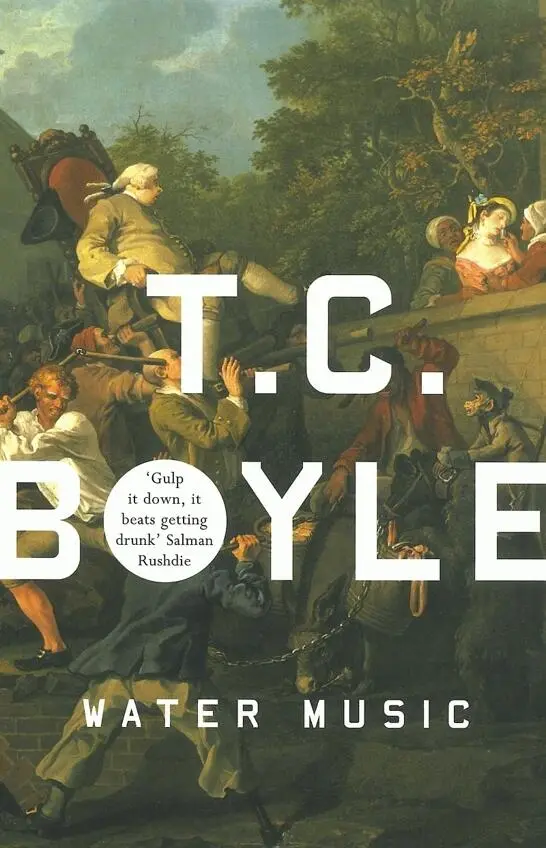
- Название:Water Music
- Автор:
- Издательство:Granta Books
- Жанр:
- Год:1983
- ISBN:9781862071551
- Рейтинг книги:3 / 5. Голосов: 1
-
Избранное:Добавить в избранное
- Отзывы:
-
Ваша оценка:
Water Music: краткое содержание, описание и аннотация
Предлагаем к чтению аннотацию, описание, краткое содержание или предисловие (зависит от того, что написал сам автор книги «Water Music»). Если вы не нашли необходимую информацию о книге — напишите в комментариях, мы постараемся отыскать её.
Water Music — читать онлайн бесплатно полную книгу (весь текст) целиком
Ниже представлен текст книги, разбитый по страницам. Система сохранения места последней прочитанной страницы, позволяет с удобством читать онлайн бесплатно книгу «Water Music», без необходимости каждый раз заново искать на чём Вы остановились. Поставьте закладку, и сможете в любой момент перейти на страницу, на которой закончили чтение.
Интервал:
Закладка:
When he was twenty he led a caravan across the Great Desert. Their destination was Timbuctoo, on the River Niger, sixteen hundred miles to the south. It was a difficult crossing. Sandstorms swallowed them, camels evaporated, wells ran dry. By the time they reached Ghat they’d lost nearly half their number. The sun rippled the horizon, dunes rolled off into the sky like waves on an iron sea. When the wells at Tamanrasset failed them, they fell on one another. Dassoud stood six feet four inches tall, two hundred thirty-five pounds. He was one of the survivors. The other twelve crowded round him. “We’ll make for Taoudenni, in the northern reaches of Ludamar,” he said. “It’s our only chance.”
The oasis of Taoudenni was set in a pocket of basaltic hills that rose up out of the sands like the molars of a half-buried giant. It had been the principal watering stop on the trip from Tamanrasset to Jarra since the days of the Prophet. Its wells were said to be inexhaustible. When the caravan drew within sight of the oasis they had been without water for three days, their eyelids swollen, throats raw. The trade goods — Persian rugs, salt, muskets, kif — trailed out behind them over the dunes, still lashed to the backs of rotting animals. As they approached the wells, the sole surviving camel stumbled and fell, its hoofs pedaling the void. One of the men cried out: impaled on the animal’s foreleg was a human ribcage. The bones clacked and rattled, dice in a cup. The merchants looked round. There were hummocks in the sand — hundreds of them — a hand reaching out here, the back of a skull glistening there. Taoudenni was dry.
Dassoud claimed the camel. Two men challenged him. He killed them both. Then he bled the animal, drinking deep from the open artery and draining the excess into a guerba . He ate the inner organs, the lining of the stomach, moist and raw. When he last saw the others, they were huddled round a crack in the rock where there had once been water.
He traveled by night, unearthing insect larvae, scorpions and beetles by day. He crunched them like nuts, scanning the wind-scrawled dunes, his head gone light, his life at the far end of its tether. This amused him. The more hopeless it became, the stronger he felt. One night, alone in the universe and hopelessly lost, the guerba empty, his tongue sucking at the shell of a scorpion, he realized that he was enjoying himself. The desert was hard. He was harder. If the whim had taken him, he could have turned round and strolled back to Libya.
Two weeks after leaving Taoudenni, Dassoud stumbled across the well at Tarra. He drew a guerba from the depths and drank till he vomited. While vomiting he became aware of a shadow which had fallen over him, a shadow cast by three of Ali’s elite horsemen. They were pointing their muskets at him as he knelt in the sand. Poaching from a well was as heinous a crime among the Moors as kidnapping or having sex with one’s neighbor’s livestock. The penalty was death. Dassoud listened to the click of the hammers. He was starved, dehydrated, exhausted, unarmed. The first man shot him through the elbow, the second brought a scimitar down across his face, the third was easy. When he finished with them he tore the leg from one of the horses, devoured it, and lay down to sleep. The following morning he rode into Benowm, thundered up to Ali’s tent, and offered his services as henchman and human jackal.
ESCAPE! (CONT.)
“Well Jesus Christ, Mary, Joseph and All the Saints,” says Mungo, glancing over his shoulder, “couldn’t you have aimed a little higher?”
“Against my principles.” Johnson is pounding along beside the ass now, his toga soaked through with sweat. “Shot,” he wheezes, “a man once. . back in London. Broke a boy’s heart, uff-uff, never. . forgive myself.”
“Principles?” the explorer echoes, wondering how far principles go toward meliorating an early death.
Behind them, Dassoud shows no sign of letting up. In fact, for the past hour or so he’s been hurling epithets at the explorer’s back, his blade slashing in the sun as if to underscore his meaning. “Uncircumcised!” he roars. “Pig eater!”
Mungo pulls the hat down over his eyes, and has a vision of the kitchen at Selkirk: fresh-cut flowers, cold ham, Ailie smiling up at him, “You ever notice that fellow seems to have it in for me?”
“Ha!” says Johnson, rumbling along. “He hates you. Hates you the way a. . beard hates a. . razor or a balloon hates a. . pin. It’s nature. You. . come onto the scene with your. . your wheaty hair and catty eyes, a freak and a wonder,” he puffs, gasping for breath. “Where you think that leaves him? You might just as well. . expect a trash-yard cur to put up with a lapdog.”
“Oh,” says Mungo.
♦ ♦ ♦
The day wears on, Johnson silent and morose, the muzzle of the explorer’s horse flecked with blood, Dassoud padding along with the grim determination of a wolf running down its quarry. The horse is a problem. The explorer has been sparing it as much as possible by periodically dismounting and jogging the odd mile or two, but for all his effort the animal has been teetering on the verge of collapse for the better part of the afternoon — at one point he had to set its tail afire to keep it going. And Johnson’s ass hasn’t done much better, feigning lameness, bucking and biting, braying like a calliope. No doubt about it — it’s only a matter of time before one animal or the other gives out and Dassoud overtakes them. And then: goodbye Niger, goodbye Africa, so long mortal coil.
But then, just when things look bleakest, Johnson sings out like a shipwrecked sailor descrying a mast on the horizon. “Look!” he crows. “Up there, through the trees!” The explorer looks. There, winding over the wooded hill before them like an erratic seam, is the road to Bambarra. But what’s this? A funnel of dust seems to be hugging the road, the tapered end narrowing away from them. The explorer’s first thought is dustmen — thousands of them — sweeping along the road, but then, like an epiphany, it comes to him: the refugees! They’ve doubled back! “Johnson!” he cries. “You’re a genius!”
This new development, however, has not been lost on Dassoud. The Chief Jackal begins pouring it on, surging at them like a sprinter making for the tape. The gap closes to fifty yards, then forty, Johnson beats the ass, Mungo whips his horse, the gap closes to thirty yards. Then Johnson does a peculiar thing. “An old Mandingo trick,” he shouts, stuffing the ass’s right ear into his mouth and champing down as if he were lashing into an overcooked chop. The ass lets out a screech, bucks twice and then takes off like a three-year-old at the start of the steeplechase. Mungo follows suit, the horse’s ear like a strip of felt laid against his tongue, biting down till he tastes blood. And sure enough, the nag comes to life, galvanizing its last inner resources in a furious scramble of fetlock and hoof.
Johnson and Mungo, ass and nag, rocket over the stony ground through a stand of trees and up onto the road, Johnson shouting out in Mandingo to the ghostly figures emerging from the gloom. Then the ass slashes into the thick of it, neck and neck with the explorer’s mount. Weary refugees leap aside, the hoofs rain on the road, chickens take to the air. A moment later the riders emerge on the far side, galloping along parallel to the roadway. Johnson kicks at the ass, his elbows flapping as if he were trying to take off, the trees a blur, the explorer fighting to keep up. “Now!” shouts Johnson, and they plunge back into the talcum gloom. This time they upset a litter and bowl over a village dignitary with a graven idol tucked under his arm, Johnson all the while jabbering away at the astonished faces: “Slow him down! Stop the Moor!” Twice more they skew from side to side at breakneck speed, pebbles flying, dust raveling out behind them, until Johnson rattles off the road and plunges into the woods, the explorer hot on his heels.
Читать дальшеИнтервал:
Закладка:
Похожие книги на «Water Music»
Представляем Вашему вниманию похожие книги на «Water Music» списком для выбора. Мы отобрали схожую по названию и смыслу литературу в надежде предоставить читателям больше вариантов отыскать новые, интересные, ещё непрочитанные произведения.



Обсуждение, отзывы о книге «Water Music» и просто собственные мнения читателей. Оставьте ваши комментарии, напишите, что Вы думаете о произведении, его смысле или главных героях. Укажите что конкретно понравилось, а что нет, и почему Вы так считаете.