T. Boyle - Water Music
Здесь есть возможность читать онлайн «T. Boyle - Water Music» весь текст электронной книги совершенно бесплатно (целиком полную версию без сокращений). В некоторых случаях можно слушать аудио, скачать через торрент в формате fb2 и присутствует краткое содержание. Год выпуска: 1983, ISBN: 1983, Издательство: Granta Books, Жанр: Современная проза, на английском языке. Описание произведения, (предисловие) а так же отзывы посетителей доступны на портале библиотеки ЛибКат.
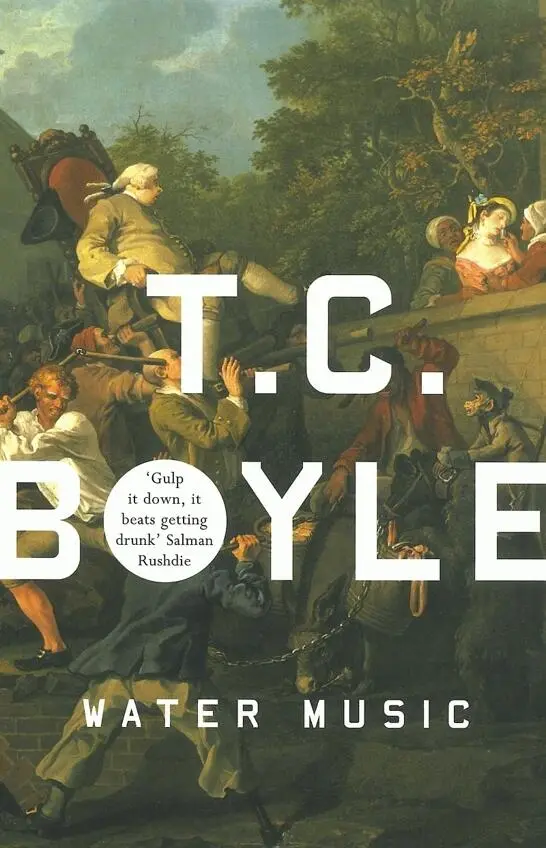
- Название:Water Music
- Автор:
- Издательство:Granta Books
- Жанр:
- Год:1983
- ISBN:9781862071551
- Рейтинг книги:3 / 5. Голосов: 1
-
Избранное:Добавить в избранное
- Отзывы:
-
Ваша оценка:
Water Music: краткое содержание, описание и аннотация
Предлагаем к чтению аннотацию, описание, краткое содержание или предисловие (зависит от того, что написал сам автор книги «Water Music»). Если вы не нашли необходимую информацию о книге — напишите в комментариях, мы постараемся отыскать её.
Water Music — читать онлайн бесплатно полную книгу (весь текст) целиком
Ниже представлен текст книги, разбитый по страницам. Система сохранения места последней прочитанной страницы, позволяет с удобством читать онлайн бесплатно книгу «Water Music», без необходимости каждый раз заново искать на чём Вы остановились. Поставьте закладку, и сможете в любой момент перейти на страницу, на которой закончили чтение.
Интервал:
Закладка:
The explorer turns to survey the scene behind him, trying to decide whether he’s part of a military expedition or a foxhunt, when a sudden flash of light catches his eye in the far distance. It is Johnson, mounted on his doleful blue ass (an animal remarkable for its lugubrious length of muzzle and ear), just now making his way over the lip of the horizon. The explorer raises his arm and waves. And there! — a movement inveigled by the distance and the rippling corrugations of the air — Johnson is waving back!
♦ AEOLIAN♦
Jarra is a town of a thousand wattle huts, give or take a few. It lies just south of the Sahel, on the border of Ludamar, Kaarta and Bambarra. One approaches the town through a series of gentle yeasty hills rising out of the plain like bubbles in batter. This time of year the hills are pocked with blackened stubble, a consequence of the villagers’ burn-and-bloom philosophy. Fires raged here a month ago. Bands of flame coruscating along the dark line of the earth, roiling billows darkening the sky. It went particularly hard on the rats. Legions of them, like migrant lemmings, foaming out of the holocaust and into the path of the entire assembled village. The Jarrans lifted rakes and hoes and cudgels, bursting rats like so much wet pottery. They harvested blood.
These are the grazing lands, broken here and there by close stands of wood — karite, kapioka and two-ball nitta, doum palm and acacia. Beyond them, cultivated fields fan out round the village walls like the upturned palms of sleeping giants, etched and furrowed, patiently waiting to snatch up the first random drops from the sky. There is a river too — the Woobah — now just a succession of puddles seething with tails and scales. It slinks out of the woods as if ashamed of itself, meanders through the village like a drunk, then disappears in the grassland beyond. The rest is just about what you’d expect. Dusty streets, consumptive cattle, women with haunted eyes and children with distended bellies and hunger-bleached hair. These are the hard times, the long lingering days before the rains. Udders dry, grain reserves shot — even the insipid nitta pods in short supply.
Ali and his retinue boom onto the scene in a storm of white dust, scowling and black-bearded, fierce and vain. Villages like this are fair game for the Moors — for Kafirs live here, unbelievers, and not only is it the sacred duty of all good Muslims to spread the word of Allah, but Kafirs are notoriously feeble at defending themselves. Hence: fair game. The illiterate blacks of Jarra — Mandingoes for the most part — fall conveniently into the Kafir category, though nearly all of them have informally adopted the tenets of Islam. The Moors glance down at the prayer rugs, sandals, jubbahs , and then up at the flat black faces. They’re not fooled. To them the Jarrans are a sort of inferior subspecies, nonhuman really, a race designed by Allah to milk the goats and butter the bread of the Chosen People, namely themselves. Thus, Kafir cattle, Kafir children, Kafir women, grain, jewelry, huts, the very clothes on their backs, are considered as properly belonging to the Moors. When Ali’s boys thunder into town, you can be sure it’s not just to see the sights.
On this occasion, however, rapine and plunder are not foremost in Ali’s mind. He has long since established a system of extortion with Jarra and other Kafir towns within his compass. He sells them protection, assessing so much produce and so many bolts of cloth in return. If he gets what he asks, he leaves them alone. If not, he hacks half the villagers to pieces and takes twice as much. The reason for the present visit has nothing to do with protecting the Jarrans from himself, but with protecting them from the Kaartans. A simple case of power politics. Yambo II, the headman of Jarra, had sided with Bambarra in the ongoing conflict between Tiggitty Sego of Kaarta and Mansong of Bambarra. At the time it seemed the expeditious thing to do: Mansong was really tearing them up, hewing to the right, gouging to the left. But since then there had been a number of reversals, the Bambarrans had fallen back, and Tiggitty Sego, mothermurdering mad over the Jarrans’ defection, was now advancing on the town to chastise them. And so Yambo, at the cost of three hundred head of cattle and nineteen virgins under the age of twelve, had hired Ali to bail him out.
♦ ♦ ♦
Long after the dust has settled, the explorer makes his grand entrance. On foot. He is limping slightly, and leading his horse by the rein. During the course of the journey the animal has drooled steadily, bled from the anus, vomited, pitched forward into the dirt twice, and gone lame in three of its four legs. The upshot is that the explorer has had to hoof it himself for the last twenty miles or so. As he hobbles into town, the Jarrans come out to line the streets and scrutinize him. Colorful people: faces like licorice, big hoop earrings, strings of beads and cowrie shells winking in their hair, skirts and sashes pulsing red, yellow and orange like a thousand flags. Colorful, but quiet. There’s not a stir through the entire crowd, not a whisper, not a grin. The meditation room at a Carthusian monastery would have been noisy by comparison. The explorer, thinking he may have overawed them, does his best to look harmless and unassuming. At his side, Johnson bobs along on the blue ass, fat and serene as a potentate. From time to time he raises a chubby palm to salute one of the sirens in the crowd or swat at a fly. Bringing up the rear is Dassoud, strutting along on a charger the size of a park statue. Keeping an eye on things.
The explorer’s immediate desires are pretty basic: a mug of water, a plate of mush, a mat on which to throw his weary bones. Under normal circumstances he would have been provided with all this and more. For the Mandingoes of Jarra are a friendly and hospitable people — they’ve already groomed and watered Ali’s thundering herd, and slaughtered eight bullocks for his dinner. But just as Mungo draws into town, the wind begins kicking up. Kicking up violently in fact. The coattails fly up over his head, his hat lifts off like a kite on an updraft and his ears begin to roar as if someone has suddenly clapped seashells to them. Behind him, the horse whinnies and farts, its mane foaming round its ears. Suddenly a wall collapses with a groan, and a thatched roof takes off like a flock of vultures flushed from the kill. This is wind!
“Whooo!” he says, turning to Johnson. But Johnson, along with Dassoud and everyone else in sight, is bolting headlong in the opposite direction. He stands there, puzzled. “What’s the rush?” he shouts. “It’s nothing but a little breeze.” The wind whistles. The sky goes dark. A hut skitters by. And then he hears it — a harsh sibilance, a spitting ticking release of air, as if all Edinburgh, Glasgow and the Borderlands had turned out to hiss the villain in a melodrama. All at once he’s terrified. He takes to his legs — but too late! WHOMP! The horse blows down. And then he is himself knocked to his knees, suddenly stung in every pore of his body as if he’d blundered into a hive of bees. Sand! It’s a sandstorm!
He scrambles to his feet, the jacket beating round his head like the wings of the devil and all his legions. There is sand in his eyes, his ears, up his nose, down his throat. Suddenly an airborne goat cracks him across the shoulderblades and down he goes again. He fights up, staggering, and an empty calabash rebounds off his head like an asteroid, and then — SLAP! — a guinea hen catches him flush in the face and he’s down for the count.
Up again, down again. This is getting serious. “Help!” he screams. SSSSSS-SSSShhhhhhhhhhhhh! hushes the sand. He can’t breathe, his lungs are filled with it; he’s gone blind, crawling over wind-strewn refuse, minidunes, kettles and spoons, tattered blankets, the corpses of goats or milch cows. Where to go? Is this the way it ends? But then he feels a pressure on the back of his neck, a hand there, an arm. He grabs at the hand and follows it along the ground, creeping like a rodent, the shriek in his ears, things batting at his head, the wild wind clutching at his lungs like a pair of hot tongs. .
Читать дальшеИнтервал:
Закладка:
Похожие книги на «Water Music»
Представляем Вашему вниманию похожие книги на «Water Music» списком для выбора. Мы отобрали схожую по названию и смыслу литературу в надежде предоставить читателям больше вариантов отыскать новые, интересные, ещё непрочитанные произведения.




Обсуждение, отзывы о книге «Water Music» и просто собственные мнения читателей. Оставьте ваши комментарии, напишите, что Вы думаете о произведении, его смысле или главных героях. Укажите что конкретно понравилось, а что нет, и почему Вы так считаете.