T. Boyle - Water Music
Здесь есть возможность читать онлайн «T. Boyle - Water Music» весь текст электронной книги совершенно бесплатно (целиком полную версию без сокращений). В некоторых случаях можно слушать аудио, скачать через торрент в формате fb2 и присутствует краткое содержание. Год выпуска: 1983, ISBN: 1983, Издательство: Granta Books, Жанр: Современная проза, на английском языке. Описание произведения, (предисловие) а так же отзывы посетителей доступны на портале библиотеки ЛибКат.
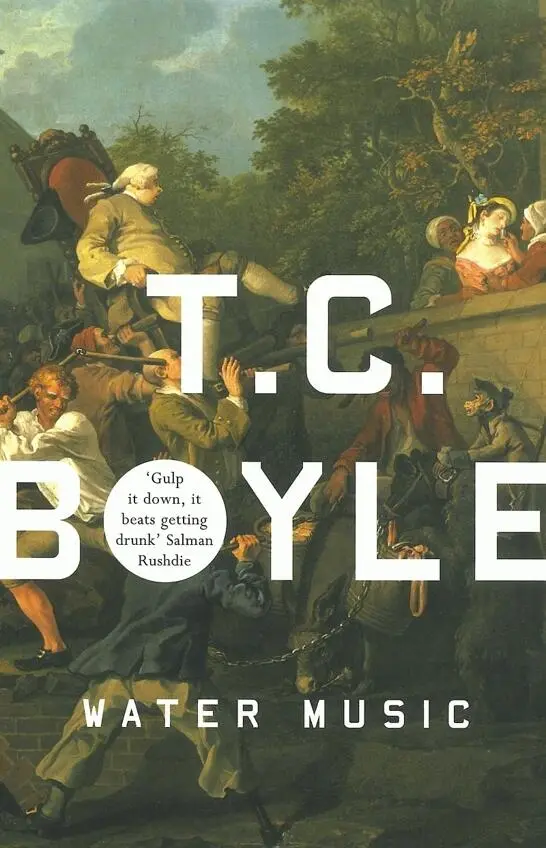
- Название:Water Music
- Автор:
- Издательство:Granta Books
- Жанр:
- Год:1983
- ISBN:9781862071551
- Рейтинг книги:3 / 5. Голосов: 1
-
Избранное:Добавить в избранное
- Отзывы:
-
Ваша оценка:
Water Music: краткое содержание, описание и аннотация
Предлагаем к чтению аннотацию, описание, краткое содержание или предисловие (зависит от того, что написал сам автор книги «Water Music»). Если вы не нашли необходимую информацию о книге — напишите в комментариях, мы постараемся отыскать её.
Water Music — читать онлайн бесплатно полную книгу (весь текст) целиком
Ниже представлен текст книги, разбитый по страницам. Система сохранения места последней прочитанной страницы, позволяет с удобством читать онлайн бесплатно книгу «Water Music», без необходимости каждый раз заново искать на чём Вы остановились. Поставьте закладку, и сможете в любой момент перейти на страницу, на которой закончили чтение.
Интервал:
Закладка:
But if he’s been disappointed in the majority of them, Ned Rise has been a godsend. Sober and industrious, looking out for his fellows’ asses as well as his own, volunteering to scout ahead, palaver with the natives, strike tents, chop wood, haul water. He’s the sort of man who’s not afraid to step in and take charge when something goes wrong and the rest of them are milling around and wringing their hands like schoolgirls or seeking the solution in a bottle of rum, the sort of man who’ll never say die, a scrapper who’s out to conquer Africa rather than lie down and let it devour him. All this, and he’s got a head on his shoulders too. He can read, write and do sums, and he’s had some training in the Classics. Already he’s picked up enough Mandingo to help smooth relations with the locals, sitting in on lengthy bargaining sessions over tolls, right of ingress, routes and distances, tokens, gifts and outright bribes. And there’s no doubting his pluck — just look at the way he scaled that wall at Medina. No, if they were all like Ned Rise, Mungo could rest easy at night.
What with breakdowns of various sorts — asses expiring, soldiers shirking, missing the road and marching for half a day in the wrong direction — the expedition has fallen behind schedule. Held up and let down, it’s taken them nearly a month to reach Dindikoo, gateway to the trackless waste of the Jallonka Wilderness. As they approach the village — a grid of shadow and light cut into a densely wooded hillside — the explorer becomes increasingly agitated. He repeatedly raises himself in his stirrups, fixing on the distant huts and granaries with an intense and exclusive concentration, as if he were afraid they might disappear if he were to look away. His heart is pounding at his ribcage. Superstitious, he crosses his fingers behind his back and utters a short prayer.
They’ve reached an impasse and he alone knows it. Up to this point they’ve been lucky — getting on without a guide, miraculously avoiding further conflict with the natives — but from here on it will be different. If they can’t hire a guide at Dindikoo it’s all over. Because Mungo has decided to trace a new route — along the ridge of the Konkadoo mountains — rather than bear north for the fanatical realms of Kaarta and Ludamar, or risk going south through the Jallonka Wilderness. At least to this point he’s been traveling a famihar road, though it’s been almost eight years and he’s made his share of navigational errors. But to head due east over the mountains. . Mungo doesn’t even want to think about it.
Suddenly he’s swinging round in his saddle and calling out to Zander. “I’m going ahead,” he shouts. “Take charge and bring the coffle into that village in the glen.”
♦ ♦ ♦
Dindikoo. It’s just as he remembered it. Tilled fields jostling with deep umbrageous forests, shade trees spread like parasols over the neat thatched huts with their conical roofs and hard-baked circular walls. Wild begonias and ferns along the road, stumps choked with purple and white convolvuli, a kurrichane thrush massaging the shadows with long liquid glides and quick curt mordents. And the sweet sound of water, a trickle and a rush, from one of the rare magical springs that survives the dry season. Is that hibiscus he smells?
The first person Mungo encounters is a boy of ten or twelve, chubby, dressed in a mini-toga and with a maddeningly familiar expression on his face. Could it be? “You, boy!” he shouts, but the child, surprisingly agile despite his tendency toward endomorphic excess, has vanished into the bush as nimbly as a chevrotain. Odd, the explorer thinks. Must have frightened the bugger. And then dismisses it from his mind as he continues on into town.
A moment later he’s dismounting in a dusty courtyard strewn with palm fronds and woodchips, amid a circle of naked children and broad-beamed women. He smiles. Distributes beads and hard candy. “Remember me?” he asks in his nicest Mandingo. “Mungo Park? The explorer?”
If they remember, no one gives the faintest sign of it. They just press round, hands extended, thirty or forty of them now. Patiently, grinning and bowing to each matron and enthusiastically patting the head of each child, he passes out another round of bead necklaces and all-day suckers. After ten minutes or so his bag of tricks is just about depleted and the women have already turned their backs on him, giggling and chattering among themselves, trading a garnet necklace for a coral, dashing for their huts to gauge the effect of their new jewelry against an old gown. The final customer, Mungo realizes with a start, is the pudgy boy he’d seen on the way in. The short blunt fingers dart out, envelop the sucker and neatly deposit it in a dangling wrist saphie , the boy already glancing away as if to duck a blow. “Wait,” Mungo gasps, catching his arm. ‘‘ Kontong dentegi — what’s your name, son?”
The boy stares down at his feet. Mungo can’t get over how much he looks like Johnson, right down to the cut and texture of his hair, the lay of his ears, the pouting underlip and ironic eyes of the born comedian. “Oyo,” the boy says finally. “Woosaba Oyo.”
Oyo. The name makes the explorer’s blood race. “And your father?”
The boy points to a hut at the far end of the courtyard — yes, of course, the explorer thinks with a sense of déjà vu — it’s Johnson’s hut. Just as he left it. The neat baked half-wall, the high cone of thatched fronds like a Chinaman’s hat, and out back, the fenced alleyways of the wives’ compound and the smaller cones, like a series of volcanic peaks in miniature, that mark the roofs of their huts. Mungo shuffles toward Johnson’s hut as if in a daze, memories flooding back on him, something catching in the back of his throat.
There’s a woman out front, a slave, pounding millet with a pestle the size of a cricket bat. Beside her, splayed out in the dust, a dog the color of ripe banana, its whiskers gently rising and falling with each somnolent breath. The explorer pauses to feed his memory on the rich sensuous detail of the place — on the sights and sounds and especially the smells, isolate and distinct: wild honey, flowers in bloom, hasty pudding with shea butter, fish and oil and woodsmoke. Sodden togas flash on a hemp line, a gray parrot perches nonchalantly on a T bar beside the door. And there, in the shade of the raffia palm — isn’t that Johnson’s youngest wife? Yes. The one he broke the news to, couldn’t have been more than fifteen at the time. He remembers the way she simply turned and ducked into the hut, no sign of emotion, and then kept the town awake through the night with her racking sobs of grief and incomprehension. And here she is, hardly a day older, sitting in the shade at her loom. “Amuta?” the explorer whispers at her back.
She turns to look up at him, no change whatever in her expression. Cicadas drone in the forest. A pair of hornbills clack and honk at one another in the branches overhead. “We’ve been expecting you,” she says, saying it not as if it were a greeting, but a valediction, her voice weary and resigned, giving and taking at the same time. Mungo feels like an interloper, a criminal, bringer of bad tidings and blighter of crops.
Suddenly she’s on her feet and motioning for him to follow. She pauses at the door of the hut, sad and beautiful, her hair bound up in tight corn-row plaits, her eyes like ripe olives. “Go ahead,” she murmurs, and gestures for him to enter.
It is cool and dark inside, a funnel of milky light sifting down from the smoke hole at the top. The floor has been swept clean, the beaten earth smooth as tile. In the center of the hut, a circle of stones and three or four twists of the slow-burning liana the Mandingoes use in place of a lantern at night. To the left, a king-size bed consisting of a bamboo frame and a tightly-stretched bullock’s hide. There are some wicker chairs and a bench, saphies and calabashes dangling from the center pole, a few earthenware vessels grouped in the corner. Just about what you’d expect from any native hut.
Читать дальшеИнтервал:
Закладка:
Похожие книги на «Water Music»
Представляем Вашему вниманию похожие книги на «Water Music» списком для выбора. Мы отобрали схожую по названию и смыслу литературу в надежде предоставить читателям больше вариантов отыскать новые, интересные, ещё непрочитанные произведения.








Обсуждение, отзывы о книге «Water Music» и просто собственные мнения читателей. Оставьте ваши комментарии, напишите, что Вы думаете о произведении, его смысле или главных героях. Укажите что конкретно понравилось, а что нет, и почему Вы так считаете.