T. Boyle - Water Music
Здесь есть возможность читать онлайн «T. Boyle - Water Music» весь текст электронной книги совершенно бесплатно (целиком полную версию без сокращений). В некоторых случаях можно слушать аудио, скачать через торрент в формате fb2 и присутствует краткое содержание. Год выпуска: 1983, ISBN: 1983, Издательство: Granta Books, Жанр: Современная проза, на английском языке. Описание произведения, (предисловие) а так же отзывы посетителей доступны на портале библиотеки ЛибКат.
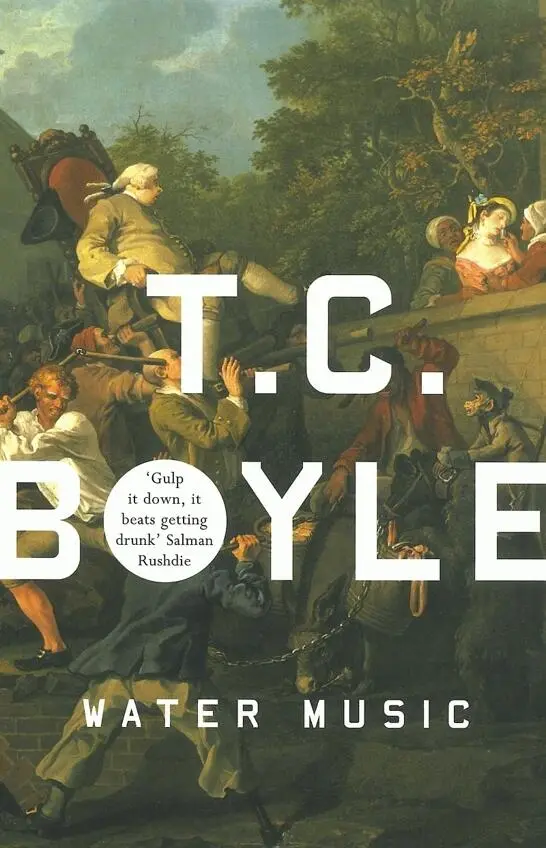
- Название:Water Music
- Автор:
- Издательство:Granta Books
- Жанр:
- Год:1983
- ISBN:9781862071551
- Рейтинг книги:3 / 5. Голосов: 1
-
Избранное:Добавить в избранное
- Отзывы:
-
Ваша оценка:
Water Music: краткое содержание, описание и аннотация
Предлагаем к чтению аннотацию, описание, краткое содержание или предисловие (зависит от того, что написал сам автор книги «Water Music»). Если вы не нашли необходимую информацию о книге — напишите в комментариях, мы постараемся отыскать её.
Water Music — читать онлайн бесплатно полную книгу (весь текст) целиком
Ниже представлен текст книги, разбитый по страницам. Система сохранения места последней прочитанной страницы, позволяет с удобством читать онлайн бесплатно книгу «Water Music», без необходимости каждый раз заново искать на чём Вы остановились. Поставьте закладку, и сможете в любой момент перейти на страницу, на которой закончили чтение.
Интервал:
Закладка:
Ned and Billy step up their pace, hungry for surcease. Thwack-thwack, echo the switches. Clotta-clot, answer the asses’ hoofs. Down a long slow incline and into a basin of green, the road slicing through a cluster of cultivated plots sectioned off by rows of stakes driven into the ground. These are the early crops, nurtured drop by precious drop from the trickle of thirsty wells, emergent leaves pinned to the earth and waiting to burgeon in the driving rains of the monsoon — swaths of sprouting peanuts, yams and sorghum flanked by still, silent fields of maize. Here it is suddenly, a conspiracy of water, chlorophyll and cellulose standing erect and viridescent in the sun, here it is after all those interminable miles of yellowed grass and dehydrated forest, the sight of it reassuring, anodynic, as cool as a compress held to the eyes. Beaming, Boyles turns to his companion: “Pretty, ain’t it, Neddy. Almost like—” He is about to say, “Almost like home,” but doesn’t have the opportunity to round out the sentiment because ass #13, perhaps as wistful and aesthetically gratified in its own asinine way as he himself is, has suddenly veered off the road and made a beeline for the green nirvana trembling before its aching eyes. The defection is duly registered by Ned’s ass, which immediately kicks up its heels and dances round the road as if it’s been stung in the flank. A moment later the animal throws back its bead, bucks off the double load of opera glasses and knives, and lurches after the first with a lusty bray.
“Hey!” Ned shouts. “You come back here!”
“Heel!” Boyles roars.
But to no avail. The asses are already two hundred yards off, up to their withers in greenery and munching away with as little thought or compunction as milch cows set out to pasture.
Mungo is there in a trice. As are about three hundred Medinan farmers with hoes, pitchforks and spears. There is a tumult of voices, hysterical shouts and vehement curses, a confusion of flying feet. The explorer is in the thick of it, lashing out at the errant asses with his riding crop, trampling row upon row of carefully nurtured, irreplaceable and life-sustaining plantlings. Ned and Billy too, running pell-mell through the wide slashing leaves, calling out hopelessly to their asses, frantic to put an end to it, exonerate themselves, pull the world up on its axis and crank it back to the composed misery of five short minutes ago.
But the line’s been breached, the damage done. Swarming like insects, the farmers converge on the first of the asses, inundating the hapless animal in a flurry of flailing hoes and bloody spears. Killer bees, locusts, army ants, they break open the crates and fight over the trade goods, rip the ass’s limbs from the sockets, strip off the skin and butcher it on the spot, already rising up in group frenzy to seek out the rest of the malefactors, equine and human alike. They make short work of the second ass, a thicket of spears sprouting from its hide like the quills of a porcupine, then turn their attention to the mounted explorer. He is thirty yards off, shouting out soothing phrases in Mandingo (“Forgive me for I know not what I do”; “Name your price”; “Looks like rain. .”), while his horse stamps and whinnies. The immediate reaction is disappointing: a deluge of stones, spears and hoes clatters down around him.
By this time a number of the soldiers have come running up the road brandishing muskets and bayonets. M’Keal is roaring threats and racial slurs, and now Martyn is charging over the hill, his horse frothing, sword drawn. Ned manages to make it back to the road, where Walters and Purvey and some of the others have formed a protective circle, but Boyles is tackled and pinned to the earth by two irate little black men in baggy shorts and white toques. “Hold your fire!” Mungo bellows as his horse emerges from the ravaged field, leaves and tassels strewn across its back as if it’s been decorated for a wedding parade.
Ultimately, it’s a standoff. The gathering force of the Royal African Corps on one side, the enraged farmers on the other. Mungo’s men hold their ground, worry written into their faces. The Medinans jeer and pelt them with clods of earth. One man waves a bloody ass haunch as if it were a weapon, while others sport red flannel caps confiscated from Boyles’ baggage. The rest, to a man, are gesticulating with spears and hoes and middle fingers held aloft. “Up yours, white man!” someone shouts in Mandingo, and the whole crowd takes it up, a chant, a slogan, a promise and a platform.
The explorer sits astride his mount, looking out over the massed black heads, the swarms of reinforcements pouring from the city gates. He can’t help feeling that somehow relations with the natives could have got off to a better start. Yes, something’s gone wrong here, he thinks — definitely — as he watches the crowd swell like a blister, new arrivals taking up the chant, the pale flash of Boyles’ face swallowed up in the black mass like a feather in an inkwell.
♦ REQUIEM FOR A DRUNK ♦
“Well, Zander, I guess this is the proof of the pudding, eh? — we’ve got to have a guide. If only to smooth things over. We certainly can’t afford another unfortunate incident like this corn thing.” Mungo draws on his pipe, contemplative. “That was a bad show,” he says after awhile. “For a minute there I thought we were going to have a pitched battle on our hands.”
Zander’s eyes are rimmed with red. He looks worn out, emotionally as well as physically. “But what they did to him — it was worse than barbaric.
It was, it was—”
“They’re savages. Zander. No getting around it.” The explorer is bent over a map, the wall of the tent pink with the setting sun, a dish of lentils and salt beef cooling in the dust beside him. “That’s why we’ve got to get us a dependable black who knows these people and their habits and where the road goes and what village is next and who the headman is. I say we make for Dindikoo, Johnson’s old village. They know me there. Maybe we’d even run across some relative of his — a cousin or a nephew maybe — who’d be willing to go with us.”
Zander is staring down at the knot of his hands. He hasn’t touched his food. “I don’t know,” he says. “I don’t know.”
♦ ♦ ♦
The coffle is camped at Barraconda, five miles up the road from Medina. Even by West African standards, Barraconda’s a pretty sorry place. Forty or fifty huts huddled behind a wall of stakes and thorns, a grassless, shrubless, treeless perimeter pockmarked with the cloven hoofprints of kids and goats, a plethora of bloodsucking flies, a total absence of water. Having got word in advance from Medina, the Barracondans have mewed themselves up in their huts and drawn all the water from their wells. For the soldiers, it is pure hell. Nothing to cook with, nothing for the asses, not even a drop to moisten the lips. Worse: they’ve had to forgo sooloo beer, loose women and a holiday in Medina.
But nobody’s complaining. Not after last night’s sobering encounter and the gut-wrenching horror of the morning.
♦ ♦ ♦
Typically, things had gone from bad to worse in the cornfield the preceding evening. The ranks of the farmers had been almost immediately reinforced by platoons of snarling, frenzied women holding up their wasted infants and shrieking about hard times and loss of faith, the earth dried to powder, barren granaries and empty stomachs. Cripples slithered to the front of the press where they could shake their crutches in the white men’s faces, while local orators set up bamboo platforms and began to denounce everything under the sun in shrill querulous tones. And through it all, the fearful doomsday howling of the town’s dogs.
The combination was too much for Mungo’s stout-hearted men: they were getting nervous. M’Keal was blustering, Martyn within a hair’s breadth of spitting eight or nine skinny farmers on the point of his saber. And the asses, scenting ass blood and squinting out of their big flat eyes at the carcasses of their late companions, began to back off, ears pressed flat, on the verge of stampede. It was Scott who saved the day. He reined in his horse, bumped and jerked his way over to the beleaguered explorer and suggested that they withdraw to the hill behind them and worry about Boyles later. Under the circumstances, Mungo couldn’t help but concur. He gave the order, his voice cracking, and the men fell back in a hail of sticks and stones.
Читать дальшеИнтервал:
Закладка:
Похожие книги на «Water Music»
Представляем Вашему вниманию похожие книги на «Water Music» списком для выбора. Мы отобрали схожую по названию и смыслу литературу в надежде предоставить читателям больше вариантов отыскать новые, интересные, ещё непрочитанные произведения.


Обсуждение, отзывы о книге «Water Music» и просто собственные мнения читателей. Оставьте ваши комментарии, напишите, что Вы думаете о произведении, его смысле или главных героях. Укажите что конкретно понравилось, а что нет, и почему Вы так считаете.