T. Boyle - Water Music
Здесь есть возможность читать онлайн «T. Boyle - Water Music» весь текст электронной книги совершенно бесплатно (целиком полную версию без сокращений). В некоторых случаях можно слушать аудио, скачать через торрент в формате fb2 и присутствует краткое содержание. Год выпуска: 1983, ISBN: 1983, Издательство: Granta Books, Жанр: Современная проза, на английском языке. Описание произведения, (предисловие) а так же отзывы посетителей доступны на портале библиотеки ЛибКат.
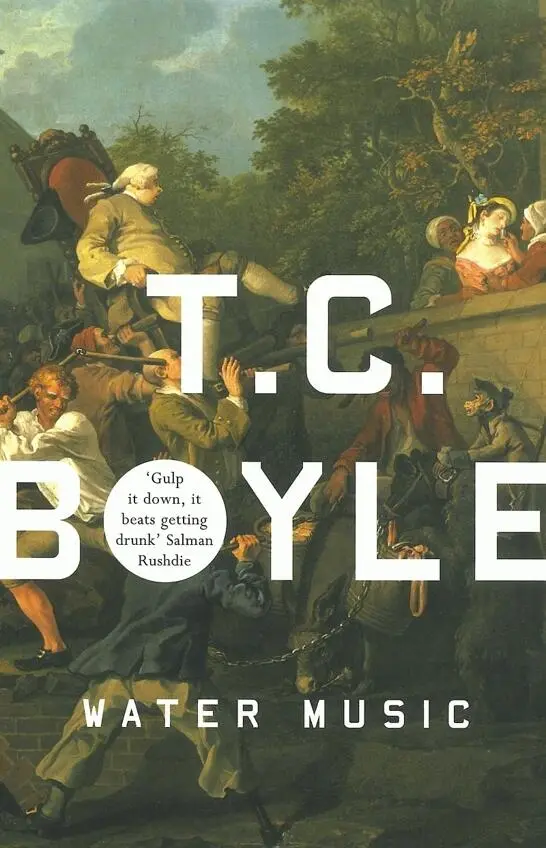
- Название:Water Music
- Автор:
- Издательство:Granta Books
- Жанр:
- Год:1983
- ISBN:9781862071551
- Рейтинг книги:3 / 5. Голосов: 1
-
Избранное:Добавить в избранное
- Отзывы:
-
Ваша оценка:
Water Music: краткое содержание, описание и аннотация
Предлагаем к чтению аннотацию, описание, краткое содержание или предисловие (зависит от того, что написал сам автор книги «Water Music»). Если вы не нашли необходимую информацию о книге — напишите в комментариях, мы постараемся отыскать её.
Water Music — читать онлайн бесплатно полную книгу (весь текст) целиком
Ниже представлен текст книги, разбитый по страницам. Система сохранения места последней прочитанной страницы, позволяет с удобством читать онлайн бесплатно книгу «Water Music», без необходимости каждый раз заново искать на чём Вы остановились. Поставьте закладку, и сможете в любой момент перейти на страницу, на которой закончили чтение.
Интервал:
Закладка:
But what makes this one different, what makes it extraordinary and special, unlike any other hut in the whole of Africa, what makes it Johnson’s hut, is the bookshelf, bathed in overhead light until it looks ghostly and illusory: the bookshelf neatly constructed of bamboo and hemp and lined with the complete works of Shakespeare, quarto volumes, bound in leather. The sight of it somehow overloads the explorer’s glandular system and he feels like crying, a deep ache in his throat and chest. He takes up one of the volumes at random— Othello —and reads:
If virtue no delighted beauty lack,
Your son-in-law is far more fair than black.
Jolly old Johnson, he thinks, shaking his head slowly and deliberately, as if it suddenly weighed two hundred pounds.
He replaces the volume and then notices Johnson’s writing desk — no more than a leaf really — squeezed up against a square shutter cut into the thatch. Slips of papyrus paper, an earthenware jar of quills and a pot of indigo ink: tools of the trade. Never underestimate the power of the written word, Mr. Park , he would say if he were here now, grinning and shuffling and holding up something for the pot. The explorer idly strokes the ink jar, touches a sharpened quill to the tip of his tongue. Lost in reminiscence, he’s only vaguely aware that Amuta has left him alone in the hut, too preoccupied to give much thought to her odd greeting (“We’ve been expecting you.” We who?), oblivious to everything but the sad sweet sensation of fingering Johnson’s artifacts and resurrecting the past.
When he turns round he is almost startled by the figure in the doorway. Backlit, the face in shadow, too squat and wide for Amuta. A man. The stranger steps forward, light on his feet for so squat a fellow, the botanical fringe of his hair silhouetted in the light from the doorway, and for one wild moment — trompe l’oeil — the explorer thinks it is Johnson himself come back from the grave.
“ E ning somo, marhaba ,’’ Mungo says, the traditional greeting.
The voice that comes back at him is so hauntingly familiar it makes his scalp creep and his throat go dry: “ E ning somo, marhaba Park. ’’
Uncanny. The inflection, timbre, tone. But what with the size of the village and all the inbreeding that goes on, who can say? The explorer clears his throat. “Are. . are you a relative of John — I mean of Katunga Oyo’s?”
Black in shadow, black in light, the figure steps deliberately forward until bathed in the golden glow of the smoke hole, at once illuminated and realized, the leading man gliding from the wings to a burst of applause. Suddenly he’s speaking in English: “Relative? No, I wooden say dat.”
Mungo edges closer, the quill still clutched in his hand, blood pounding, adrenalin up, all the voices of rationality, all the sonorous schoolteachers and African Associates and pedantic scientists in safe and sane Great Britain shouting no, no, no. But it is. Yes, yes, yes: it is. Johnson. Johnson in the flesh.
The explorer’s reaction is purely instinctual — he flings himself at the fat little man before him with all the enthusiasm of a freshman home for the holidays. “Johnson!” he cries, vigorously pounding his back and pinching the fleshy shoulders in a crushing embrace, “you should have written, you should have at least. . but you don’t know how good it is to see you, old boy, how good. . but tell me,” stepping back now, “how did you, I mean, I thought—?”
The Mandingo remains perfectly rigid through all of this, making no effort to return the explorer’s embrace, no effort at even the most rudimentary of social signals — he does not smile, he does not offer his hand. He seems so unmoved, so emotionless, that the explorer begins to doubt himself for a minute. Could this be a twin brother? First cousin? But no: it is Johnson. Unmistakably. Past sixty now but looking twenty years younger, his hair sprinkled with salt, fatter than ever. There’s the gold straight pin through his nostril, and there, the look of mock dignity on his face, the look that says you’ve ruffled my feathers, friend, but I’ll consider the case closed if you come up with a calabash of palm wine and maybe a leg of lamb to sweeten my kouskous. He’s seen that look a thousand times. Of course it’s Johnson. “Johnson,” the explorer says, sharp and impatient, as if he were trying to wake someone from a deep sleep, “Johnson: don’t you recognize me?”
The black man looks him dead in the eye. “The name’s Isaaco.”
“Isaaco? What do you mean? Johnson — it’s me, Mungo.” It is then that the explorer realizes what is lacking, the missing element in the composition of Johnson so permanently embedded in his memory: the toga. Spindly-legged and potbellied, his former guide is wearing nothing but a single piece of linen — immaculate as a buck’s neckcloth — swaddled round his loins. Above it — and this is a shock — the great hard ball of his belly is seamed with two ragged horizontal scars, the first clamped across his ribcage like a high-waisted belt, the second obliterating his navel and then skewing off at an angle into the folds of his loincloth, only to reappear, pink and ugly, along the outside of his thigh. Toothy, angular, the scars could have been cut with a stupendous pair of pinking shears.
A wave of pity and revulsion washes over the explorer and he reaches out a tentative consolatory finger, as if to smooth the line of the upper scar.
“I–I didn’t know. I would have done anything, you know that.”
The Mandingo’s eyes are fixed on the smoke hole.
“Johnson—”
The eyes dropping, no hint of amusement, jaw set. “The name is Isaaco.”
♦ FIRST EDITIONS ♦
Johnson/Isaaco is seated on a bullock-hide stool. He is wearing a crimson and indigo toga patterned over with pairs of leering yellow eyes, and he has assumed the lotus position. A cap of the sort worn by British sailors perches on his head. It is made of silk and has been nattily embroidered with gold thread. At his side, Amuta and a steatopygous twelve-year-old in a striped shift. Ranged behind him, alike as bowling pins, a host of retainers and slaves. Johnson, world traveler, wise man and saphie -scribbler, has grown wealthy.
On the other side of the fire, seated in the dirt, are Mungo, Zander, Scott, Martyn — and Ned Rise. The remains of a feast — a rack of lamb, plantain leaves, empty calabashes and yam skins — are scattered round them. Insects and amphibians chirr in the darkness of the surrounding forest, many-voiced, an electric current, and then some higher form of life silences them with a sudden desolate howl. The fire leaps.
“Well, John — er, Isaaco,” Mungo says, hearty as a solicitor with an investment portfolio in his lap, “just what would induce you to come along with us as guide and interpreter?” The explorer raises a cup of hoona tea to his lips. “You can name your price.”
Johnson belches softly into his fist. “You know,” he observes, either by way of non sequitur or homily — the explorer can’t tell which, “when a man finds hisself in dire straits, let’s say clamped ‘tween the jaws of a crocodile like a prime chop. .” (he pauses here to wave down Mungo’s pained objection) “. . he has two options, the way I see it. Abandoned like a worn-out shoe by his friend and employer and left entirely to his own devices, he can either sink or swim. I mean he can give it up and drift off to his eternal reward as a pile of crocodile shit or he can use his brain, know what I mean? Maybe, down there in the crawlin’ ooze with blind grubs and leeches and things already sniffin’ him out and the old croc thinkin’ he got himself one tasty big piece of beef, maybe then he takes his two thumbs like this,” viciously stabbing at the firelight with his erect thumbs, “and maybe he drives ‘em deep into them lidless old eyes, thumbs like daggers, right down to the core of that tiny lizard brain, and then tears back like he was pickin’ apples off a tree. Huh? Now what kind of crocodile is goin’ to hold on after that?”
Читать дальшеИнтервал:
Закладка:
Похожие книги на «Water Music»
Представляем Вашему вниманию похожие книги на «Water Music» списком для выбора. Мы отобрали схожую по названию и смыслу литературу в надежде предоставить читателям больше вариантов отыскать новые, интересные, ещё непрочитанные произведения.





Обсуждение, отзывы о книге «Water Music» и просто собственные мнения читателей. Оставьте ваши комментарии, напишите, что Вы думаете о произведении, его смысле или главных героях. Укажите что конкретно понравилось, а что нет, и почему Вы так считаете.