T. Boyle - Water Music
Здесь есть возможность читать онлайн «T. Boyle - Water Music» весь текст электронной книги совершенно бесплатно (целиком полную версию без сокращений). В некоторых случаях можно слушать аудио, скачать через торрент в формате fb2 и присутствует краткое содержание. Год выпуска: 1983, ISBN: 1983, Издательство: Granta Books, Жанр: Современная проза, на английском языке. Описание произведения, (предисловие) а так же отзывы посетителей доступны на портале библиотеки ЛибКат.
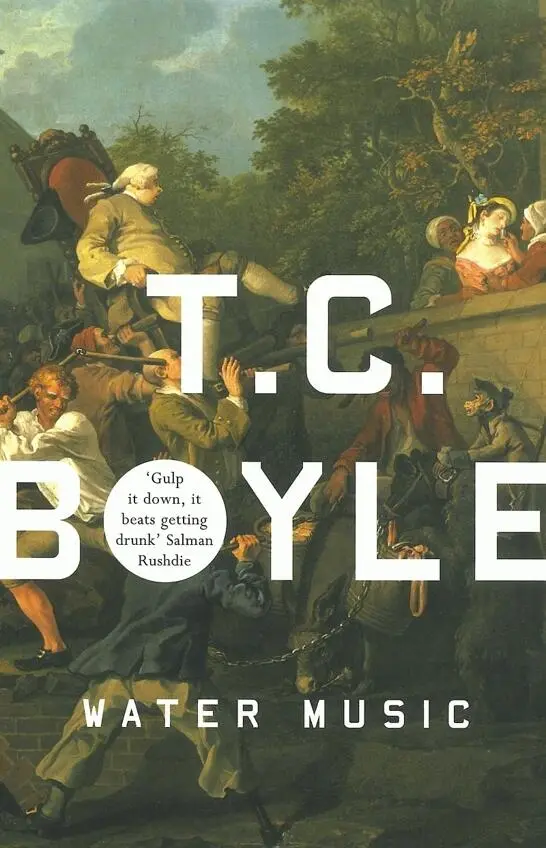
- Название:Water Music
- Автор:
- Издательство:Granta Books
- Жанр:
- Год:1983
- ISBN:9781862071551
- Рейтинг книги:3 / 5. Голосов: 1
-
Избранное:Добавить в избранное
- Отзывы:
-
Ваша оценка:
Water Music: краткое содержание, описание и аннотация
Предлагаем к чтению аннотацию, описание, краткое содержание или предисловие (зависит от того, что написал сам автор книги «Water Music»). Если вы не нашли необходимую информацию о книге — напишите в комментариях, мы постараемся отыскать её.
Water Music — читать онлайн бесплатно полную книгу (весь текст) целиком
Ниже представлен текст книги, разбитый по страницам. Система сохранения места последней прочитанной страницы, позволяет с удобством читать онлайн бесплатно книгу «Water Music», без необходимости каждый раз заново искать на чём Вы остановились. Поставьте закладку, и сможете в любой момент перейти на страницу, на которой закончили чтение.
Интервал:
Закладка:
Ailie is embarrassed. The look on his face as he stood outside her bedroom door on that fateful morning suddenly comes back to her. She tries to rise from the chair but he takes hold of her arm.
“—if anything should happen, you know, and you need help — money, emotional support, anything at all — you can always come to me, because I, I—”
She’s touched. Who wouldn’t be? “That’s very kind of you, Georgie.”
“You can lean on me,” he says.
♦ PUBLIC RELATIONS ♦
No one really has any idea how much an ass can take.
A hundred pounds? Two hundred? Three? Half a dozen sacks of rice? Three kegs of gunpowder and a crate of walnut-framed mirrors in the Queen Anne style? A roll of baft the size of a giant redwood? There is no question that the creature is a beast of burden, that it exists to haul things as surely as a mosquito exists to draw blood. But then why is the animal so ill-tempered, so bristling and recalcitrant?
Even the Foulani assmasters would have to shake their heads over that one. And certainly no one connected with the coffle has even a passing acquaintance with the finer points of an ass’s nature. Least of all Ned Rise. Born and raised in the city, what does he know of solipedous quadrupeds? Or blobber-lipped blackamoors for that matter? Or hundred-and-ten-degree temperatures that bake the brain inside your head as neatly as kidneys in a pie?
What he does know is that the expedition is a shambles. Already. Seven days out of Pisania and confusion is the order of the day: soldiers bitching, negroes pilfering, asses collapsing under the weight of panniers loaded with lead shot. Right from the beginning Ned has had his doubts. First off, they were forced to leave five hundred pounds of rice behind at Pisania because the asses couldn’t handle it. Five hundred pounds. Of food. And yet they loaded up every last scrap of trade goods — red flannel nightcaps, beads and stones, India baft, glass marbles, linen napkins and French crystal — and dozens of sacks filled with tiny white seashells. Loaded it all up so the asses could barely stand. And then there was the curious little problem with the guides and porters: not a single wog, blind, beggared or lame, would go with them. Not for all the beads and baubles in the world. So who has to haul all the excess baggage and drive the asses? You guessed it. Add to that the fact that the great white hero has about as much idea where he’s going as Jemmie Bird, and it’s no wonder you’ve got men straggling all over the road, footsore and pissed through with their own sweat, hollering for double rum rations and red meat for dinner.
So it’s gone ever since they left Pisania. Up at dawn, haggling with splay-nosed harridans over the water at this well or that, loading up the bucking, biting asses and hobbling off down the road, the heat like a fist in the face, like a prizefighter backpedaling and jabbing away at you every step you take. Walk till you drop, then get up and walk some more. When the sun goes down you pitch your tent outside the walls of some mud-and-wattle shithole, and boil up a blackened kettle of rice. If you’re lucky, the white hero haggles with the local niggers and comes up with an emaciated goat or a couple of senile chickens. And then, before you know it, the sun is up and you’re back on the road again.
Ned’s chief responsibility in all this is ass #11. The number is painted in red on the animal’s flank, and again on the double load of opera glasses and Birmingham knives lashed to its back. Across the dusty plains and through the drooping forests pullulating with biting, stinging insects, down ravines and up rises, through the baked and blasted streets of squalid little shanty towns — Samee, Jindey, Kootaconda, Tabajung — up to his neck in river mud, sweat and red dust, still lightheaded from his bout with dysentery and keeping an eye out for Smirke, Ned Rise finds himself following ass #11, step for step and movement for movement, as if he were surgically attached to it, as if he were a suckling babe and this great hairy lop-eared beast were his mother. He plods along, his hand on the ass’s flank, near to fainting with the heat, the stench and the exertion, dodging ass turds and swatting flies. Every once in a while he looks up through a film of sweat to see one of the officers riding by on a fine sturdy Arabian, uniform pressed, a canteen held to his lips.
On this particular day — the seventh day out — it looks as if there’ll be a break in the routine. About four, a rumor goes up and down the length of the coffle: they’re heading into a big town, Medina, capital of Wooli. A thousand huts, somebody whispers. Women, beer and meat. Park’s going to give them a full-day stopover. Though the coffle is spread out in either direction as far as he can see, Ned can sense the effect this rumor has on the men. There’s a lightness in their step, the ass switches fall with a studied regularity, somewhere up ahead someone laughs. Inspired, Ned begins to drive his own ass with a vengeance, anxious to lay his bones down in the shade of a mud-walled hut, take his shoes off and maybe find himself a little negress to massage his feet and groin.
The trail at this juncture winds through a grove of thorn and fig. It is dry, tinder dry, the wood brittle, a fine patina of dust spread over everything. Lions cough in the bush, antelope skitter through the trees like a fall of leaves. As Ned rounds a bend, he spots Boyles up ahead, halfheartedly slapping at his ass’s haunches and poking along like an errant schoolboy. “Hey Billy,” he calls, “wait up a minute, will you?”
Boyles turns to look over his shouder, squinting into the styptic sun, and then flags a hand over his head. “Neddy, hey!” he shouts, subsiding into the bush like a deflated balloon while his ass—#13—pokes at the stiff hastate leaves in the hope of finding something palatable. As Ned comes up, Boyles reaches out a thin wrist to hand him a canteen of rum and water. “Did you hear, Neddy?” he says. “Stick-up-the-arse is going to give us a two-day layover at Medea. Five thousand huts. Cold springs bubbling up out of the ground. And there’s so much sooloo beer they slosh it into the cattle troughs to fatten up their goats and bullocks and the like.”
Sooloo is the only native word in Boyles’ lexicon. But at each village they pass — even if it consists of only three or four brittle bleached-out shacks — he makes good use of it, repeating the word endlessly, in all its permutations of pitch, timbre and syllabic emphasis, all the while pantomiming the libatory sequence from first drink to elation, stupor and collapse. Black faces crowd round him. Smiles break out on fleshy pink lips, teeth flash in the sun. The white man is a traveling circus, a fool, a zany. Kakamamie kea , they laugh. He’s crazy. Before long someone appears with a calabash of beer or mead or palm wine. Boyles puts it to his lips, drains half of it at a gulp and then wobbles his legs and rolls his eyes. The audience roars. Pretty soon a second calabash appears, and then a third. Someone strums a simbing or raps out a rhythm on the tabala , the women begin a shuffling dance, and Boyles helps himself to the liquor. No matter where they are, Billy Boyles, like a thin taper guttering in the wind, manages to stay lit.
During the course of the next two hours, impelled by high hope and rising expectation. Rise and Boyles slowly succeed in passing one man after another until they’ve made their way very nearly to the head of the coffle. Immediately ahead of them is Sergeant M’Keal, striding alongside his ass like a man half his age, stone drunk of course, and roaring out snatches of some obscure regimental song or other. Beyond M’Keal are two other eager beavers — Purvey, it looks like, and can it be? — yes, Shaddy Walters, the cook. Neck and neck, their switches moving like metronomes across the buttocks of their respective asses, panting, wheezing and drooling, existing only for the promise of Medina, that obscure object of desire looming over the hill before them like a vision in a dream. And way up there, halfway to the high, baked, red walls, Park and Scott, drifting along on their chargers, the lovely liquid melodies of Scott’s clarinet hanging in the air like an invitation.
Читать дальшеИнтервал:
Закладка:
Похожие книги на «Water Music»
Представляем Вашему вниманию похожие книги на «Water Music» списком для выбора. Мы отобрали схожую по названию и смыслу литературу в надежде предоставить читателям больше вариантов отыскать новые, интересные, ещё непрочитанные произведения.







Обсуждение, отзывы о книге «Water Music» и просто собственные мнения читателей. Оставьте ваши комментарии, напишите, что Вы думаете о произведении, его смысле или главных героях. Укажите что конкретно понравилось, а что нет, и почему Вы так считаете.