Merce Rodoreda - Death in Spring
Здесь есть возможность читать онлайн «Merce Rodoreda - Death in Spring» весь текст электронной книги совершенно бесплатно (целиком полную версию без сокращений). В некоторых случаях можно слушать аудио, скачать через торрент в формате fb2 и присутствует краткое содержание. Год выпуска: 2009, Издательство: Open Letter, Жанр: Современная проза, на английском языке. Описание произведения, (предисловие) а так же отзывы посетителей доступны на портале библиотеки ЛибКат.
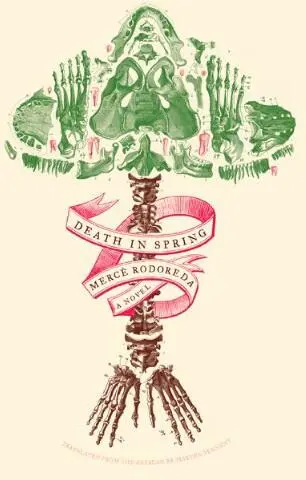
- Название:Death in Spring
- Автор:
- Издательство:Open Letter
- Жанр:
- Год:2009
- ISBN:нет данных
- Рейтинг книги:4 / 5. Голосов: 1
-
Избранное:Добавить в избранное
- Отзывы:
-
Ваша оценка:
Death in Spring: краткое содержание, описание и аннотация
Предлагаем к чтению аннотацию, описание, краткое содержание или предисловие (зависит от того, что написал сам автор книги «Death in Spring»). Если вы не нашли необходимую информацию о книге — напишите в комментариях, мы постараемся отыскать её.
is one of Mercè Rodoreda's most complex and beautifully constructed works. The novel tells the story of the bizarre and destructive customs of a nameless town — burying the dead in trees after filling their mouths with cement to prevent their soul from escaping, or sending a man to swim in the river that courses underneath the town to discover if they will be washed away by a flood — through the eyes of a fourteen-year-old boy who must come to terms with the rhyme and reason of this ritual violence, and with his wild, child-like, and teenaged stepmother, who becomes his playmate. It is through these rituals, and the developing relationships between the boy and the townspeople, that Rodoreda portrays a fully-articulated, though quite disturbing, society.
The horrific rituals, however, stand in stark contrast to the novel’s stunningly poetic language and lush descriptions. Written over a period of twenty years — after Rodoreda was forced into exile following the Spanish Civi War—
is musical and rhythmic, and truly the work of a writer at the height of her powers.
A book for the ages,
can be read as a metaphor for Franco's Spain (or any oppressed society), or as a mythological quest novel. Rodoreda’s last novel is a bold, ambitious statement, and a fitting capstone to her remarkable career.
Death in Spring — читать онлайн бесплатно полную книгу (весь текст) целиком
Ниже представлен текст книги, разбитый по страницам. Система сохранения места последней прочитанной страницы, позволяет с удобством читать онлайн бесплатно книгу «Death in Spring», без необходимости каждый раз заново искать на чём Вы остановились. Поставьте закладку, и сможете в любой момент перейти на страницу, на которой закончили чтение.
Интервал:
Закладка:
V
I was standing before the river, by the marsh, listening to the night. I thought I saw rings in the water. All my being brought the girl to life, brought her to me, her hair pulled high, and when she was almost at my side, it fell loose, down her back. She drew nearer and melted into me as if she and I were fog. She stepped back and took me by the arm with two strong, tiny hands, and we began to walk, we headed toward the water; as we approached it, the river withdrew, farther and farther away, as we walked. I had never walked with anyone like that. My wife and I would stroll hand in hand, or I would put my arm on her shoulder, or she would hold me by the waist, and it was something children did. But the girl from the water stood very close to me, held my arm with both of her hands and laughed. I couldn’t see her face. She didn’t have a face, but she laughed. We walked like that for a long time, toward the dead water at the head of the dry, sandy trail that lay before us. Motionless canes forming a fan-like vault sprouted on both sides of the narrow path, and soon the girl and I would walk through them, unable to see sky or mountain, only leaves. She dropped my arm and stood in front of me, I in front of her. Lips at the level of lips, eyes at the level of eyes, hearts troubled, but it was as if only separation existed, as if the two could never meet. I could feel her bird-breath beseeching tenderness. At that moment I stepped back from the unknown, and my voice, not addressing anyone, whispered very softly, don’t wish for this.
I reached the marsh. At the edge the mud flower grew, a lone flower born without green leaves. There were patches of them. From the damp sprouted a new-green stem, topped by a bud. The bud grew large, the green streaked with the color of crimson dust. One day I had curled up, waiting for the flower to blossom. It made a clicking sound when it opened and the flower released the leaves. I plucked it, and bitter, viscous water spurted from the stem. If you touched it and rubbed your fingers over your lips, you got sores. All of a sudden, I realized what I desired: sorrow. The stones scattered in the mud were like sorrow, patches of sorrow. I turned back. I don’t know how long I wandered about during those nights. The clay figures were dead, destroyed. I was searching for a bond, but I didn’t know what I was searching for or where to look. Now I know, now that my life has come full circle, like a glass ball on the verge of shattering. I waited for dawn to examine myself in the water. With my hand over my mouth, the water reflected grief-filled eyes. The sky was wide, the earth wide, the village small. I clutched a rock, and as if the hand were someone else’s, I struck my forehead. My eyes filled with tears, although I had no wish to cry, and I saw everything as if I were under water, but now salty drops filled my eyes. I raised my arm and gazed at my hand; it wasn’t the hand I wished. I made my way to the blacksmith’s to see his son. He was lying down, touching himself, and I pretended I didn’t see him. To avoid seeing him, I thought about hands: my child’s, Senyor’s, the hands of the old man who had given me the drink. I looked at mine, and the hand didn’t belong to anyone, not to me, or the water, or life, or death. The same as me. My hand, like me.
I had to stop at the slaughterhouse. I was ill and paused by the wall to gaze into the distance. Clouds were coming from the direction of Pedres Altes. I glanced up. Looking at the slowly approaching clouds made me dizzy. I turned round, my face to the wall, and banged my forehead against it. I felt like vomiting, but didn’t. The stench of dead horse rose from the wall, blending with the night air, attempting to restore past things to life, things that could no longer be, things that wished to live again for a moment but could not. I started walking toward my house, afraid I wouldn’t make it. The door was ajar, and I could see a bit of starlight in the courtyard at the end. That’s when they beat me. The voice of the person beating me was telling me to stop wandering at night: if I continued to roam about at night, they would kill me. The words carried the stench of dead horse and the memory of swimming under the village. As the river hurled me along, the breath of that thing that had approached me, causing me to release my grip on the root, bore the stench of dead horse, but I hadn’t recognize it that day because it was accompanied by the smell of water and moss. It was the same malodor from the shadow that had pursued me at Font de la Jonquilla, the same breath. The blacksmith struck me, again and again, until I turned round and knocked him to the floor. He grabbed my legs, trying to pull me down, but there was a door behind me and I let myself fall against it. When he stood up I kicked him, heard him groan. He must have rolled away because I couldn’t find him. Again, he threw himself on me and knocked me senseless.
I woke up feeling I was being watched. I ached all over, like that night by the river while the village went up in flames. They were looking at me. My wife was kneeling in front of me, very close, looking into my eyes, as I had looked into my father’s that afternoon in the courtyard. She moved away when I stirred. Seated with my back to the wall, I bent forward, as if I were searching for a link with life, but the feelings that bound me were like blighted grass, and I leaned back against the wall. When my wife left, I stood up not knowing what to do. I opened the white wooden box that had blackened over the years; inside it lay the old rope and awl. I leaned over, gazing for a long time at the rope and awl, until finally my knees began to hurt. Then I picked up the rope, wrapped it round my wrist three times, and with my free hand followed the rope to the end. But I discovered nothing.
Lightning flashed, followed by a clap of thunder. Before the rain began to fall, more thunder sounded, as if the sky were rent and the lightning had come to cauterize the heavenly wounds. The water fell like a torrent over the house. It rained all night, the sky never tiring until early morning.
VI
I wanted to see the village. The wisteria trunk in front of my empty house bore three incisions that my mother had carved. The men were leaving for work, and I looked them in the face. Never before that morning had I gazed so intently at the faces of the people from my village. The men didn’t look at me, the women did, but I couldn’t discern if the women looked at me with pity or revulsion. The men had dismissed my face from those things that were visible. Old faces, young faces, all of them bear life experiences, as if histories were written on them. Suddenly I could hear a hammer striking the anvil. It was coming from the opposite direction. The last faces were those of three children. I left the village by the stables and headed toward the Pont de Fusta, where three little boys were fighting with sticks. I stopped. Two of them were running about, but one knew how to dodge the blows without moving and strike the others. The one delivering blows had a long, narrow face with little eyes and a low forehead. The other two had round faces, large ears, and desperate eyes. I started across the bridge, but I came to a halt when I reached the center. The day was limpid, the sky and water young, the dark mountains sharply outlined against the sky. The day was so clear I could almost count the trees on the farthest mountains. I retraced my steps. The little boys were still fighting. When they saw I was returning, they stopped fighting for a moment, and I covered my eyes with my arm. One of the round-faced boys came and stood by me, and when I began to walk, he did too. Soon he left me because I was moving slowly. He trudged in front of me, but stayed close by. From time to time he twisted round, searching for my feet, and when he had seen them, he would turn his back to me. At the horse enclosure, I stopped to contemplate Maraldina, the Muntanyes Morades, and Senyor’s mountain with the still green ivy. It was tiring to look that far away. In my pocket I carried the awl my mother had used to pierce my ears when I was little. You can have everything you want, but accompanied by pain, until you learn not to want anything. I had found it in the box where my wife kept the ropes. I paused to look at the grazing horses, their coats shiny, eyes entranced. I turned back round and the little boy was standing firmly in front of me, his head up, staring at me. The sun was falling on the esplanade of Pedres Baixes. Behind Pedres Altes it was all grey, everything was lost in the greyness where the watchmen lived with the tiny horses whose tails reached the ground. The little boy continued on his way in front of me, but he turned round from time to time, until we parted at the end of the horse enclosure. When I looked he was far away, and I could barely make out the dead tree on Maraldina because of the curve in the Festa esplanade. When I reached the bend in the river, I searched for the place where I had crossed the first time. I remembered a shrub on the left, but it has disappeared. I knew the shrub was there that day because at first I had planned to leave my clothes beside it rather than by the tree. Many trees were now scattered about the area. Close to the water, I found a spot I didn’t remember: long and narrow, covered with large, very white pebbles. Where had I crossed? Memory plays tricks on us. The man who killed the serpent had died at the bend in the river, trampled by his horse; I didn’t know it the first time I swam across. He and his horse had been one and the same as they chased the serpent; then they became two. I was looking for some small sign, whatever it was that could help me find where I had crossed. I strolled up and down, occasionally placing my arm in front of my eyes because the light was getting stronger and I couldn’t bear the glare. I undressed and sat naked, my back against a tree, feeling the support. To my left, in front of the marsh, lay the mud-flower pond. To my right, at a distance, the canes by the esplanade. The morning was dead, the canes swaying, and in the daylight the green water was almost colorless. Water got in my eyes. Soon the blacksmith’s house would be ready, as well as everyone else’s; the horses would neigh on moonlit nights and the blacksmith’s son would respond and the man would be. Water got in my eyes; the river was very broad in that spot. Calm, but very broad. Shiny flecks on the sun-splashed water, darkly mottled where there was no sun. When I got out, I sat down to rest. I would have wished for things to come, but things did not come. The grasses were breathing, enjoying the moment; I was breathing only from exhaustion, having swum the breadth of the river.
Читать дальшеИнтервал:
Закладка:
Похожие книги на «Death in Spring»
Представляем Вашему вниманию похожие книги на «Death in Spring» списком для выбора. Мы отобрали схожую по названию и смыслу литературу в надежде предоставить читателям больше вариантов отыскать новые, интересные, ещё непрочитанные произведения.


Обсуждение, отзывы о книге «Death in Spring» и просто собственные мнения читателей. Оставьте ваши комментарии, напишите, что Вы думаете о произведении, его смысле или главных героях. Укажите что конкретно понравилось, а что нет, и почему Вы так считаете.