Aleksandar Tisma - The Book of Blam
Здесь есть возможность читать онлайн «Aleksandar Tisma - The Book of Blam» весь текст электронной книги совершенно бесплатно (целиком полную версию без сокращений). В некоторых случаях можно слушать аудио, скачать через торрент в формате fb2 и присутствует краткое содержание. Год выпуска: 2016, Издательство: NYRB Classics, Жанр: Современная проза, на английском языке. Описание произведения, (предисловие) а так же отзывы посетителей доступны на портале библиотеки ЛибКат.
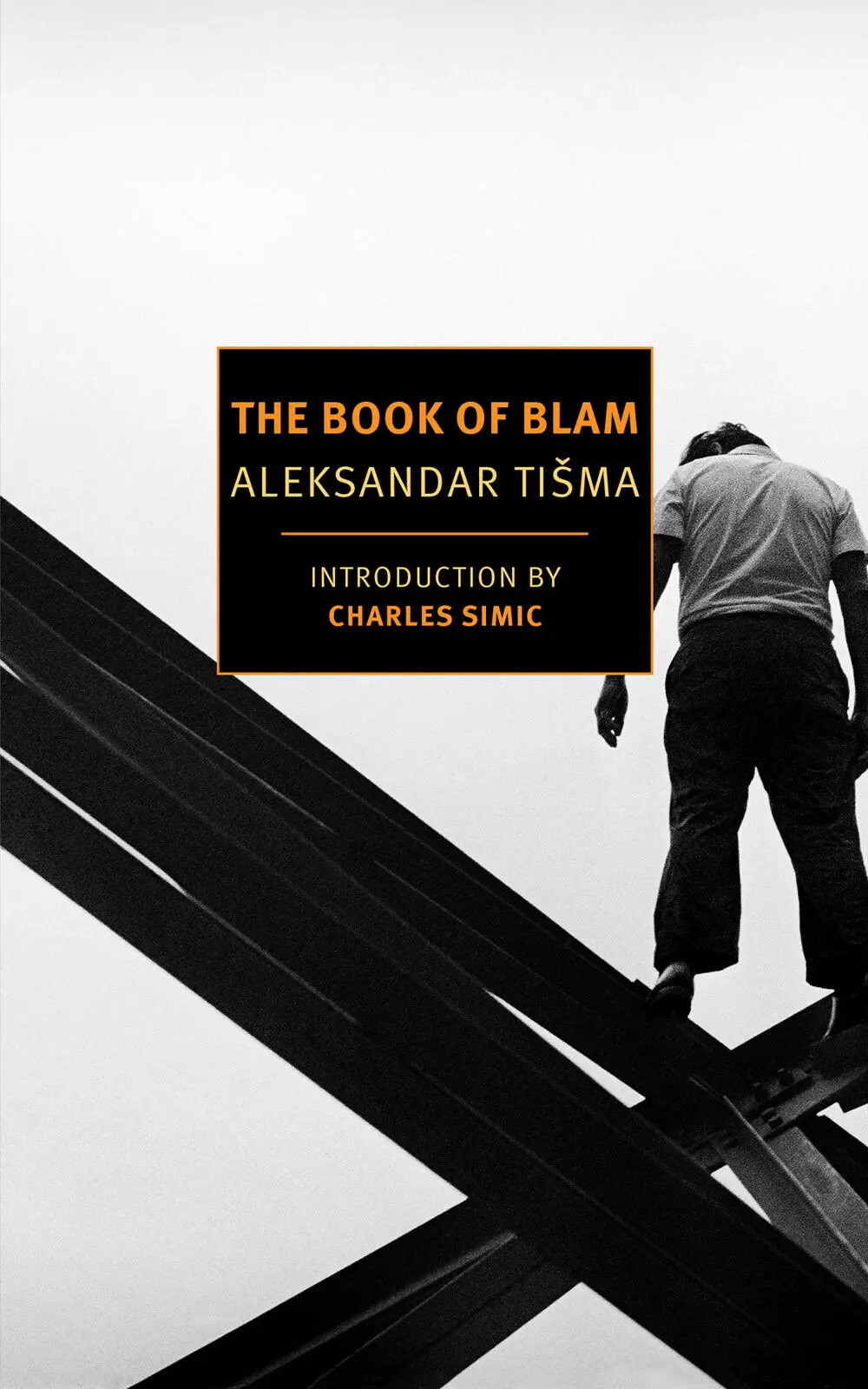
- Название:The Book of Blam
- Автор:
- Издательство:NYRB Classics
- Жанр:
- Год:2016
- ISBN:нет данных
- Рейтинг книги:5 / 5. Голосов: 1
-
Избранное:Добавить в избранное
- Отзывы:
-
Ваша оценка:
The Book of Blam: краткое содержание, описание и аннотация
Предлагаем к чтению аннотацию, описание, краткое содержание или предисловие (зависит от того, что написал сам автор книги «The Book of Blam»). Если вы не нашли необходимую информацию о книге — напишите в комментариях, мы постараемся отыскать её.
The Book of Blam — читать онлайн бесплатно полную книгу (весь текст) целиком
Ниже представлен текст книги, разбитый по страницам. Система сохранения места последней прочитанной страницы, позволяет с удобством читать онлайн бесплатно книгу «The Book of Blam», без необходимости каждый раз заново искать на чём Вы остановились. Поставьте закладку, и сможете в любой момент перейти на страницу, на которой закончили чтение.
Интервал:
Закладка:
Chapter Ten
IN THE Naše novine Christmas issue for 1941, the first year of the Occupation, the paper’s cub reporter, Tihomir Savić, published a full-page feature entitled “The Life and Times of Our Editorial Board.” It is written in a jocular tone, as befits both occasion and subject matter, and illustrated by five portraits (four men and one woman) from the pen of an anonymous artist with a fluent, cartoonlike hand. The article begins with a description of the office: three rooms crammed with desks and piles of newspapers, proofs, and printing plates and populated by a small army of newspapermen scribbling, dictating, talking over the phone to correspondents, assigning articles, accepting advertisements. The article goes on to introduce the members of the team separately — sketch and text, sketch and text, and so on, down the line. First comes Predrag Popadić, who is characterized as invariably well-groomed (his sketch shows him with an arrow-straight mustache over a sarcastic smile, shiny, wavy hair, and a tie perfectly tied) and coolheaded, never losing his equilibrium, not even if he is short of material for the next issue, in which case he sends a cub reporter — Tihomir Savić, say — to some “scene of the crime” or other, knowing Savić will not dare to show his face without a scoop. The subject of the second sketch, a large-nosed profile with hair sticking out behind the ear, is the chief political commentator; he is described as morose and laconic, always off in his dream world. The next, who has a round, bald head, a double chin, and two dots for a nose, is the editor for national news. He is known for injecting a note of levity into the tensions of life at the paper. Then comes a good-natured, bovine face with eyes slanting downward and a bow tie under a wiry neck. It belongs to the editor of the games and children’s page, who is in fact a confirmed bachelor with no hearth or home, a connoisseur of cafés and streets after dark. The only woman — who is pictured with heart-shaped lips, long eyelashes, and a turned-up nose — is said to be not only the fastest typist in Novi Sad but also capable of brewing the most divine coffee and winding the most ornery customer around her little finger. And finally the boyish face, all eyeglasses and flowing hair, belongs to Tihomir Savić himself, who is so young that he still believes in the beauty of life: in addition to the articles that put food on his table, he writes poetry in the wee hours of the night.
Notwithstanding the superficiality of the texts and accompanying drawings, they give a recognizable if one-sided picture of their subjects, but, then, Naše novine looks at everything one-sidedly. The other side is lies and coverups, a willingness to whitewash reality — to preserve a little place sheltered from reality — with a non-existent harmony and meaning. The editors will eventually pay for that other side: the editor-in-chief, the chief political commentator, and the national news editor will be shot for collaborating with the enemy; the editor of the games and children’s page will be sentenced to hard labor and die in prison; and the sweet young typist and reporter poet, who marry the following year, will escape with the retreating German troops and end up running a bed and breakfast in Australia.
Nothing Savić’s article describes is left in Novi Sad today but the premises he evokes in the opening passage: the three rooms above the Avala overlooking the courtyard, then as now bustling with filmgoers before the matinees and evening shows. Immediately after the war came to an end and Naše novine closed up shop, the space was occupied by a young partisan officer and commissar who used it to entertain transient Comrades and local girls, but he was soon replaced by a higher ranking officer and his family. Next, the entire floor — the entire building, in fact — came under the management of the cinema, which was ordered by the local command to find the officer another apartment. From then on, Naše novine ’s former premises resounded once more with ringing phones and clacking typewriters, though the staff was of course different: two young women — one newly married, the other, a cashier with a trace of a mustache and newly divorced — and a middle-aged family man, a former gymnast with a stiff, dignified way about him. But if a current-day reporter decided to do a feature on them, he might well come up with similar portraits; indeed, even the side of their characters omitted from the feature — their tendency to lie, though now in the more innocent guise of providing fantasies on the silver screen — could be seen as unchanged. Which confirms both the stability of the human condition and the futility of the word as a means of exposing it.
WHILE TIHOMIR SAVIĆ was hard at work on his Christmas feature, Blam spent a good deal of time just below Savić’s windows in the courtyard of the Avala. These were the weeks immediately following Blam’s marriage and Estera’s death, a time when his summer fever of rebellious expectation, fear, and hope gave way to shock. It was in a state of shock that he made the daily but brief, tongue-tied visits to his mother and father, trying to comfort them but knowing he could be of no help, not even by reminding them of his existence as a son, a druglike substitute for the object of their attention. In addition to the state of shock, which he fought, he had a numb drunken feeling, which he embraced. He saw Estera’s death — so sudden, dramatic, and out of character with the person he knew, yet so inexorably real — as the end of a period of wanderings, false hopes, and vain psychological schemes. Death was something Blam now found everywhere, in every word, movement, and newspaper report, in the patrols in the streets, the flags flying, the guards and weapons making their appearance everywhere. Anything outside those clear signs of destruction — the visits he paid to his parents, for instance — was merely an opiate, a means of putting death out of his mind for a while and thus letting it come more quickly, easily, painlessly.
The most effective opiate was his work at the travel agency: it was so hopelessly dull that during the eight hours it lasted, it precluded all thoughts of the existence of the other, absolute hopelessness. The moment he set off for home, however, the effect wore off like that of a bad medicine. At home he would find Janja waiting for him, but not the Janja of the summer vision, not Janja at the pump, hot and unkempt, who could have whipped up the frenzy he so longed for. Instead, he found the Janja he later observed from the tram, the hard and self-assured Janja who had whipped up her own frenzy with no thought of him, with her own life, her own apartment, her own job, her own lover, and everything that went with them, a Janja who, without ever having opened up to him, or softened, or brought to life the picture of her he carried with him, had taken leave of him every bit as inexorably as he had taken his leave of life.
This double image of the end proved too much for him: it drove him out of the house, into the streets, and not in search of hints or clues, as in the summer, because by now the guessing game had become a disease, a preparation for death. No, now he wandered aimlessly, looking neither left nor right, not thinking, or trying not to think, using all the strength of his legs and the warmth of his insides to push on through the cold and the sleet. He avoided human contact, especially friends, because the sight of a familiar face only called forth new visions of destruction. And yet, or perhaps as a consequence, he tended to choose the busiest parts of town for his wandering, places where people were crowds rather than individuals, impersonal, purely physical, and their moving, surging, pushing brought the fatigue he desired, like the wet snow and fierce wind. And so every day he made his way to the Avala. And one day he ran into Čutura again.
Читать дальшеИнтервал:
Закладка:
Похожие книги на «The Book of Blam»
Представляем Вашему вниманию похожие книги на «The Book of Blam» списком для выбора. Мы отобрали схожую по названию и смыслу литературу в надежде предоставить читателям больше вариантов отыскать новые, интересные, ещё непрочитанные произведения.









Обсуждение, отзывы о книге «The Book of Blam» и просто собственные мнения читателей. Оставьте ваши комментарии, напишите, что Вы думаете о произведении, его смысле или главных героях. Укажите что конкретно понравилось, а что нет, и почему Вы так считаете.