Jonathan Levi - Septimania
Здесь есть возможность читать онлайн «Jonathan Levi - Septimania» весь текст электронной книги совершенно бесплатно (целиком полную версию без сокращений). В некоторых случаях можно слушать аудио, скачать через торрент в формате fb2 и присутствует краткое содержание. Год выпуска: 2016, Издательство: The Overlook Press, Жанр: Современная проза, на английском языке. Описание произведения, (предисловие) а так же отзывы посетителей доступны на портале библиотеки ЛибКат.
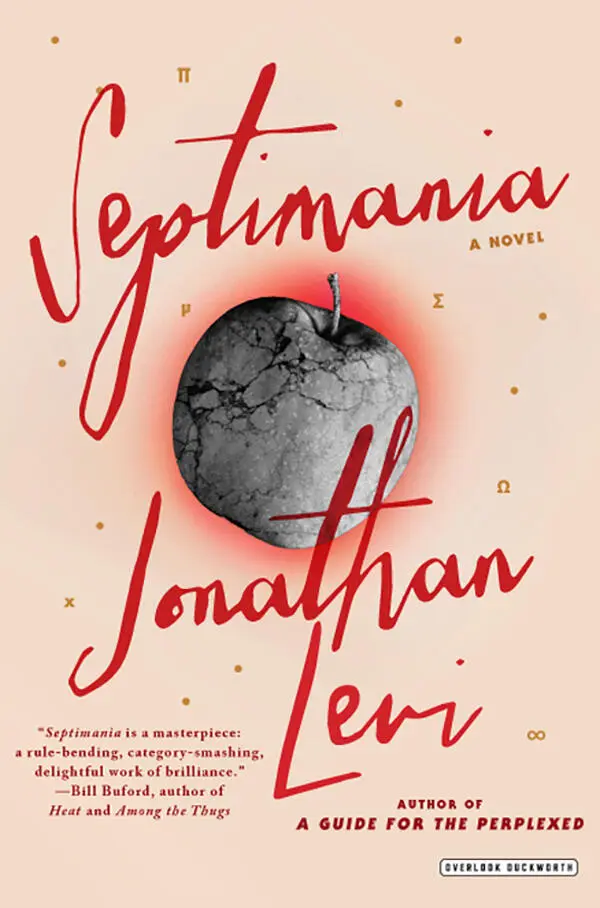
- Название:Septimania
- Автор:
- Издательство:The Overlook Press
- Жанр:
- Год:2016
- ISBN:нет данных
- Рейтинг книги:4 / 5. Голосов: 1
-
Избранное:Добавить в избранное
- Отзывы:
-
Ваша оценка:
Septimania: краткое содержание, описание и аннотация
Предлагаем к чтению аннотацию, описание, краткое содержание или предисловие (зависит от того, что написал сам автор книги «Septimania»). Если вы не нашли необходимую информацию о книге — напишите в комментариях, мы постараемся отыскать её.
Over the next fifty years, Malory’s search for Louiza leads to encounters with Pope John Paul II, a band of lost Romanians, a magical Bernini statue, Haroun al Rashid of Arabian Nights fame, an elephant that changes color, a shadowy U.S. spy agency and one of the 9/11 bombers, an appleseed from the original Tree of Knowledge, and the secret history of Isaac Newton and his discovery of a Grand Unified Theory that explains everything. It is the quest of a Candide for love and knowledge, and the ultimate discovery that they may be unified after all.
Septimania — читать онлайн бесплатно полную книгу (весь текст) целиком
Ниже представлен текст книги, разбитый по страницам. Система сохранения места последней прочитанной страницы, позволяет с удобством читать онлайн бесплатно книгу «Septimania», без необходимости каждый раз заново искать на чём Вы остановились. Поставьте закладку, и сможете в любой момент перейти на страницу, на которой закончили чтение.
Интервал:
Закладка:
“ Nel mezzo del cammin di nostra vita ,” Tibor quoted to whomever would listen. “We got off the plane in the middle of the flight, and that particular yellow line suits us just fine.”
Much of the truth of Tibor’s story was veiled in cigarette smoke, but no one dared contradict Tibor when he was in voice. The paw that Tibor had first placed on Malory’s shoulder, that Transylvanian crag of a hand, was nothing compared to the force that hogtied the Bomb Squad, the Nurses, and any others he corralled into the garden of the Dacia with his stories. Malory was as happy as the rest of them to recline on the paternal speechifying of Tibor.
Cristina, as Principessa , held her own court and followed a different protocol. Cristina never had to queue for auditions. She arrived in Rome to three well-paying jobs — cleaning a Canadian journalist’s office in Piazza Barberini, wiping the noses and bottoms of four-year-olds in an asilo on the Via Sistina, and preparing lunch for a lonely fiddle maker in an attico off Piazza Navona twice a week. Cristina never followed Tibor on his evening tours of the garden. Cristina perched gray-eyed on a sprung sofa off the kitchen, smoking a filtered cigarette of exotic origin. Some evenings, she would look over to Malory, and Malory would join her. He didn’t smoke. But he shared their loss in a silence that he hoped gave her as much comfort as it gave him. And sometime during the evening — before dinner, during, or most often once the dishes had been piled up in the Dacia bathtub — Cristina would stand up from the sprung sofa. The Bomb Squad, or occasionally a non-Rumanian guest, would strike a guitar or a zither or a drum, and Cristina and the Nurses would throw on costume boas or army greatcoats or strip down to their Weimar nighties and perform a post-Brechtian, pre-Madonna cabaret with a determined chaos that, for at least a little while, helped all of them forget the daily indignities of exile.
Malory expected it would be a matter of days until the Bomb Squad found Louiza and their child. But as the rains of November rose higher up the embankment of the Tevere, overflowing the Isola Tiberina and threatening the trees along the upriver prow and the more untraveled cargo holds of the Ospedale Fatebenefratelli, as the rains of December drove Tibor’s Divine Comedy rehearsals under sheets of plastic and corrugated scrap, the Bomb Squad returned every evening to the Dacia without a single wisp of fair hair or dyslexic, mathematical clue.
“Sometimes,” Radu said to Malory one evening, wiping the rain off his glasses with the sleeve of Malory’s jacket, “you get closer to your treasure by figuring out where it definitely is not.” Malory put his own palm on Radu’s shoulder. Perhaps he had lost, perhaps they all had lost at least as much as Malory and had even less of a chance of recovery. “Some bombs are hidden very deep.”
“Accidental discovery, mio Principe. ” Settimio listened every morning at breakfast, as he served Malory his Earl Grey and scones in front of the statues of Newton and the Woman and the Apple, as Malory recounted the previous evening’s Tales from the Dacia. “The history of man, and I suspect nature in general, is one of accidental discovery, finding something precious while looking for something else.”
“But don’t you understand? I don’t want anything else.”
Settimio knew that the cure for petulance was to be found in the Sanctum Sanctorum. And during the days — while Malory waited for the evening summons to the Dacia and hope of news from the Bomb Squad — Settimio profited from Malory’s other passions and cushioned him with manuscripts around the seven-sided desk.
One of those mornings, the day before Christmas, Settimio appeared at the padded door of the Sanctum Sanctorum.
“ Mio Principe .”
Malory had been examining the manuscript of Newton’s Principia— although he found himself taking frequent breaks to read back over Haroun al Rashid’s encounters with the daughter of Charlemagne. He placed a slip of paper into the book, slightly embarrassed that Settimio might have found him out, and looked up.
“You may recall Fra Mario. From the Dominicans. Santa Maria …”
“Of course!” Malory said, climbing up from the stables of the Jewish butcher back to memories of an organ left untuned and a girl left unfound.
“Fra Mario rang,” Settimio said, “on the telephone, a moment ago. A young lady, he said.”
Malory jumped up — less petulant now — and headed towards Settimio and the padding. He had known, at least he had hoped that, even if his own gravity was insufficient, the bulk of Santa Maria sopra Minerva might pull Louiza back to its pews and end his two months of anxiety and search. This was better than any voyage of transformation.
“Not that young lady, purtroppo, ” Settimio said. “A young Italian lady. Quite insistent. Fra Mario said that she must see you at once.”
“Italian?” Malory asked. “I don’t know any young Italian ladies.”
But when fifteen minutes later the Driver parked the Vespa in the Via del Beato Angelico and escorted Malory through the rear entrance of Santa Maria, past Michelangelo’s Salvatore , past the tomb of the anorexic Santa Caterina and past the pew below the organ where he had last found Louiza, the copper curls bobbing above the gate of the Carafa Chapel reminded Malory that yes, indeed, he did know one Italian lady.
“Malory,” Antonella whispered — but with the same enthusiasm she used to serve him biscuits and tea in the Maths Faculty. Malory hugged Antonella back — not caring that the Lippi Madonna was looking down at him with contempt — happy, grateful at this very fleshy reminder of a life before his landing on the planet of Septimania. “Look at you!” Antonella said finally, releasing him only to hold him at the length of a nose and a little more. “What a change.”
“Well, yes,” Malory said, “a haircut, a few new clothes …”
“No, no,” Antonella said. “Your eyes, Malory. They are — they have become so vulnerable. You have seen a few ghosts since the last time you drank tea with your Antonella.”
“You’re in Rome for Christmas? To see family?” Malory asked, trying to ignore the warmth of both her sympathy and the scent of lavender that came off her hair. I should invite her out for tea or coffee, he thought, without knowing where or how. The Villa Septimania was out of the question, and Malory hadn’t ever drunk tea or coffee outside the villa.
“To see you, my Malory. Only you.”
“Me?”
“To bring you news.”
“About Louiza?” Malory couldn’t help himself, although he wished he’d been slightly more discreet and kept up the pretense of interest in Antonella herself for just a few more minutes. Antonella looked at Malory and at Malory’s curiosity. His need to know, far beyond any normal curiosity, kept him looking into her eyes. The mid-afternoon light shone blue around Antonella’s red curls. Above that halo, Lippi’s Annunciation ballooned in illustration — closer than when Malory had looked above Louiza’s head back in October and seen her face in the pale oval of the Madonna. Now it was the curls of the Angel, come to give good news to the Madonna, that Malory saw reflected in the hairdo of the Italian girl before him.
“Be careful,” Antonella said.
“Careful of what?” Had this been the good news the Angel gave Mary?
“When you left Cambridge,” Antonella said, “there were many Americans who stopped by the Faculty.”
“Looking for Louiza?”
Antonella kept her gaze fixed on Malory.
“I know this is the last thing you want to hear from your Antonella, my Malory. Forget Louiza. Please, for your own safety.”
Читать дальшеИнтервал:
Закладка:
Похожие книги на «Septimania»
Представляем Вашему вниманию похожие книги на «Septimania» списком для выбора. Мы отобрали схожую по названию и смыслу литературу в надежде предоставить читателям больше вариантов отыскать новые, интересные, ещё непрочитанные произведения.











Обсуждение, отзывы о книге «Septimania» и просто собственные мнения читателей. Оставьте ваши комментарии, напишите, что Вы думаете о произведении, его смысле или главных героях. Укажите что конкретно понравилось, а что нет, и почему Вы так считаете.