Jonathan Levi - Septimania
Здесь есть возможность читать онлайн «Jonathan Levi - Septimania» весь текст электронной книги совершенно бесплатно (целиком полную версию без сокращений). В некоторых случаях можно слушать аудио, скачать через торрент в формате fb2 и присутствует краткое содержание. Год выпуска: 2016, Издательство: The Overlook Press, Жанр: Современная проза, на английском языке. Описание произведения, (предисловие) а так же отзывы посетителей доступны на портале библиотеки ЛибКат.
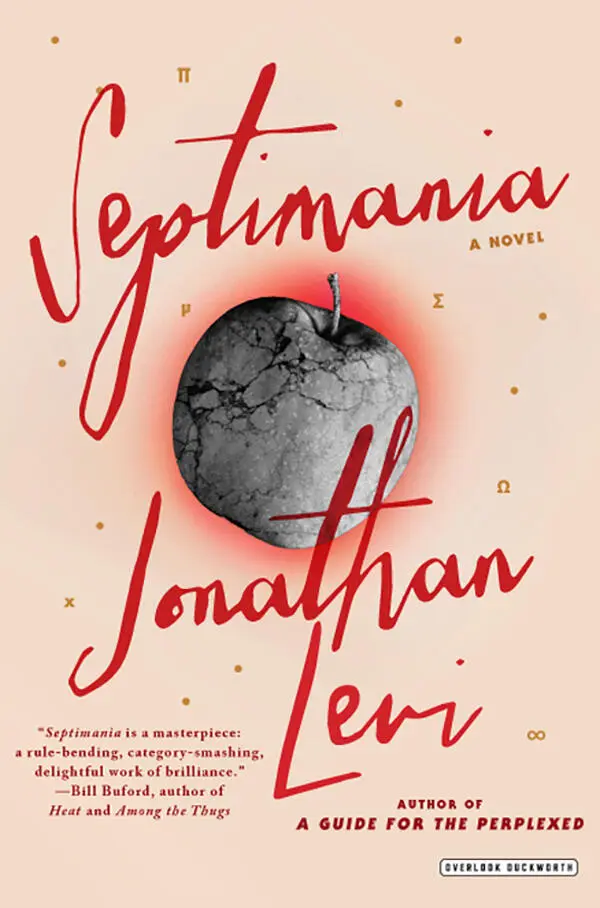
- Название:Septimania
- Автор:
- Издательство:The Overlook Press
- Жанр:
- Год:2016
- ISBN:нет данных
- Рейтинг книги:4 / 5. Голосов: 1
-
Избранное:Добавить в избранное
- Отзывы:
-
Ваша оценка:
Septimania: краткое содержание, описание и аннотация
Предлагаем к чтению аннотацию, описание, краткое содержание или предисловие (зависит от того, что написал сам автор книги «Septimania»). Если вы не нашли необходимую информацию о книге — напишите в комментариях, мы постараемся отыскать её.
Over the next fifty years, Malory’s search for Louiza leads to encounters with Pope John Paul II, a band of lost Romanians, a magical Bernini statue, Haroun al Rashid of Arabian Nights fame, an elephant that changes color, a shadowy U.S. spy agency and one of the 9/11 bombers, an appleseed from the original Tree of Knowledge, and the secret history of Isaac Newton and his discovery of a Grand Unified Theory that explains everything. It is the quest of a Candide for love and knowledge, and the ultimate discovery that they may be unified after all.
Septimania — читать онлайн бесплатно полную книгу (весь текст) целиком
Ниже представлен текст книги, разбитый по страницам. Система сохранения места последней прочитанной страницы, позволяет с удобством читать онлайн бесплатно книгу «Septimania», без необходимости каждый раз заново искать на чём Вы остановились. Поставьте закладку, и сможете в любой момент перейти на страницу, на которой закончили чтение.
Интервал:
Закладка:
“ Certo, ” Settimio smiled.
“And do you remember the Celestial Orb? All you had to do was to turn the orb towards the sun, and you could see into all the countries of the world, all the cities, all the homes.”
“The Celestial Orb, sì, I remember.”
“Settimio,” Malory wasn’t certain how to ask the question without seeming either silly or greedy. “Those treasures — they wouldn’t be stored here, would they? They wouldn’t be part of my inheritance?”
Settimio’s smile softened. “It would certainly make the cook’s job easier at dinnertime.”
“You’ve been very kind to me,” Malory said. “And the food I like seems to appear at mealtime without my having to do much more than Judar with his bag. But the Celestial Orb …”
“You wish there were an easy way to turn a little globe in your hand and find your Louiza? I wish it too.”
That night, Malory lay with his cheek kissing the top of the seven-sided desk and slept free of dreams, surrounded as he was by nothing but.
In the morning, Settimio woke him at the desk and led him up to the dining table and the chairs of Tiberian oak for his tea and scones. Outside, it was still dark.
“The streets are empty at this time of the morning,” Settimio said, as he guided Malory onto the back of the Driver’s Vespa. “The Driver will take you to the Mattatoio , the slaughterhouse in Testaccio. Rumanians, Bulgarians, Poles, the illegal workers of Rome line up there at dawn. At seven o’clock, any employer in need of a worker for a day, a week, a month, can drive by and make a selection.”
But on this morning, there were no Rumanians at the Mattatoio who responded to Malory’s questions, who knew the name of Tibor. The Driver took him across the river to Porta Portese, where matrons from Monteverde Vecchio knew they could always pick up cheap day help from Yugoslavia, Bulgaria, Turkey, or Albania when their regular domestics called in sick. Malory waded into the early-morning scent of women, desperate to wash pots in the back rooms of Chinese restaurants, to babysit the children of occasional tourists, to wheel the crippled and demented beneath the Roman pines for a bit of fresh air and a few hundred lire. But no one knew Tibor. No one knew a Rumanian woman who had recently given birth. Malory returned to the villa with no treasure to speak of.
Four days after the Pope’s Inaugural Mass — which Malory watched as a favor to Settimio on a small black-and-white television in the kitchen — Malory was leaning over the parapet of the garden, looking down on Fatebenefratelli and thinking how accustomed he was becoming to his anxiety, when Settimio approached him with a message.
“Suor Miriam telephoned from the Ospedale Israelite, mio Principe. Your Rumanian friend, he found Suor Anna. He was looking for you.” Settimio was glowing, Malory thought, with radioactive pleasure at his prescience. “He will be at Trajan’s Column at five this afternoon.”
Malory arrived at Piazza Venezia on the back of the Driver’s Vespa. He’d seen Trajan’s Column before, or at least a plaster cast of it, in the Victoria and Albert Museum in London, where two dismantled halves stood in a nineteenth-century pavilion built to house the story of Trajan’s conquest of Rumania. Two long helixes of chariots and fallen warriors, victorious soldiers and captive slaves as depressed as any he’d seen at the Mattatoio or Porta Portese, wound up the V&A columns — a comic strip for the circus-going masses. The message was clear even in London — Victory was in the Roman DNA. The single triumphant shaft of Trajan’s Column was the starting point for a display of conquest and power that stretched in an unbroken line of ruins down the Fori Imperiali to the Colosseum. Triumph was as politically complete as it was genetically inevitable.
“ Fututi pizda matii. ”
Malory looked up.
“Organ tuner!” the voice called. “Organ tuner!” One hundred feet in the air, at the summit of Trajan’s Column, someone was waving his arms frantically. It was possible, Malory thought, that this someone had a beard. It was possible that the Rumanian had beaten Trajan at his own game.
“Mr. Malory, please?” There was a man beside him, a boy really, in a pair of oversized black eyeglasses like the guitar player he’d seen out his window at the Trinity College May Ball that past June.
“Me?” Malory asked. The Driver turned the Vespa back on, just in case.
“Please,” the boy said again, “you are organ tuner man?”
“Not exactly!” Malory looked up from the boy to the shout from Trajan’s Column.
“Malory!”
“Tibor!” Malory unstraddled the Vespa and started across the Via dei Fori Imperiali as the Driver stopped traffic as best he could.
“Yes!” the boy said, running alongside Malory. “Is Tibor. He wants you.”
“He likes heights, doesn’t he?” Malory said.
“He sees better up there,” the boy said.
“Maybe he can find somebody for me,” Malory said, hurrying down the incline towards the base of the column, although he imagined it would be difficult for Tibor to disappear at this point, perched as he was one hundred feet above the Forum.
“No, no,” the boy said, skipping to keep up with Malory. “He is making auditions.”
“Auditions?” Malory remembered something vague Tibor said about Shakespeare and Bucharest.
“Don’t you know?” the boy’s glasses bounced on the bridge of his nose. “Tibor was big shot director in Rumania. National Theater, Shakespeare …”
“Ah yes,” Malory said, “Carlsberg …”
“… and Camels,” the boy added, smiling. “My name is Radu,” he said.
“Malory.” Malory shook the boy’s hand.
“Please, Mr. Malory,” he said, “this way.”
Malory walked around to the far base of the column. Another boy guarded a door.
“This is Sasha.”
“Hello, Mr. Malory.” Sasha shook his hand — a skinny version of one of the Monkees, the one with long sewer-streaked hair and spaniel cheeks.
“It’s all right,” Malory said to the Driver. The two boys, flashlights in hand, led Malory inside.
For a hundred, maybe two hundred steps, Malory climbed a staircase as Radu and Sasha told him how Tibor had received money from the Commune di Roma and several charities to stage a production of Dante’s Divine Comedy.
“Tibor has a plan. He is going to cast two hundred people,” Radu said.
“No pros,” Sasha added.
“And lead the audience around Rome.”
“Down to the inferno of a shithole of the Cloaca Maxima.”
“Up to the paradiso of the altar of the Ara Pacis.”
“Orphans as angels.”
“Politicians and priests as the Damned.”
“Refugees and homeless as refugees and homeless.”
“Mostly Rumanians.”
“Rumanians have a colorful history with Rome.”
“I’m sorry,” Radu said, “that we can’t take you up the outside of Trajan’s Column. The whole history of Trajan’s slaughter of the Rumanians …”
“Dacians …” Sasha explained.
“His battle with the Dacians …”
“Two battles, two wars …”
“Brought them back to Rome as slaves …”
“Like us …”
“ Fututi pizda matii! ” Radu stopped and turned on Sasha and continued for thirty seconds in unbroken Rumanian.
“Excuse me,” Malory said, taking advantage of the pause to catch what little breath he had. “Who are you?”
Radu stopped. He pushed his oversized glasses straight on the bridge of his nose.
“Tibor didn’t tell you about the Bomb Squad?” Sasha asked.
“The Bomb Squad?” Malory wondered whether it was a mistake to leave the Driver below.
Читать дальшеИнтервал:
Закладка:
Похожие книги на «Septimania»
Представляем Вашему вниманию похожие книги на «Septimania» списком для выбора. Мы отобрали схожую по названию и смыслу литературу в надежде предоставить читателям больше вариантов отыскать новые, интересные, ещё непрочитанные произведения.









Обсуждение, отзывы о книге «Septimania» и просто собственные мнения читателей. Оставьте ваши комментарии, напишите, что Вы думаете о произведении, его смысле или главных героях. Укажите что конкретно понравилось, а что нет, и почему Вы так считаете.