Raja Alem - The Dove's Necklace
Здесь есть возможность читать онлайн «Raja Alem - The Dove's Necklace» весь текст электронной книги совершенно бесплатно (целиком полную версию без сокращений). В некоторых случаях можно слушать аудио, скачать через торрент в формате fb2 и присутствует краткое содержание. Год выпуска: 2016, Издательство: The Overlook Press, Жанр: Современная проза, на английском языке. Описание произведения, (предисловие) а так же отзывы посетителей доступны на портале библиотеки ЛибКат.
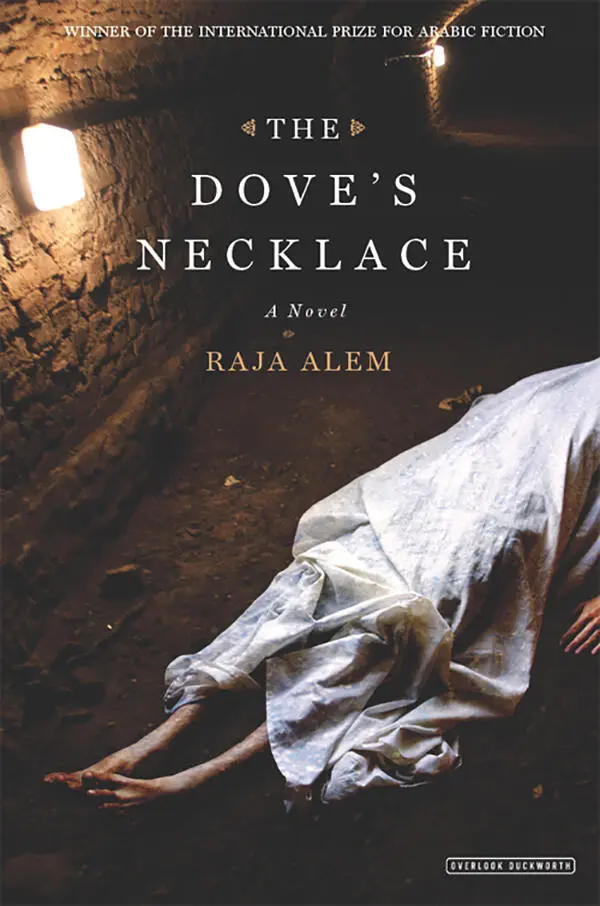
- Название:The Dove's Necklace
- Автор:
- Издательство:The Overlook Press
- Жанр:
- Год:2016
- ISBN:нет данных
- Рейтинг книги:4 / 5. Голосов: 1
-
Избранное:Добавить в избранное
- Отзывы:
-
Ваша оценка:
The Dove's Necklace: краткое содержание, описание и аннотация
Предлагаем к чтению аннотацию, описание, краткое содержание или предисловие (зависит от того, что написал сам автор книги «The Dove's Necklace»). Если вы не нашли необходимую информацию о книге — напишите в комментариях, мы постараемся отыскать её.
Tackling powerful issues with beautiful and evocative writing, Raja Alem reveals a city-and a civilization-at once beholden to brutal customs, and reckoning (uneasily) with new traditions. Told from a variety of perspectives-including that of Abu Al Roos itself-
is a virtuosic work of literature, and an ambitious portrait of a changing city that deserves our attention.
The Dove's Necklace — читать онлайн бесплатно полную книгу (весь текст) целиком
Ниже представлен текст книги, разбитый по страницам. Система сохранения места последней прочитанной страницы, позволяет с удобством читать онлайн бесплатно книгу «The Dove's Necklace», без необходимости каждый раз заново искать на чём Вы остановились. Поставьте закладку, и сможете в любой момент перейти на страницу, на которой закончили чтение.
Интервал:
Закладка:
“Mu’az chickened out! Mu’az is a chicken, Mu’az is a chicken!” The taunts of the neighborhood children pursued him until he disappeared into the maze of the Lane of Many Heads. At midday, his brother Yaqub went to finish the task of butchering and picking out the parts their father had asked for.
FROM: Aisha
SUBJECT: Message 22
‘No,’ said Ursula, ‘it isn’t. Love is too human and little. I believe in something inhuman, of which love is only a little part. I believe what we must fulfil comes out of the unknown to us, and it is something infinitely more than love. It isn’t so merely HUMAN.’
Gudrun looked at Ursula with steady, balancing eyes. She admired and despised her sister so much, both! … ‘Well, I’ve got no further than love, yet.’
Over Ursula’s mind flashed the thought: ‘Because you never HAVE loved, you can’t get beyond it.’
(Women in Love)
I wonder whether I’m Gudrun, but at the same time, there’s some Ursula in me, I find.
Your cruelty comes so unexpectedly; sometimes you cut me off for one night, sometimes more.
I know you’re always pursuing new victims for your massage table, but what I can’t stand is how much I depend on you. And how I burden you with my feelings, which change from one second to the next. I can’t help but feel my feelings have wiped you out. I pity you sometimes.
But you put up with me, unless there’s a new body on your massage table. You were up-front about everything from the beginning, you sounded a little martyr-like when you said “My passion in life is healing the injured. I want to help by giving them a little pleasure in the midst of all that pain.” But when you help one body by giving it pleasure, you put all the leeches, which are stuck to your flesh, on hiatus.
I’ve been a leech for the past two days in a row. I drink serenely from the cruelty of your cold shoulder. I know you won’t leave me waiting for long. You’ll come back to me. And you’ll say, “You’re a sex bomb.” It wouldn’t be wise of you to detonate me from afar.
A sex bomb?! Is that what you’ve been blowing up in my face every time you turn up or disappear without warning like this?
I remember when Azza was only five she used to sleepwalk — or, at least, she used to pretend she was sleepwalking when anyone caught her — across the alley into our house, through the door that we always left ajar, up the stairs, across the six laid-out sleeping rolls where my brothers slept, and into my bed. I could feel her tiny body squatting there beside my sleeping head. “Aisha,” she whispered. “I hate sleeping.” Without opening my eyes, I’d lift up the edge of the blanket for her to crawl in. When she settled in the bed, she wouldn’t press her body up against mine, rather she brushed against me lightly where it mattered. Making her body into a crescent, she left space between us: her forehead against my lips, her left hand tucked in my armpit, her toes between my thighs. Our bodies connected at three points, we’d both fall into a deep sleep. I felt my heart go out to this child who’d abandoned sleep to come find me.
There was a time when I thought I could bring you into my bedcovers like a child, but you shattered the parts of that child inside of me.
Aisha
The Mahmal
A N ANCIENT SILENCE LAY OVER THE LABABIDI HOUSE. YUSUF COULD SENSE IT IN all the rooms, the narrow passages and the open spaces of the parlors, and inside the mirrors that lay on either side of the arched doorways. Yusuf sat in the silence on his own, eyes watching him out of the photos. In the silence, his life came to him out of corners he’d never noticed before. Everything he’d missed came to visit him in al-Lababidi’s house.
One night, he was dozing on the floor of one of the sitting rooms, surrounded by photos of the people of Mecca, and when he woke up with a start at midnight, he’d realized he’d been thrown back into the same dream he’d had on the night the body was found, when he was nodding off on their rooftop in the Lane of Many Heads.
He’d been watching the neighborhood that night from the rooftop. The book Saudi Arabia by the First Photographer s by William Facey and Gillian Grant lay in his lap. Mu’az had brought it to show him, opening it to the page with a picture by an anonymous photographer found in a file on the First World War. “You need to see this for yourself,” Mu’az said, raking up a circle of fear around Yusuf. “I fear God’s wrath! I won’t be the one to expose people’s secrets.” Then he disappeared.
Yusuf spent the entire night examining that photo, but he couldn’t figure out the secret Mu’az had tried to get him to see. It was a photo of the mahmal, the procession of the kiswa, moving through the Meccan streets having arrived from Egypt. The mahmal was always occasion for celebration; those gifts were like a yearly revival for the poor Hijaz. Between glances at the photo and down at the alley, Yusuf was nodding off, and at one point the photo and the alley infiltrated his dreams. He dreamed of them both as one and the same. All of a sudden the mahmal was passing through the Lane of Many Heads, guarded by soldiers at the front holding their swords pointed toward the ground. In front of them were the down-and-outs of the Lane of Many Heads, mingling with the great men of Mecca who walked behind the Sharif in decorated headdresses, the religious scholars in white turbans and the Bedouin in headscarves and igals. The women were dressed in black abayas and white yashmaks, diaphanous veils that covered their mouths but left their eyes and foreheads bare for all to behold. A single tree recurred in the image; military drummers girded the procession. Women peeked enviously at the procession from behind screened windows and cracks in the wall. Yusuf’s heart stopped when he spotted the men on the roof at the left of the picture. Half-hidden behind the minaret on the roof, a man dressed in white traditional clothes seemed almost to be waving at him; another man had turned toward the wall so Yusuf couldn’t see him; Mu’az was watching the scene surreptitiously from behind the minaret with the two other men. The houses in the Lane of Many Heads looked like they’d been patched up. Some parts bespoke great past wealth and others had been fixed with new pockmarked bricks or cement or wood, or even mud. It was a mix of planks and patches, through which the mahmal passed on its way to Mushabbab’s orchard, where the camels would rest.
Yusuf came right up close to the decorated canopy on the back of a camel in which the covering of the Holy Kaaba lay. It looked like the kind of cage they put over a woman’s coffin to conceal her post-mortem allure. “Who’s under that cage?” wondered Yusuf.
“Azza,” said a voice inside him.
“Aisha,” said another.
Yet another said, “Yousriya. Salma. Maymuna. Sa’diya …” It couldn’t decide on a name. Some presentiment was telling him to decipher the designs and words embroidered in gold on the kiswa and the canopy of the litter … When they got to the orchard, the men began lowering down the magical-looking mass of the kiswa. Yusuf was expecting the girl wrapped up in there to appear. But the men weren’t taking down the cloth, but rather the writing itself. Word by word they decorated the orchard, the pride and joy of the Lane of Many Heads. When the silver- and gold-couched words had all been hung up on the walls of the orchard, a young woman in trailing black appeared all at once out of the writing-denuded camel howdah into the orchard. Yusuf’s heart was pounding; it told him he knew her. In that instant, the trumpets and drums, the ruler and notables, all the celebrants, disappeared as if they’d never been there, and in their place was a huge fire. The neighborhood people were adding firewood. They said it was to melt down the gold and silver in the orchard’s decorations so it could be donated to the people of the neighborhood. The fire raged and smoked, and the walls began to melt from the heat; the girl was melting too. When she had melted down completely into a puddle, a giant reared up out of the puddle and with a single flick of its tail knocked the alley upside down.
Читать дальшеИнтервал:
Закладка:
Похожие книги на «The Dove's Necklace»
Представляем Вашему вниманию похожие книги на «The Dove's Necklace» списком для выбора. Мы отобрали схожую по названию и смыслу литературу в надежде предоставить читателям больше вариантов отыскать новые, интересные, ещё непрочитанные произведения.







Обсуждение, отзывы о книге «The Dove's Necklace» и просто собственные мнения читателей. Оставьте ваши комментарии, напишите, что Вы думаете о произведении, его смысле или главных героях. Укажите что конкретно понравилось, а что нет, и почему Вы так считаете.