Raja Alem - The Dove's Necklace
Здесь есть возможность читать онлайн «Raja Alem - The Dove's Necklace» весь текст электронной книги совершенно бесплатно (целиком полную версию без сокращений). В некоторых случаях можно слушать аудио, скачать через торрент в формате fb2 и присутствует краткое содержание. Год выпуска: 2016, Издательство: The Overlook Press, Жанр: Современная проза, на английском языке. Описание произведения, (предисловие) а так же отзывы посетителей доступны на портале библиотеки ЛибКат.
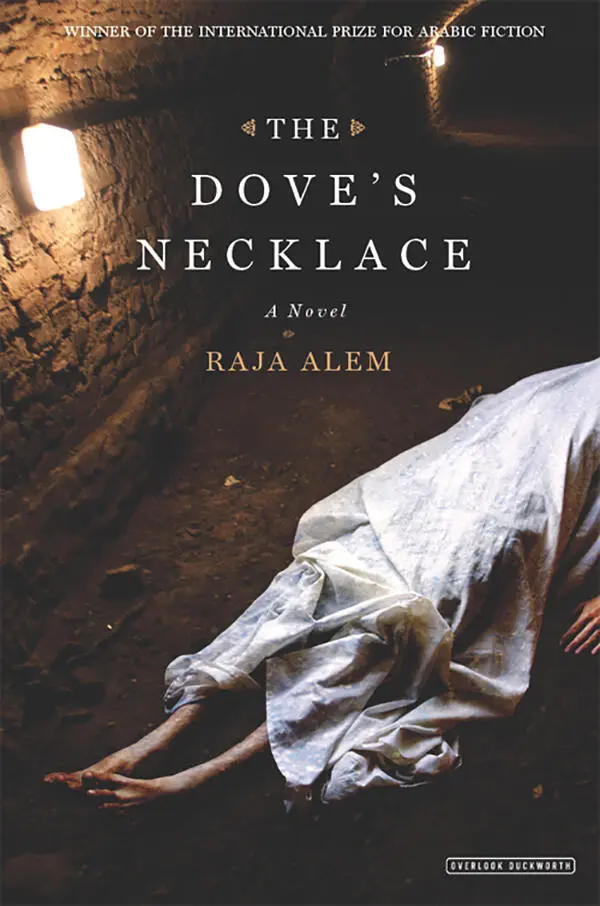
- Название:The Dove's Necklace
- Автор:
- Издательство:The Overlook Press
- Жанр:
- Год:2016
- ISBN:нет данных
- Рейтинг книги:4 / 5. Голосов: 1
-
Избранное:Добавить в избранное
- Отзывы:
-
Ваша оценка:
The Dove's Necklace: краткое содержание, описание и аннотация
Предлагаем к чтению аннотацию, описание, краткое содержание или предисловие (зависит от того, что написал сам автор книги «The Dove's Necklace»). Если вы не нашли необходимую информацию о книге — напишите в комментариях, мы постараемся отыскать её.
Tackling powerful issues with beautiful and evocative writing, Raja Alem reveals a city-and a civilization-at once beholden to brutal customs, and reckoning (uneasily) with new traditions. Told from a variety of perspectives-including that of Abu Al Roos itself-
is a virtuosic work of literature, and an ambitious portrait of a changing city that deserves our attention.
The Dove's Necklace — читать онлайн бесплатно полную книгу (весь текст) целиком
Ниже представлен текст книги, разбитый по страницам. Система сохранения места последней прочитанной страницы, позволяет с удобством читать онлайн бесплатно книгу «The Dove's Necklace», без необходимости каждый раз заново искать на чём Вы остановились. Поставьте закладку, и сможете в любой момент перейти на страницу, на которой закончили чтение.
Интервал:
Закладка:
“What is it, Khalil?” said the trash, addressing him directly. “Are you getting all high and mighty? No one’s bigger than the Lane of Many Heads. You might be strong and capable now, but what about in a decade? We all have a lifespan: you have yours and we have ours. Read the expiration date stamped on the back of your neck. You human beings are trash. You manage to stay on your feet for sixty or seventy years, or ninety or a hundred even, but in the end your legs give out and leave you here. You pile up beside us, and everyone who passes by curses how you stink. There won’t be any garbage trucks to cart you away; the municipality trucks can’t get down streets as narrow as this. Who cares if you have a pilot’s license or a driver’s license, how long did you think your eyesight was going to last? Look how your bald spot’s growing and your black hair’s graying. The veins on your hands are starting to bulge. The fire that used to run through your insides is flickering feebly over the surface now and in a little while it’s going to leave you for good. Today it’s anger and passion that make your hands tremble, but soon it will be decrepitude and diabetes. And just wait till you smell of piss and turn the stomach of anyone who tries to hand you a bite of food. No, don’t be scared. Don’t let the thought of that kind of ending stop you; just be gentle now while you’re stomping all over people and their joy. Be a little a bit kinder. You never know, maybe that little bit of compassion will come back around when you’re thrown on the heap.”
By the time Khalil got to the end of the lane, all the lights in the cafe had been turned off, except for one hanging from the roof of the shed where the Pakistani and Sri Lankan waiters slept. They rented out the corners to undocumented workers and exchanged smuggled pornographic photos, which they kept for company and used to sate their devils until they were interrupted by the dawn call to prayer. The Sudanese cashier, who was still awake and sitting behind his desk, scratching at his ledger, greeted Khalil, and absentmindedly Khalil raised a hand in return. He sat down on a chair that had been forgotten at the edge of the cafe, in limbo, one of his feet inside the cafe, the other in the street. He sat there like the embodiment of ruin: his arms lay slackly in his lap, his palms stacked one atop the other, his head drooping forward slightly, his eyes trained gravely on a spot of ground before him, the point of prostration in prayer. The mosque was in front of him. He knew, without even looking at his watch, that dawn was at the edges of the city, about to dissolve as the calls to prayer began and intermingled—“Prayer is better than sleep”—and then the single lightbulb hanging from a wire in the doorway of the mosque would flick on, Imam Dawoud’s silhouette would appear behind the barred window as he stood in front of the prayer niche, which was marked by an arrow drawn onto the wall, and he’d announce the dawn prayer.
Khalil looked to the sky: “Don’t cut me …” he said, trembling, his sister Yousriya speaking through him with the voice of a helpless, desperate woman. He sighed. “Kill me in an accident, God, crush me with metal so there’s not even a scrap left to rot, but don’t take away my strength, don’t take away my eyes. Those who are disemboweled or slandered die martyrs. Disembowel me and let me die a martyr! But before you kill me, kill her first, that—”
“God is the Greatest.” The call to prayer rang out from a distance like an “Amen” of assent to his own prayer. It was received by the first angels of the dawn. His soul trembled. He remembered that he hadn’t washed off what he’d done in the night so he avoided going into the mosque lest the angels turn his prayer into a black rag and slap him in the face with it, striking him dead in front of the men lining up to do their ablutions in front of the mosque.
FROM: Aisha
SUBJECT: Message 21
“‘Look,’ said the Contessa, in Italian. ‘He is not a man, he is a chameleon, a creature of change.’” ( Women in Love ).
The chameleon Birkin in my clothes.
Do you know what a miracle it is for the one you’ve prayed for to appear at the end of your prayers?
You popped up on my screen this morning — completely unexpectedly — just behind my left shoulder when I turned my head, exactly when I whispered my greeting to the angel Raqib, who perches there, noting down my sins. That angel is the embodiment of creativity, always ready to erase pages and pages and give us another chance to start writing afresh.
This is what you bring out in me: I woke up with a blast of energy, massaged my poor injured body then poured the energy into this message to you.
In the past few days, I’ve had trouble figuring out whether I’m praying or writing. Everything has melded together into a corner which I escape to.
Aisha
P. S. You said, “I don’t want you to miss waking up with the Lane of Many Heads, or with God for that matter. How many of us are there waking up in the same bed now? Four? Or forty?”
Do you realize how beautiful the melodrama was that played itself out on your stage?
In that scene, you, the Western man, appeared on stage as an individual, as the possessor of your own body. You took an entirely personal step, playful and carefree. For you it was just a treasure hunt. I, on the other hand, whenever I looked up, I locked eyes with my father and mother and my siblings and the Lane of Many Heads. They were all watching my every move, every flirtation; your every touch was felt by the body of that audience.
Do you see? Where can I find the words to explain it to you? I never came to you as an individual. I was a sheet of white paper covered in ciphers, the eyes of the Lane of Many Heads. You were an elephant stomping on the sheet.
I gave you what wasn’t mine to give. I couldn’t believe how much I smuggled into your arms with every single moment. No matter how hard you squeezed me in your arms to extricate only me, three bodies emerged: one starved and made thirsty, a second that had been encoded with years of “this is forbidden, that’s forbidden, that’s allowed,” and a third, a tiny, tiny body, which grew smaller and darker in the presence of God, despite my long-ago divorce and the verbal agreement you and I made that morning in the park beside the train station.
Try to imagine me like I was in that room. As you were being lashed by the waves, I was being buffeted, too, as I tried to excise a single body that could be yours and yours alone while they jostled and brawled with one another on my bare shoulders.
Aren’t you blown away by how spontaneously I performed in front of that unsympathetic audience?
Cyber Life
M U’AZ WENT INTO THE MOSQUE AND PRAYED. THEN HE LINGERED THERE UNTIL all the other worshippers had gone and only he and his father were left. His father watched him with pride as Mu’az prayed for forgiveness, tracing the chains of sin that were weighing him down. He asked for forgiveness a hundred times — a thousand times — for every photo he’d taken, every face he’d abused. He summoned all the angels that had abandoned him for his private abominations, and he apologized for the keys he’d burdened Yusuf with and the trouble he’d gotten him in. He begged for mercy and renounced everything except for the book he’d stolen from Mushabbab’s library. It was a sin that couldn’t be erased. He couldn’t bring himself to put it back or even part with it. He insisted on taking it with him everywhere, even into his dreams, constantly flipping through it in the studio or in the Lababidi house on Mount Hindi, which the angels had long since abandoned owing to the mass of photos stored there. Mu’az discovered that his dreams were the only place where he could enjoy privacy, the only place he could be alone with his intimate belongings, whether or not they were sinful. Like the desires he had, which were brought to life in the snapshots he took of girls’ bangs and legs, or this book, which was packed full of the work of the earliest photographers. They took him along with them, from the early 1860s all the way to the end of the 1950s, and he stood beside them as they snapped rare shots of Mecca and the Hijaz. He met the traveler Muhammad Sadiq Mirza and his sons in the photos of the supplication of pilgrims on Mount Arafat; Snouck Hurgronje, disguised as Abd al-Ghaffar, showed him what the pilgrimage looked like in 1889. He spent time alone with Ibrahim Rifaat, who’d taken some of the rarest photos of Mecca and Medina; Clemow and Hallajian at the turn of the twentieth century; Lawrence in 1916. In John Philby’s photos from the first quarter of the twentieth century, he saw the pilgrims alighting from their ships in the port of Jeddah, and then he moved with de Gaury, Rendel, and Thesiger into the 1930s and ’40s. In his dreams, they all became one: his genes climbed up the scaffolding of their genes, ascending through their genius, in-mixing. He woke to find that he was like Dolly the sheep: just a clone. No more, no less.
Читать дальшеИнтервал:
Закладка:
Похожие книги на «The Dove's Necklace»
Представляем Вашему вниманию похожие книги на «The Dove's Necklace» списком для выбора. Мы отобрали схожую по названию и смыслу литературу в надежде предоставить читателям больше вариантов отыскать новые, интересные, ещё непрочитанные произведения.









Обсуждение, отзывы о книге «The Dove's Necklace» и просто собственные мнения читателей. Оставьте ваши комментарии, напишите, что Вы думаете о произведении, его смысле или главных героях. Укажите что конкретно понравилось, а что нет, и почему Вы так считаете.