Raja Alem - The Dove's Necklace
Здесь есть возможность читать онлайн «Raja Alem - The Dove's Necklace» весь текст электронной книги совершенно бесплатно (целиком полную версию без сокращений). В некоторых случаях можно слушать аудио, скачать через торрент в формате fb2 и присутствует краткое содержание. Год выпуска: 2016, Издательство: The Overlook Press, Жанр: Современная проза, на английском языке. Описание произведения, (предисловие) а так же отзывы посетителей доступны на портале библиотеки ЛибКат.
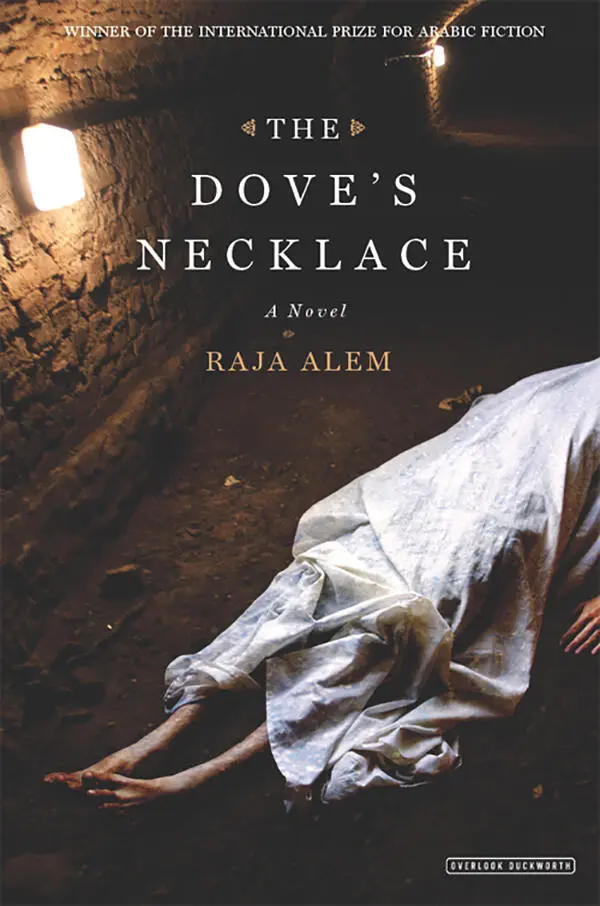
- Название:The Dove's Necklace
- Автор:
- Издательство:The Overlook Press
- Жанр:
- Год:2016
- ISBN:нет данных
- Рейтинг книги:4 / 5. Голосов: 1
-
Избранное:Добавить в избранное
- Отзывы:
-
Ваша оценка:
The Dove's Necklace: краткое содержание, описание и аннотация
Предлагаем к чтению аннотацию, описание, краткое содержание или предисловие (зависит от того, что написал сам автор книги «The Dove's Necklace»). Если вы не нашли необходимую информацию о книге — напишите в комментариях, мы постараемся отыскать её.
Tackling powerful issues with beautiful and evocative writing, Raja Alem reveals a city-and a civilization-at once beholden to brutal customs, and reckoning (uneasily) with new traditions. Told from a variety of perspectives-including that of Abu Al Roos itself-
is a virtuosic work of literature, and an ambitious portrait of a changing city that deserves our attention.
The Dove's Necklace — читать онлайн бесплатно полную книгу (весь текст) целиком
Ниже представлен текст книги, разбитый по страницам. Система сохранения места последней прочитанной страницы, позволяет с удобством читать онлайн бесплатно книгу «The Dove's Necklace», без необходимости каждый раз заново искать на чём Вы остановились. Поставьте закладку, и сможете в любой момент перейти на страницу, на которой закончили чтение.
Интервал:
Закладка:
I was in a coma for hours. Without our computers, we cease to live, I thought. And why? Because we are removed from the digital truth.
I’m out of order now, but still this list of commands is penetrating deep into my memory. It took me a couple of tries to get this service to work. These are the steps:
All Programs —> Supplementary —> System Controls —> Reset or Restore
Renew System Time or Revertto an Earlier Point in Time
All of a sudden you find yourself in front of this calendar and you can choose to go back one day, or a whole month, and with a single click you can delete the whole intervening epoch from your system. You can go back in time to when things were still working perfectly.
Should I look into my head to find the virus that disabled this service?
Should I think about which time it makes sense to restore to? Which periods to delete so I can go back in time?
Maybe I should start by erasing my name
Aisha
Maybe I should change it to
Hayah.
Aisha
P. P. S. 1. You said you like the digital photos I send you. It amazes me that though they come from this muddy darkness, they’re light when they reach you (and museum-worthy!).
2. A photo of Umm al-Sa’d? None exists.
Attachment 2: Hamid al-Ashi: this is his yard and his shelves of paper.
Attachment 3: This is a sheep tied up in a fire-pit. The Madbi cooking yard is never without a feast being preparedfor the fortunate people who can afford it — people from outside the Lane of Many Heads, of course. The aroma makes its way to us.
You can’t smell.
Nasser turned up at my, the Lane of Many Heads’, entrance tonight. And he uttered these words, as if they were an oath: “I wasn’t made for this poverty and I won’t let the Lane of Many Heads ruin my career. Not now, and not even when I’m old and feeble.” And yet I still draw him in deeper and deeper. The dark circles under his eyes and his hollow cheeks tell me he hasn’t slept in ages. I notice everything. I watched him sneak over to Aisha’s house for the second time. I knew he was looking for Women in Love this time. It was vital for him to find that red sock, anything that represented Aisha, any snippet of her dreams. The smell hit him as soon as he walked into the hall. The whole building smelled like the inside of his undershirt. Nasser felt like he was walking through his own personal paranoia. He felt his way up the stairs, which were enveloped in darkness. Every door in the building was wide open. None of them had been shut except for the door to the cubbyhole. He knew it was the room squeezed in between two floors. He did try the lock, but in the end he had to break it. As soon as he took his first step into the room, his eyes ceased to see the world around him. In front of him, he saw only her bed, looking like a battleship. He fought the desperate urge to throw himself onto that space that had been inhabited by her body, her suffering, by the German demon who accumulated in her loneliness.
“Aisha is the very devil. But what, Nasser — you think you’re a holy sheikh? And you’ve come to exorcize the demon from inside her? You want to extract it from her eye and blind her? Or from her toe and doom her to a wheelchair? Which body part are you going to have to sever to get him out and punish her?”
He didn’t dare go forward. There was a satin sheet covering the bed — it was the color of lavender, light purple — and it was ruffled and twisted like a body in love. He scanned the entire room, looking for Women in Love . Wherever he looked, the scent of lavender lured him on. He moved forward. He dug through the drawers in the dressing table. He looked in all four corners, but he didn’t dare touch the bed or the balled up sheet. There was no trace of the book. Everything in that house was stretched out; it was as though the people who lived there had left the place very, very slowly, with plans to return. Everything except for the cubbyhole, which looked tapped out. As if it had had enough of waiting for the women who loved to return. They’d been gone a long while.
He shut the door quietly behind him and left.
He would definitely have chosen to go from her lips downward. The opposite direction to the German. The thought turned his stomach.
Jameela
B ETWEEN YUSUF AND AISHA’S PAPERS, NASSER FELT LIKE HE WAS MOVING AROUND in a fantasy Mecca. It wasn’t the Mecca he knew from his usual beat. That night, he stopped over some pages of Yusuf’s entitled “Sheikh Muzahim’s Biggest Secret: A Farce”:
January 1, 2005
Jameela was like butter stuffed into her black abaya. It was open all the way down the front, concealing nothing. The beautiful Yemeni girl’s headscarf lay nonchalantly on her shoulders, leaving her black braids uncovered. Sheikh Muzahim’s heart leapt into his throat at the sight of her. She was a luscious round pumpkin dripping with butter. Sheikh Muzahim’s right eye, less afflicted by glaucoma than the other, dived into her lap and buried itself there.
“Welcome, priceless ornament, exquisite face, may the Hijazi earth welcome the beauty of al-Mukalla!”
“I’d like a Galaxy.” Her voice echoed in the empty depths inside Sheikh Muzahim. He nodded.
“Your Sheikh Muzahim, his store, and all his sweets are at your feet. I have every kind of candy: lollipops, lemon bonbons, Mars with caramel, Kit-Kat, coconut Bounty … But your choice is the sultan of chocolate, Galaxy!”
Sheikh Muzahim believed that Yemeni workers were the best at all trades and it was good luck, too, that their lust for life made them reproduce more.
Jameela had spotted the Galaxy bars in a dark blue tin and was instantly hypnotized by the rancid cacao. He held out a bar for her, making sure to brush the edges of her fingers; his eyes practically popped out and the blue clouds of glaucoma roiled at the touch. No snuff, qat, or mahaleb cherry could compare with the electricity that crackled between him and the soft-skinned beauty.
At the first simmering of femininity, the scent would shoot through him to the very tip of the big toe on his right foot. In that smell glimmered the Bedouin charcoal-seller who had hidden him under her dress when his tribe came under attack, as happened constantly in the desert. He was seven at the time. The girls in his tribe started embroidering their dresses when they were still children, then got married in the dress, and never took it off for the rest of their lives. It secreted away every memory of every moment of passion and sadness until it passed on with them. All that wrapped itself around him inside the dress of the Bedouin charcoal-seller; he got an instant erection the size of Mount Tuwayq and ejaculated a flood bountiful enough to irrigate an orchard.
The same mountain reared up now whenever he saw fifteen-year-old Jameela. She brought back the moan that echoed in the the well inside him that he’d turned his back on long ago, along with the dream of a male heir. Jameela’s gaze had the placidity of a cow’s; what was it that was absent from her face? Disgust and defiance. There was none of that in Jameela’s sweet, animal gaze; she gave him back what Azza’s mother had taken from him.
A Hair
“N ASSER, SON!” HIS MOTHER’S VOICE ON HIS CELLPHONE CUT SHORT THE NAGGING of that phrase from Women in Love in his head, “best strive with oneself only, not with the universe.” It was the middle of the night. “I’ve found you a bride! She’s rich, pretty, and respectable.” The Lane of Many Heads roared with derision inside Nasser’s skull.
“Oh God, Mom, not this again …”
Читать дальшеИнтервал:
Закладка:
Похожие книги на «The Dove's Necklace»
Представляем Вашему вниманию похожие книги на «The Dove's Necklace» списком для выбора. Мы отобрали схожую по названию и смыслу литературу в надежде предоставить читателям больше вариантов отыскать новые, интересные, ещё непрочитанные произведения.









Обсуждение, отзывы о книге «The Dove's Necklace» и просто собственные мнения читателей. Оставьте ваши комментарии, напишите, что Вы думаете о произведении, его смысле или главных героях. Укажите что конкретно понравилось, а что нет, и почему Вы так считаете.