Raja Alem - The Dove's Necklace
Здесь есть возможность читать онлайн «Raja Alem - The Dove's Necklace» весь текст электронной книги совершенно бесплатно (целиком полную версию без сокращений). В некоторых случаях можно слушать аудио, скачать через торрент в формате fb2 и присутствует краткое содержание. Год выпуска: 2016, Издательство: The Overlook Press, Жанр: Современная проза, на английском языке. Описание произведения, (предисловие) а так же отзывы посетителей доступны на портале библиотеки ЛибКат.
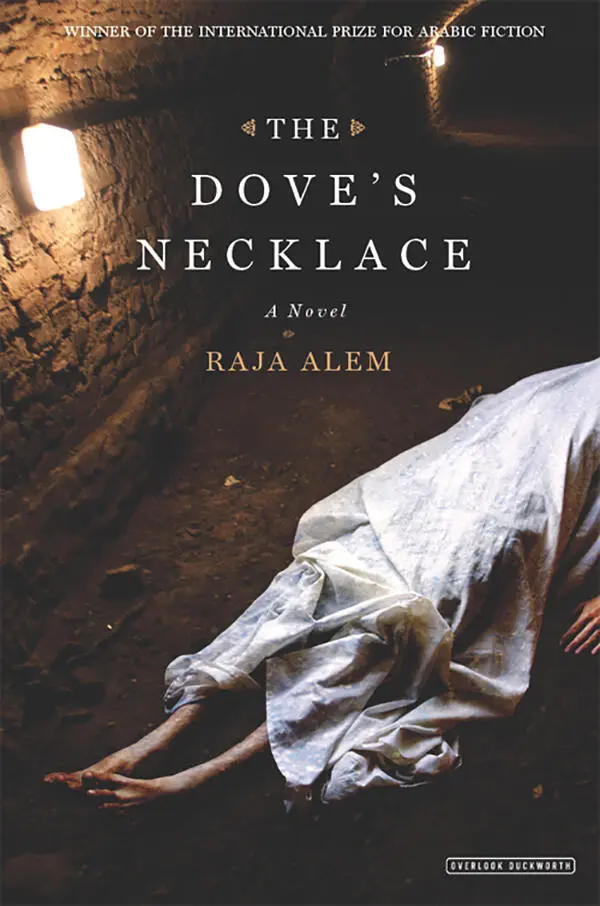
- Название:The Dove's Necklace
- Автор:
- Издательство:The Overlook Press
- Жанр:
- Год:2016
- ISBN:нет данных
- Рейтинг книги:4 / 5. Голосов: 1
-
Избранное:Добавить в избранное
- Отзывы:
-
Ваша оценка:
The Dove's Necklace: краткое содержание, описание и аннотация
Предлагаем к чтению аннотацию, описание, краткое содержание или предисловие (зависит от того, что написал сам автор книги «The Dove's Necklace»). Если вы не нашли необходимую информацию о книге — напишите в комментариях, мы постараемся отыскать её.
Tackling powerful issues with beautiful and evocative writing, Raja Alem reveals a city-and a civilization-at once beholden to brutal customs, and reckoning (uneasily) with new traditions. Told from a variety of perspectives-including that of Abu Al Roos itself-
is a virtuosic work of literature, and an ambitious portrait of a changing city that deserves our attention.
The Dove's Necklace — читать онлайн бесплатно полную книгу (весь текст) целиком
Ниже представлен текст книги, разбитый по страницам. Система сохранения места последней прочитанной страницы, позволяет с удобством читать онлайн бесплатно книгу «The Dove's Necklace», без необходимости каждый раз заново искать на чём Вы остановились. Поставьте закладку, и сможете в любой момент перейти на страницу, на которой закончили чтение.
Интервал:
Закладка:
“You bury yourself in work! You’ll be the end of the family line and you’ll never have the chance to have a kid who has your name.”
Nasser fidgeted with some paper. His bed was covered with Yusuf’s diaries, and Azza’s sweat was leaking out of the pages onto the bedclothes. He couldn’t even close his eyes against it; the smell seeped out anyhow. Going back to his mother’s ways was inconceivable. He struggled to focus on what she was saying. “She’s an orphan. Her uncles are very modern and would be happy for you to meet her, with a chaperone and so on, of course. Please, Nasser, make me happy before I die!”
“God keep you here for us, Mom … Can we chat about this tomorrow? It’s pretty late.”
“Son, don’t go to your grave a dried-out stick!” Her words darkened the already-dim room. He hung up. He closed his eyes and tried to slow himself down, fleeing to that remote spot in the corner of his heart, where no murder or misery could sneak in. There, he’d hidden the image of a girl: a girl whose veil he’d never dared to even tug on, so that throughout his adolescence and maturity she’d remained wrapped head to toe in her abaya, though she was still as light and joyful as a shadow.
Tonight, though, he reached out a feverish hand to that cloud of black he’d concealed throughout his adolescence, and began pulling off layer after layer of the endless blackness. But when he at last got to the center of the cloud he didn’t find the women he’d been collecting — glimpsed through the windows of cars speeding past him in the traffic, or the windows of his neighbors in Ta’if. Back then, whenever he looked up at a girl’s bedroom window, he’d find a sandal dangled out the window, sole facing him, in a rude rejection of his presumptuous advance. In the mirrors of those dirty soles, Nasser saw his own lonely face waiting for a female face to inhabit it.
He took his memory tin out of the bottom of his wardrobe. All there was inside was a single long hair and a hairclip decorated with a tiny red diamanté apple. He remembered how he’d found it on a side table in his friend’s house, how the blood had rushed to his temples when he’d picked it up and stuffed it quickly into his breast pocket. His hand hadn’t stopped trembling for days; the apple next to his heart was a fully formed girl and she had captivated him for years. He never said she was imaginary, the Apple Girl. He’d spent his prime obsessed by that apple and the single long hair that he’d wrapped in velvet and laid in a long thin box like a precious, jewel-studded sword in its sheath, as if waiting for great men with jet-black beards and glittering eyes to uncover it and forge its blackness into the path of their destiny.
Vague scenes haunted him; he thought they were from that film starring the famous Bedouin singer Samira Tawfiq. What was it called …? Amira, Daughter of the Arabs ? Maybe … The one where the handsome prince falls madly in love with a black hair that he finds in the middle of the vast desert, and abandons his tribe and kingdom to travel the land searching for the woman it belongs to.
Nasser felt like all the men of his generation could have been that Arab prince, capable of falling in love with a nameless hair. A name is a woman — it’s a woman’s self, her honor — and could be enough to kill a man out of passion. He remembered his mom’s trips to find a bride for his older brother. The whole family used to join in the offensives she led on houses where she’d heard there were available daughters. There was an African woman, Hajja Hawwa, who used to go round the houses helping families out with their laundry and ironing and would bring back descriptions of the girls wherever she’d been: “Al-Mukharrij’s daughter, her braids are as thick as a palm trunk and reach down to her ankles … The al-Asiri girl is as curvy as a moringa branch and has breasts like home-grown pomegranates … Al-Zahraniya’s eyes are fatally seductive … Al-Ghamidi’s girl is quicksilver, whoever gets her’ll be a lucky man …”
Her usual trade was smuggling forbidden features, but one time, she came with just a name. She breathed the name like she was breathing a spirit into his brother’s body: Salma. It was love.
The name started a hurricane inside Nasser’s brother. Like our ancestor Adam when God breathed the names of all creatures into his back so we could be created, his brother built an idol on the foundation of that name, Salma, molding her out of the breasts of the most gorgeous movie actresses, Umm Kulthoum’s deepest sighs, and the loveliest kidnapped brides out of Fairuz’s plays … He prepared a dower of twenty thousand riyals, a neckpiece of pure gold rashrash-work like a shimmering cascade, bottles of rose, musk, and ambergris, and a set of make-up with bright turquoise eye-shadow, pink rouge, and blood-red lipsticks, and he furnished the splendid open sitting room in the Qarawa Gardens in Ta’if, where he worked as a supervisor at the Bugariya orchards. But when he finally met Salma on the night of the wedding, she turned out to be a demon, and he fell into a terrible depression.
Nasser recalled the pall that marriage had cast over his brother’s life. He’d drawn his lot from a bundle of names three times, and every time, she turned out to be either a demon, or just a “woman with no salt,” as they say, meaning unremarkable and insignificant. He finally settled on the fourth: his Filipina maid. Every time, Nasser used to live off the crumbs that fell from the names and descriptions of his brother’s dreams, just like he was feeding now off David’s leftovers from Aisha’s letters, which had shattered all his teenage fantasies and replaced them with women like herself, women capable of penetrating his mind with their words, of desire and fruition. “Nasser, you’ve stolen a sleeve from that cheap flesh and now you’re worshiping it!”
Dogs barked in the distance, and Nasser thought to himself that the municipality should go back to culling them using meat mixed with broken glass. It would mean dog corpses filling the horizon with their rotting smells, though. He put his hand under his shirt and felt for his heart, which he’d never faced up to before. Bringing it out into the air, he could tell from the cracks all over it that there was a gaping hole inside of him like a cage, for a lover like Aisha or a wild bird like Azza, and that it was still beating and capable of loving Azza’s bare feet padding up the stairs to the roof as she crept out in her sleep to visit Mushabbab, or sinking into the sandy ground of Mushabbab’s orchard, or even when Mushabbab knelt down humbly to cover the tips of her toes. Nasser knew that all the men who’d had those two women had left cracks in his heart where oxygen was seeping in, feeding his infatuation, and teaching him how to outdo all of them in courtship. If either Azza or Aisha fell into his cage, he’d show no mercy: he’d starve her to make her eat his live flesh, he’d interrogate her and wring out her femininity, he’d tear away all the pages that Yusuf or the German had imprisoned her with, he’d wash her long hair with his hands and wipe everything she’d said from behind her ears with fragrant kewra water, and rest his own ear on her lips to break her fast … She, the one Yusuf’s diaries described as fasting from words.
“But Nasser, she’s half your age, and besides — you’ve been fasting all these years and now you’re falling for a dead woman!”
A Window for Azza
December 2, 2005
From California, USA, a motorbike has been imported to the Lane of Many Heads … You must have heard the roar of its engine.
Note all the details on the delivery slip, Azza:
Make: Yamaha, imported 2004
Читать дальшеИнтервал:
Закладка:
Похожие книги на «The Dove's Necklace»
Представляем Вашему вниманию похожие книги на «The Dove's Necklace» списком для выбора. Мы отобрали схожую по названию и смыслу литературу в надежде предоставить читателям больше вариантов отыскать новые, интересные, ещё непрочитанные произведения.






Обсуждение, отзывы о книге «The Dove's Necklace» и просто собственные мнения читателей. Оставьте ваши комментарии, напишите, что Вы думаете о произведении, его смысле или главных героях. Укажите что конкретно понравилось, а что нет, и почему Вы так считаете.