Raja Alem - The Dove's Necklace
Здесь есть возможность читать онлайн «Raja Alem - The Dove's Necklace» весь текст электронной книги совершенно бесплатно (целиком полную версию без сокращений). В некоторых случаях можно слушать аудио, скачать через торрент в формате fb2 и присутствует краткое содержание. Год выпуска: 2016, Издательство: The Overlook Press, Жанр: Современная проза, на английском языке. Описание произведения, (предисловие) а так же отзывы посетителей доступны на портале библиотеки ЛибКат.
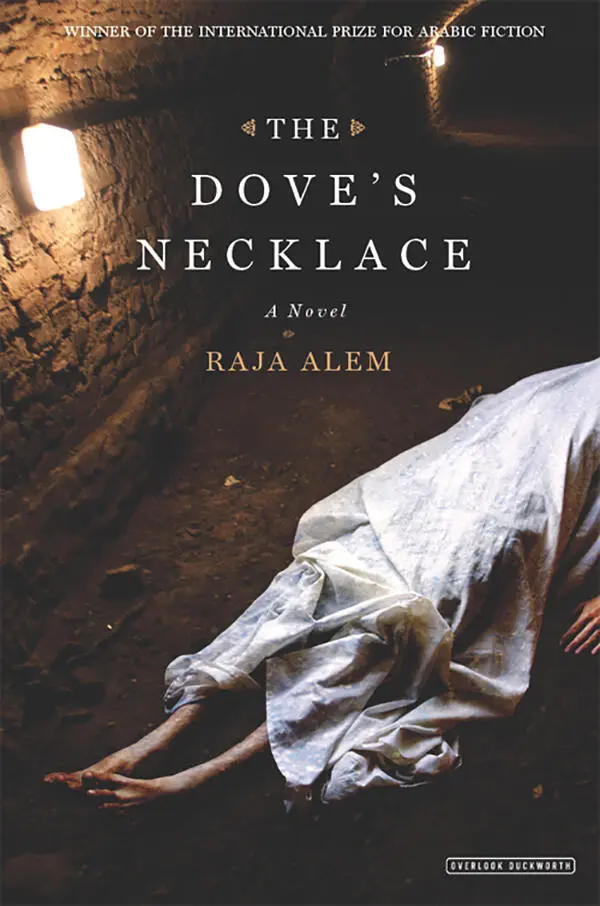
- Название:The Dove's Necklace
- Автор:
- Издательство:The Overlook Press
- Жанр:
- Год:2016
- ISBN:нет данных
- Рейтинг книги:4 / 5. Голосов: 1
-
Избранное:Добавить в избранное
- Отзывы:
-
Ваша оценка:
The Dove's Necklace: краткое содержание, описание и аннотация
Предлагаем к чтению аннотацию, описание, краткое содержание или предисловие (зависит от того, что написал сам автор книги «The Dove's Necklace»). Если вы не нашли необходимую информацию о книге — напишите в комментариях, мы постараемся отыскать её.
Tackling powerful issues with beautiful and evocative writing, Raja Alem reveals a city-and a civilization-at once beholden to brutal customs, and reckoning (uneasily) with new traditions. Told from a variety of perspectives-including that of Abu Al Roos itself-
is a virtuosic work of literature, and an ambitious portrait of a changing city that deserves our attention.
The Dove's Necklace — читать онлайн бесплатно полную книгу (весь текст) целиком
Ниже представлен текст книги, разбитый по страницам. Система сохранения места последней прочитанной страницы, позволяет с удобством читать онлайн бесплатно книгу «The Dove's Necklace», без необходимости каждый раз заново искать на чём Вы остановились. Поставьте закладку, и сможете в любой момент перейти на страницу, на которой закончили чтение.
Интервал:
Закладка:
Nasser glanced around him, following the eye of the puzzle-master who supervised him and guided his investigations. He saw no trace of the glory that Yusuf had found in the history of al-Mansur Street, which used to be known as “the Chamomile.” In the early twentieth century it was easily the most fashionable area in the city, equivalent to Hyde Park, or Central Park, or the Champs-Élysées, where everyone who was anyone would promenade each afternoon to show off how elegant and radiant they were, their bejeweled rainbow-like costumes easily eclipsing the finery of their Turkish overlords.
On the other side of the alley, a black man stood up, drawing Nasser’s attention to a threadbare red couch, a water urn next to it, and a peeling Formica bookshelf whose three shelves bore a few leftover rounds of dry bread and a couple of open cans of food. A living room out in the street, on the bare earth. The man came over, arms outstretched to greet Nasser, and Nasser yielded to the hand, discovering too late its leechlike softness; it was as though his hand was encased completely in squelching clay. The man’s palm was firmly glued to his and he stared into Nasser’s eyes as he said, “Women! They come with knives. Some of us can read their sharp edges. You will. But take it slowly. Don’t read with your heart. We have nothing to do with it. Women are their own biggest problem.” The man let go of Nasser’s hand and vanished down the street.
Nasser’s feeling of annoyance mounted. He was sure he’d seen that face somewhere before, but he couldn’t recall where, and although he wanted to follow the man to find out, his inscrutable words stood like a barrier in Nasser’s way.
Nasser went back to the car and drove off in irritation. When he got to al-Rusayfa Street, the word “knives” resurfaced to prod him, and he remembered one of Yusuf’s old columns that had been published online was about knives.
June 20, 2000
The eighties began with a phone call from a woman to the office of the City of Mecca. She informed them of a peculiar phenomenon: “Firstly, I’m Meccan born and bred,” she said. “Now, my husband and I noticed a while ago that all the knives were disappearing from the markets. We asked around, and discovered that the cleavers and other sharp instruments were beginning to disappear too. We’ve found out that African workers are buying them in record numbers!”
The municipal employees naturally scoffed at the woman’s laughable conspiracy theory, but it brought to light a story that had been taking place silently under the surface of the city: the Emir’s deputy subsequently discovered that his undersecretary, Ba Ali, was in the process of embezzling a tract of land in al-Rusayfa belonging to the al-Qabuji family, who had been unable to evict the squatters who lived there and who had discreetly agreed with Ba Ali that the Public Security forces should be called in to remove them. They surrounded and attacked the rebel neighborhoods in total secrecy, so the news didn’t reach any other neighborhoods in the city. The residents resisted, fighting with blades and rocks in the hope of routing the soldiers, until the municipal authorities received the woman’s phone call and were alerted to the crisis. The Emir ordered an immediate end to the cleansing operation, and it was the end of the undersecretary Ba Ali’s career, but the luxury developments crept in anyway.
“Women!” snorted Nasser, remembering the letter preserved for twenty years in his boss’s archives. It was just one of a whole wave of letters that had flooded their office at the time, along with Public Security offices, research centers, universities, the municipal authority, and the Royal Court, all offering the exact same suggestion, the brainchild of a certain “Dr. Farida, Concerned Citizen”:
To confront the problem of the armies of illegal foreign workers who come to the kingdom to perform the pilgrimage and then go underground, we propose that the authorities consider taking the following steps:
Two camps should be constructed in the desert, the first for females in the Nafoud Desert, and the second for males in the desert of the Empty Quarter. Any foreign national who is unable to produce proper residence papers should be transferred to the appropriate camp immediately. If any criticism arises on the part of the so-called civilized world, as is to be expected, our official reply will be that the government that objects should open its own borders to the masses of immigrants currently hosted by the Kingdom of Saudi Arabia. Otherwise, a portion of the state budget should be allocated to provide for the immigrants until their time is over (and it is highly unlikely their number would grow). There should also be a dedicated effort to disseminating news of these camps in order to counter the idyllic image that attracts immigrants from all over the world to come here and scrounge from our overburdened budget.
Nasser sniggered at the cruelty of the female imagination. He pictured scenes from a film he thought of making, entitled Transistor States . The plot would revolve around a world ruled by women. One character would head the inspectorate for the knife industry and she’d demand to see buyers’ entry visas before authorizing any sales, and the other would draw up plans to populate the world’s deserts with a new unisex subspecies of human.
As he was waiting for the light to turn green, Nasser suddenly — and apropos of nothing — remembered a black and white photo of Mushabbab that hung on the wall to the right of Mushabbab’s couch. The face in the photo was identical to the dervish al-Shanqiti. The light went green and Nasser accelerated then made an abrupt U-turn, brakes screeching, to head back toward the orchard in the Lane of Many Heads.
He ran the last stretch to the orchard, rousing all the neighborhood cats and dogs, threw the gate open, and rushed into the yard. On the wall to the right of the couch there was a patch of yellow brighter than the paint surrounding it; someone had taken the picture. Nasser felt like he’d been tricked. He drove back to al-Mansur Street, only to find that the little living room in the street had also disappeared. All the alarms in his head were going off at once: someone was messing with him. The dervish he’d shaken hands with was Mushabbab. How could he have been so stupid as to fail to confiscate the only photo of his antagonist?
Nasser hurried to his office to look for a case from a while back involving the dervish al-Shanqiti. The file he found recounted that a black man had escaped arrest after being caught smuggling cannabis to the daughter of a prominent personality, Sheikh Khalid al-Sibaykhan. The man had apparently disappeared without a trace, and the report went so far as to claim that he possessed magical powers, which allowed him to hide from his pursuers!
Nasser pieced the information together with something he’d read in one of Aisha’s emails.
FROM: Aisha
SUBJECT: Message 18
Dear ^,
You want to know: am I consumed by guilt? Does what’s going on between us make me feel schizophrenic? By which you mean, do I ever compare this to how I grew up? You asked me if the Lane of Many Heads was a threat to me somehow, or to you, and I assured you that the only threat to you was me! This construction called “me” …
It WILL be amusing to take part in German Bohemian life … I don’t delude myself that I shall find an elixir of life in Dresden. I know I shan’t. But I shall get away from people who have their own homes and their own children and their own acquaintances and their own this and their own that. I shall be among people who DON’T own things and who HAVEN’T got a home and a domestic servant in the background, who haven’t got a standing and a status and a degree and a circle of friends of the same. Oh God, the wheels within wheels of people, it makes one’s head tick like a clock, with a very madness of dead mechanical monotony and meaninglessness. How I HATE life, how I hate it. How I hate the Geralds, that they can offer one nothing else.”
Читать дальшеИнтервал:
Закладка:
Похожие книги на «The Dove's Necklace»
Представляем Вашему вниманию похожие книги на «The Dove's Necklace» списком для выбора. Мы отобрали схожую по названию и смыслу литературу в надежде предоставить читателям больше вариантов отыскать новые, интересные, ещё непрочитанные произведения.








Обсуждение, отзывы о книге «The Dove's Necklace» и просто собственные мнения читателей. Оставьте ваши комментарии, напишите, что Вы думаете о произведении, его смысле или главных героях. Укажите что конкретно понравилось, а что нет, и почему Вы так считаете.