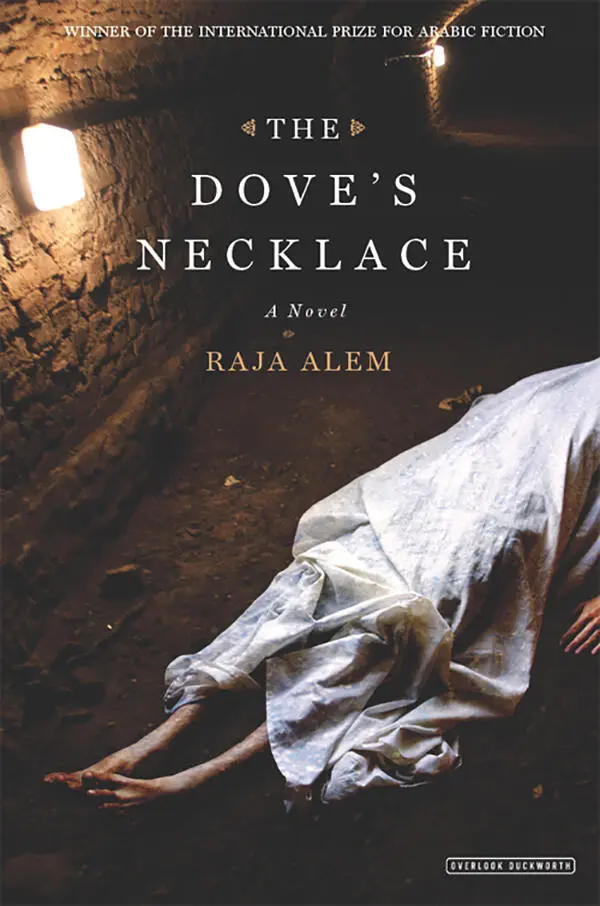
Raja Alem - The Dove's Necklace
Здесь есть возможность читать онлайн «Raja Alem - The Dove's Necklace» весь текст электронной книги совершенно бесплатно (целиком полную версию без сокращений). В некоторых случаях можно слушать аудио, скачать через торрент в формате fb2 и присутствует краткое содержание. Год выпуска: 2016, Издательство: The Overlook Press, Жанр: Современная проза, на английском языке. Описание произведения, (предисловие) а так же отзывы посетителей доступны на портале библиотеки ЛибКат.
- Название:The Dove's Necklace
- Автор:
- Издательство:The Overlook Press
- Жанр:
- Год:2016
- ISBN:нет данных
- Рейтинг книги:4 / 5. Голосов: 1
-
Избранное:Добавить в избранное
- Отзывы:
-
Ваша оценка:
The Dove's Necklace: краткое содержание, описание и аннотация
Предлагаем к чтению аннотацию, описание, краткое содержание или предисловие (зависит от того, что написал сам автор книги «The Dove's Necklace»). Если вы не нашли необходимую информацию о книге — напишите в комментариях, мы постараемся отыскать её.
Tackling powerful issues with beautiful and evocative writing, Raja Alem reveals a city-and a civilization-at once beholden to brutal customs, and reckoning (uneasily) with new traditions. Told from a variety of perspectives-including that of Abu Al Roos itself-
is a virtuosic work of literature, and an ambitious portrait of a changing city that deserves our attention.
The Dove's Necklace — читать онлайн бесплатно полную книгу (весь текст) целиком
Ниже представлен текст книги, разбитый по страницам. Система сохранения места последней прочитанной страницы, позволяет с удобством читать онлайн бесплатно книгу «The Dove's Necklace», без необходимости каждый раз заново искать на чём Вы остановились. Поставьте закладку, и сможете в любой момент перейти на страницу, на которой закончили чтение.
Интервал:
Закладка:
Your slender body kneels in front of me, you set my feet on the footrests of my wheelchair.
Your lips graze my knee for the briefest moment.
You jump up and come around behind me to push the wheelchair.
All the stores on the sidewalk of that narrow lane are closed.
Then we arrive at the river.
In the small village, I let the wheelchair spin in whatever direction it pleased. I discovered that wheelsare bolder, more curious than feet.
The old woman who knits socks in the tiny shop and the redpair you gave me.
No one ever spoiled me before you.
Why is it that we never get the opportunity to spoilthe ones we love and to be spoiledby them?
Aisha
Attachment: A photo of Aunt Halima’s samovar. Half the Haram Mosque have drunk from it.
Also a photo of her drum.
Aunt Halima always repeats her motto to me: “I’m my own woman. God have mercy on anyone who tries to tie me down!”
Discovery signed this drum for me.
Discovery is the Beyoncé of the Lane of Many Heads, ^. She and her whole band with all their instruments sit atop Aunt Halima’s heart. “She’s so beautiful, so sexy, so young. She’s one of a kind, she’s a star!”
She was always waxing lyrical about Discovery and she’d go to all the weddings just to see her, Halima and all the other women who couldn’t get enough of joyous celebration.
P. S. The first meal I ever ate with a strange man, alone, in the openair. It makes my body writhe with passion even now.
P. P. S. Azza loved the bracelet that you and I picked out for her. That day you were surprised, ^, by my naive suggestion that we get our two initials, A & A, Azza and Aisha, engraved on it. I didn’t feel I had to justify anything, but then I said one “A” would be enough. Whenever I dream of life outside the Lane of Many Heads, I become Azza, who becomes me.
Aisha
Manumission
O NE DAY, YUSUF DISCOVERED A SMALL STOREROOM BEHIND THE SITTING ROOM on the third floor, which al-Lababidi had devoted to pictures of Mecca’s largest cluster of papermakers and booksellers, the area between the Great al-Salam Gate and the Little al-Salam Gate on the left side of the incline leading from the Haram Mosque to the Mas’a. Booksellers’ and bookbinders’ stores were mixed with perfumers and kohl-sellers dating from the third and fourth centuries AH; it was a river of ink and perfume welling up from the Haram, flowing alongside the Mas’a.
On the right-hand side of the storeroom were engraved the words: The Perfumers’ Market. Soul of books and soul of oils. Book lovers believe the words of books are what give the perfumes their wonderful scent, but the old fragrance connoisseurs believe that perfumes are what give the books their magic. The truth is, it’s the human spirit diffused in the air that does it.
Yusuf spent the nights gazing at the pictures. He strolled in a waking dream from the Sidra dorms, which had been endowed as lodgings for seekers of knowledge, to the ranks of innumerable small bookstores like Fida, al-Baz, and Mirza, with their tiny dark interiors and traditional arched doorways at which Mecca’s great men — Fida, al-Baz, and Mirza themselves — sat surrounded by piles and piles of manuscripts. Yusuf gazed at a black and white photo of the founding bookseller, Fida bin Adam al-Kashmiri, a hundred years old with feet still dusty from traveling to Istanbul, Egypt, and India in search of books. He had scarcely to utter the first missing title that he noticed— Fath al-Qarib Ala Abi Shuja , say — when his grandson Abd al-Samad would throw him a small cotton cushion to put on the paved ground of the square while he went around to the neighboring stores to bring him the title Fath al-Qarib al-Mujib Ala l-Taqrib by Sheikh Abu Abd Allah al-Shafi’i. He’d come back, having fetched the book, repeating what he always said: “Price is final. Price is final.” Time was suspended and merged, allowing Yusuf to walk slowly and arrive in time for the audience at the bookshop after sunset prayers, where he was enveloped in the most beautiful Quran recitations, by sheikhs Qarut, Bahidra, Qari, Jambi, Ashi, Mirdad and al-Arba’in. Whenever one ended, another would start up somewhere in the twilight. Then, as soon as the evening prayers were over, the chanters would come — Jawa, Abu Khashaba, Bukhari — to salute the night with their hymns and folk songs. Yusuf wandered from bookshop to bookshop, stopping to see the calligraphers, disciples of Muhammad al-Farisi and his student al-Kutbi, who flung out lines of calligraphy to the cadences of the recitations. He stopped to read every one of the signs that were hung on the walls and over the arched doorways — QURANS AND THEOLOGY BOOKS, ARABIC LITERATURE — and witnessed an argument which broke out between some market traders in Sheikh Muhammad Salih Jamal’s bookstore. He stopped at the narrow frontage of the store owned by Abd al-Karim bin al-Baz, heir to the great dean of booksellers, which had become a center of intellectual activity under the auspices of Sheikh Abd Allah al-Urabi, and went in, joining the crowd of youths who were watching, entranced, the poetic duel taking place between al-Zamakhshari, al-Siba’i and Abd al-Jabbar.
Next, leaving the books in the background, Yusuf went out to the square where entertainers and storytellers were narrating the adventures of Abu Zayd al-Hilali to circles of listeners. On his left, sermons still echoed from inside al-Sawlatiya School every Thursday, along with sighs rising up from all the other schools and the homes of the great scholars of Mecca who either taught, led prayers, or delivered sermons at the Haram Mosque. Yusuf examined old title deeds and leases, some of which granted just one side of a store to a bookseller, while another bookseller took the other side; such was the booksellers’ rush for victory in the honorable occupation of bringing books to life.
As night wore on and the stores closed, Yusuf lingered alone, taking deep drafts of the night breeze, which was laden with the scent of ink, old paper, and perfumes, and echoes of the readings and recitations that were still going on. He stood amidst the network of stores, facing the awesome idol Hubal, who had been thrown out of the mosque, one of many idols that had stood in the area around the Kaaba in the pre-Islamic age and were removed after being smashed. Al-Lababidi’s shots were taken from angles that conveyed the vast might of the idol, which lay keeled over with its head, eyes, and nose squashed into the ground under one of the bookstores and its vast stone body stretched out. It was one-armed, because its arm, fashioned entirely out of gold, had been long since hacked off and melted down to make jewelry and gold bullion coins; the rest of the body had remained at the entrance of the Haram Mosque for worshippers to tread on or disdainfully leave their shoes on, until one night during the redevelopment, when it disappeared without warning.
In the dim light of the storeroom, Yusuf examined all the bookstore signs, in particular the attractive sign advertising the services of ABBAS KARARA, MAS’A, MECCA: ANY TOOTH REMOVED COMPLETELY PAIN-FREE, ALL KINDS OF FALSE TEETH FITTED, HALLMARK-GRADE GOLD CROWNING, ALL AT REMARKABLE PRICES.
Reliving his past in al-Lababidi’s photographs, Yusuf realized the danger he’d exposed Azza to. He had been fifteen when he’d dragged Azza to Sheikh Abd al-Razzaq Balila’s bookstore, which was a space of no more than four square meters where the air was laced with the aroma of books. The solemn old man in a white robe and matching muslin turban who greeted them didn’t lift his eyes from the parchment he was reading, part of a volume on mythical creatures that was bound in camel leather and stamped with gold leaf. The old man seemed to come from some immortal ancient time. Behind him were shelves loaded with old manuscripts — Ibn Sirin’s Interpretation of Dreams , Jahiz’s Book of Animals, The Soul by Ibn Qayyim al-Jawziya, The Necklace of the Dove by Ibn Hazm — side by side with stacks of parchments written in the hand of such great Sufis as al-Suhrawardi, al-Niffari’s Stations , and Ibn Arabi’s Meccan Openings . Abd al-Razzaq Balila’s bookstore represented stages through which the knowledge-seeker had to progress: when the student arrived from the Haram Mosque, laden with protestations of God’s oneness, he would travel through the old Arabic manuscripts, the exoteric sciences dispersing into irrelevance as he learned the esoteric ones.
Читать дальшеИнтервал:
Закладка:
Похожие книги на «The Dove's Necklace»
Представляем Вашему вниманию похожие книги на «The Dove's Necklace» списком для выбора. Мы отобрали схожую по названию и смыслу литературу в надежде предоставить читателям больше вариантов отыскать новые, интересные, ещё непрочитанные произведения.




Обсуждение, отзывы о книге «The Dove's Necklace» и просто собственные мнения читателей. Оставьте ваши комментарии, напишите, что Вы думаете о произведении, его смысле или главных героях. Укажите что конкретно понравилось, а что нет, и почему Вы так считаете.