Raja Alem - The Dove's Necklace
Здесь есть возможность читать онлайн «Raja Alem - The Dove's Necklace» весь текст электронной книги совершенно бесплатно (целиком полную версию без сокращений). В некоторых случаях можно слушать аудио, скачать через торрент в формате fb2 и присутствует краткое содержание. Год выпуска: 2016, Издательство: The Overlook Press, Жанр: Современная проза, на английском языке. Описание произведения, (предисловие) а так же отзывы посетителей доступны на портале библиотеки ЛибКат.
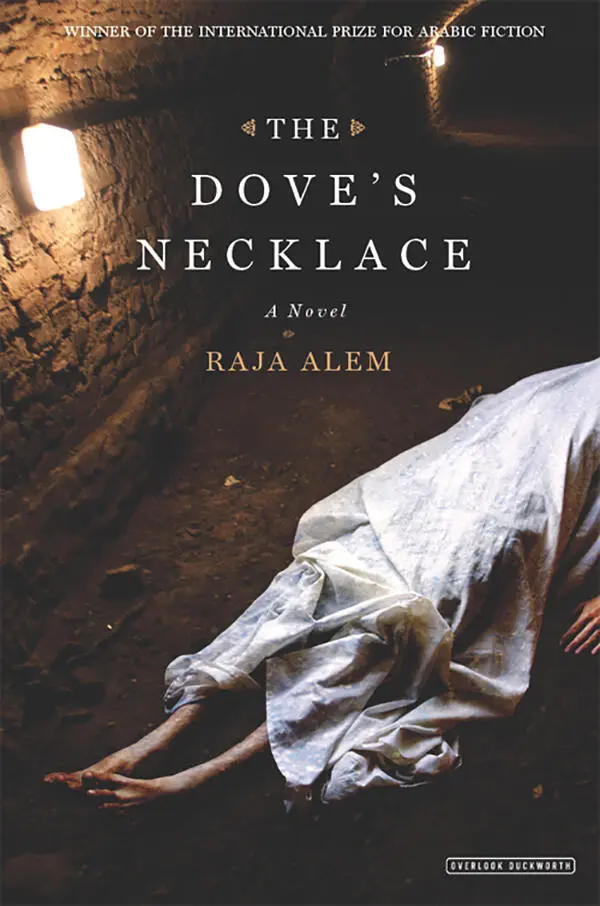
- Название:The Dove's Necklace
- Автор:
- Издательство:The Overlook Press
- Жанр:
- Год:2016
- ISBN:нет данных
- Рейтинг книги:4 / 5. Голосов: 1
-
Избранное:Добавить в избранное
- Отзывы:
-
Ваша оценка:
The Dove's Necklace: краткое содержание, описание и аннотация
Предлагаем к чтению аннотацию, описание, краткое содержание или предисловие (зависит от того, что написал сам автор книги «The Dove's Necklace»). Если вы не нашли необходимую информацию о книге — напишите в комментариях, мы постараемся отыскать её.
Tackling powerful issues with beautiful and evocative writing, Raja Alem reveals a city-and a civilization-at once beholden to brutal customs, and reckoning (uneasily) with new traditions. Told from a variety of perspectives-including that of Abu Al Roos itself-
is a virtuosic work of literature, and an ambitious portrait of a changing city that deserves our attention.
The Dove's Necklace — читать онлайн бесплатно полную книгу (весь текст) целиком
Ниже представлен текст книги, разбитый по страницам. Система сохранения места последней прочитанной страницы, позволяет с удобством читать онлайн бесплатно книгу «The Dove's Necklace», без необходимости каждый раз заново искать на чём Вы остановились. Поставьте закладку, и сможете в любой момент перейти на страницу, на которой закончили чтение.
Интервал:
Закладка:
When Yusuf had become engrossed in the Sufi section, Azza had gotten restless and tried to slip away, so he’d shaken off his abstraction and gone to hang out with her in the cartoon section.
They’d lurked there until the old man headed out to perform his afternoon prayer in the Haram Mosque, then Yusuf grabbed Azza’s hand and pulled her down the steps into a storeroom tucked between the houses in the Hajla neighborhood, where the modern-day mind could journey across the continents and see inside the minds of men, from The Courts of Great Men to Hugo’s Les Misérables as translated by the poet Hafiz Ibrahim. He pulled Azza in between the shelves. To their right, were Marx’s Capital , Kant’s Critiques of Pure Reason, Practical Reason , and Judgment , Hegel’s Encyclopedia of the Philosophical Sciences and The Union of Soul and Matter and his idealism based on the capacity of thesis and antithesis to create synthesis, Cervantes’ Don Quixote and his ill-fated war on windmills — books that had inspired many of the great upheavals that changed the path of humanity. To their left were the world wars — Hemingway’s For Whom the Bell Tolls , Tolstoy’s War and Peace , Dickens’ A Tale of Two Cities , Maxim Gorky’s The Mother —and the intellectual trials that had shaped humankind, from Asia to Europe to America — the Bustani translation of The Iliad and The Odyssey by Homer, prophet of the Greeks, Frazer’s The Golden Bough , Sartre’s The Flies and de Beauvoir’s The Second Sex , Goethe’s repurposing of Sophocles’ model of tragedy, Orwell’s Animal Farm —along with a smattering of the works of Rimbaud, Mallarmé, Maupassant, Foucault, Chekhov, Turgenev, Alexandre Dumas, Shakespeare, William Faulkner, Edgar Allan Poe, Aldous Huxley, Jacques Prévert, Balzac, Camus, and finally Colin Wilson’s The Outsider .
The yellowing pages of those old minds had made Azza cough, so Yusuf had distracted her with stories of wide-eyed young girls who ventured beyond the limited world of reality: Thumbelina, scarcely as tall as a thumb, who was nearly married to a mole, Rapunzel who let down her long hair from her prison at the top of a tower so her lover could visit her, Alice in Wonderland whose one teardrop flooded the underworld, and Cinderella with the fairy godmother who turned insects into horses and rags into jewels and silk so she could escape from the soot of her kitchen …
In the silence of al-Lababidi’s house, Yusuf’s soul peeled away and floated alone through time and space, wandering through a black and white world where Mecca’s past and present bled into one another on the walls. There was nothing to separate the photographs from the things that could be seen out of the windows. There was no longer any link to reality other than the diaries, which Nasser was as addicted to reading as Yusuf was to those photographs; the pair blended together in their shared addiction.
Nasser read on:
June 6, 1995
Azza, your addiction to comics — particularly Batman issue 135, where Batman meets Batwoman — shocked me. The jealousy killed me. I was jealous of your obsession with that superhuman being. I realize now that Batman’s surprise attacks were your model for all those fleeing bodies in your sketches …
Aisha was my unbeatable competitor. That secret conflict with Aisha robbed me of two decades of my life, though maybe she was never aware of it. She had her brothers working as emissaries who’d race me to the bookstores at the Salam Gate and buy books for her, hunting out titles I’d never even heard of, then sneaking them in plastic bags past their father the schoolteacher who’d forbidden the termites that books put into people’s heads.
Aisha, whose weak sight got ever weaker, always read in bed after her family had all gone to sleep. I always imagined her like that, curled up in their reinforced concrete pressure-cooker house, while I sat on our mud roof and we competed to get as much light as we could from the municipal street lamps. I’d finish off a whole book in one night. But where she hid her habit from her parents, I, the fatherless, would read, and love what I read, in the open, because my mother Halima believed that my demon was made of paper — and anyway my book obsession kept me away from smoking, sniffing glue, and sneaking around harassing women, which was what all the other boys my age did.
My greatest loss to Aisha was Marcel Proust’s In Search of Lost Time, the only available copy of which she’d managed, by some inexplicable miracle, to get hold of. She beat me to that lost time, which remained a hole in my heart like a keyhole through which my time trickled out, and sometimes it seemed to me that if I’d managed to get my own copy of that Lost Time then I might have lived a totally different life, might not have been betrayed like I have been.
ON THE ROOF OF AL–LABABIDI’S HOUSE, YUSUF REALIZED JUST WHAT A DAMAGING effect Aisha had had on his life, and realized that it was she, not Azza, who’d betrayed him. The one he’d excised from his diaries, the one he hated, even — he saw now what she’d stolen from him.
Yusuf was tempted to break into Aisha’s room right then to look for Proust’s Lost Time. He trembled a little at the thought. But he was pretty sure that she was sneaky and daring enough to have taken that Time with her.
He thought about Batman, wondering if Batman could have stolen Azza. Did Batman remind Azza of him, Yusuf? Or of some nocturnal creature that penetrated the darkness and avoided obstacles using sonar?
Yusuf was turning into the remnants of a bat, crashing into the remnants of her. He understood for the first time the meaning of all those red lines he drew as a teenager under Kant’s words: space and time are both finite and infinite; matter in itself is both finitely divisible and infinitely divisible; will was both constrained and free. He called out from the roof, “Azza! You’re all of those contradictions. Finiteness and divisibility of the infinite go beyond the surface. I mustn’t give up hope that you’re still there. I’ll search for you wherever you are, even in death, because your death means my death too …”
Yusuf missed bringing Aisha to life in his diaries, but he knew that fate had consigned those days to the past. There was no place for them in the present.
Ring Road
C HECKING THE PASSENGER LISTS OF ALL OUTBOUND SAUDI AIRLINES FLIGHTS for that Thursday and Friday, Nasser discovered Aisha’s husband Ahmad’s name on a dawn flight to Casablanca on the day the body had been found. His sudden appearance and disappearance made it look pretty likely that it was Aisha who was dead, but Nasser shuddered at the thought of going down that line of investigation.
That day, he was trapped for hours at the Gate Lane exit, which led to the Haram Mosque. The engines of all four lanes of cars groaned, pumping fumes into the Meccan heat in competition with public buses, refrigerated vans transporting foodstuffs, trucks piled high with live sheep, and tourist buses whose drivers stood on the gas and zoomed through the traffic, terrorizing the little cars that shoehorned themselves into the tiniest gaps in attempts to escape the creeping paralysis of the traffic. In seasons like this, and especially in the Umrah season during Ramadan, those buses played a leading role on the roads. They looked like mythical monsters, with the dense rows of pilgrims’ heads peering out of their darkened windows, and they mercilessly sliced paths through the masses of humanity before them, which is why Meccans simply vacated the center of their city and left it to the pilgrims, crossing the ring road around the Haram and heading for anywhere outside the first or second belts that encircled the heart of the city and from which all the main trade arteries branched off.
Читать дальшеИнтервал:
Закладка:
Похожие книги на «The Dove's Necklace»
Представляем Вашему вниманию похожие книги на «The Dove's Necklace» списком для выбора. Мы отобрали схожую по названию и смыслу литературу в надежде предоставить читателям больше вариантов отыскать новые, интересные, ещё непрочитанные произведения.




Обсуждение, отзывы о книге «The Dove's Necklace» и просто собственные мнения читателей. Оставьте ваши комментарии, напишите, что Вы думаете о произведении, его смысле или главных героях. Укажите что конкретно понравилось, а что нет, и почему Вы так считаете.