Raja Alem - The Dove's Necklace
Здесь есть возможность читать онлайн «Raja Alem - The Dove's Necklace» весь текст электронной книги совершенно бесплатно (целиком полную версию без сокращений). В некоторых случаях можно слушать аудио, скачать через торрент в формате fb2 и присутствует краткое содержание. Год выпуска: 2016, Издательство: The Overlook Press, Жанр: Современная проза, на английском языке. Описание произведения, (предисловие) а так же отзывы посетителей доступны на портале библиотеки ЛибКат.
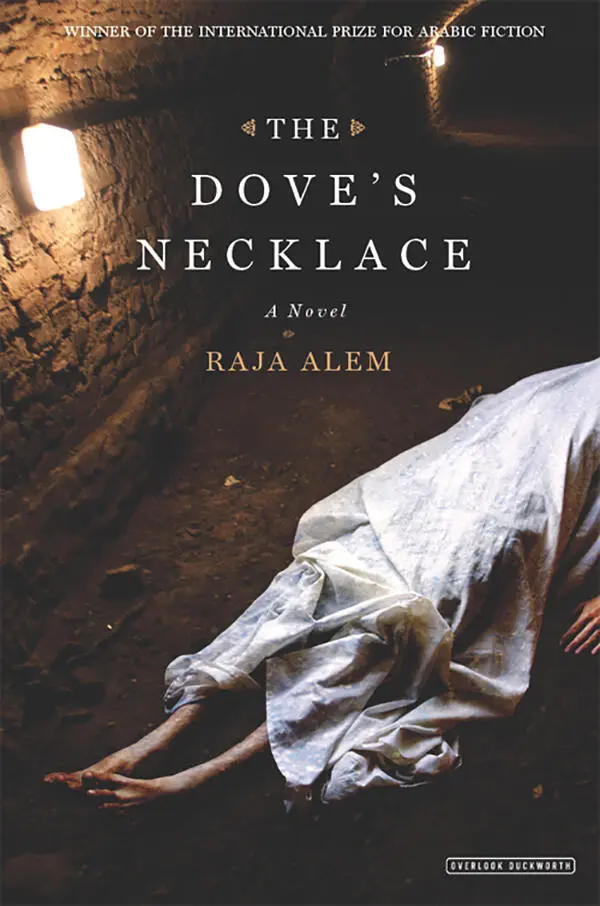
- Название:The Dove's Necklace
- Автор:
- Издательство:The Overlook Press
- Жанр:
- Год:2016
- ISBN:нет данных
- Рейтинг книги:4 / 5. Голосов: 1
-
Избранное:Добавить в избранное
- Отзывы:
-
Ваша оценка:
The Dove's Necklace: краткое содержание, описание и аннотация
Предлагаем к чтению аннотацию, описание, краткое содержание или предисловие (зависит от того, что написал сам автор книги «The Dove's Necklace»). Если вы не нашли необходимую информацию о книге — напишите в комментариях, мы постараемся отыскать её.
Tackling powerful issues with beautiful and evocative writing, Raja Alem reveals a city-and a civilization-at once beholden to brutal customs, and reckoning (uneasily) with new traditions. Told from a variety of perspectives-including that of Abu Al Roos itself-
is a virtuosic work of literature, and an ambitious portrait of a changing city that deserves our attention.
The Dove's Necklace — читать онлайн бесплатно полную книгу (весь текст) целиком
Ниже представлен текст книги, разбитый по страницам. Система сохранения места последней прочитанной страницы, позволяет с удобством читать онлайн бесплатно книгу «The Dove's Necklace», без необходимости каждый раз заново искать на чём Вы остановились. Поставьте закладку, и сможете в любой момент перейти на страницу, на которой закончили чтение.
Интервал:
Закладка:
Nasser left the car running to go and buy some laddu balls, a specialty sweet made from yellow gram flour, raisins, and a hint of cardamom, which he stuffed — all six of them, each the size of a golf ball — into a sandwich under the amused eyes of the sweetseller. He’d eat that sweet for breakfast and lunch if he could, without a thought for the risk of diabetes that loomed over him like it did all the children of the Gulf’s oil boom. He enjoyed the greasy snack at the wheel, the car idling in the same spot thanks to a bus that had stopped in the middle of the road to offload pilgrims — Saudis from other cities whose cars were kept in designated spots at the outskirts of the city while they were loaded onto public buses to be dropped right in front of the Haram Mosque, then loaded back on and returned once they had performed their Umrah obligations.
Nasser looked at the bare shoulders of the male pilgrims and the unveiled faces of the women. If so much as a corner of cloth brushed one of those faces, a sheep had to be slaughtered in recompense. He thought it was weird that a woman’s face had to be uncovered for religious rituals, but sealed up again for life — he was an active participant in that contradictory habit, of course — and he realized that his heart wasn’t racing, his mouth hadn’t gone dry, the sight of those female pilgrims didn’t cause his body to stiffen — he looked at them as if they were some kind of non-masculine, non-feminine third sex — whereas the mere glimpse of a local woman was enough to nail him to the spot! The thought of meeting an unveiled Azza or Aisha in the courtyard of the Haram and stepping on the marble that their feet had touched caused his body to seize. Suddenly he had no appetite and he wrapped the uneaten half of his sandwich up and placed it on the seat next to him.
Ahead of him, the river of cars was dammed between banks of shops: Nour Grocery, Nour Valley, Nour Bakery, Nour Shawarma, Nour Juices … Harra Supplies and Salam Beverages were the only two names that interrupted the broken record repetition of the word Nour , light, over every sign. The repetition resumed a little way down the road, where the offices of the pilgrims’ guides were loudly decorated with lights trained on pictures of the two Holy Mosques and their custodian, the King, which hovered over the heads of the men sitting on long couches, waiting to receive visitors. By one of the offices, Nasser spotted a copy of Umm al-Qura sitting on a rack in front of a small bookstore stuffed with Qurans and biographies of the Prophet, so for the second time he left the car running and went over, paid the three-riyal cover price and grabbed his copy. Back in the driver’s seat, the traffic was still motionless, so he opened up the paper and flicked through in search of Yusuf’s Window, which caught him unawares with the headline “A View Over al-Malah.” He read:
Al-Malah is being extended upward to form a multi-story cemetery.
As fans of conceptual art we’re keen to see the cemetery remodeled as a tower. Our deaths will be truly modern — if not post-modern! A more creative contractor might even fashion the upper stories out of glass so our corpses can lie watching the more freshly dead decompose artistically above them.
I’m afraid to go on my morning stroll around al-Malah these days.
Here in Mecca we’ve become specialists in religious tourism and our mission is to deport our dead. The bodies who were disinterred from al-Shubbayka know all about that. Developers razed the cemetery and moved all its dead to make way for skyscrapers, parking lots, and five-star hotels.
Long corpses were stacked on giant trucks, their legs sticking off the end. Those of us who saw that sight as kids, still see them now, floating in midair down al-Misyal, following the drainage sewers to Majin Pool. Who knows where they took them from there.
The traffic suddenly started moving and a motorcycle roared past Nasser into a narrow gap ahead, belching fumes straight into Nasser’s face. He quickly closed the window and turned on the air-conditioning, laughing at himself for needing living, rather than mummified, air. He regarded the pate of the bike’s back passenger, which was shaved so closely it shone, and the ihram robes that fluttered as the motorbike sped along, contrasting with the driver’s tracksuit and helmet. He found the frivolity of motorbikes so irritating. They’d started to replace taxis as the main form of transport in the past few years since they were so much faster in traffic. A ride cost as little as fifty riyals, but the accidents were innumerable.
Nasser had lost his place when he’d stopped reading, and when he went back to it the word revolution caught his eye.
You could say the dead were the first to form an opposition movement because in Mecca death is the frontline. Meccan graves have a history of rebelling against extortionate taxes. The most famous instance was the Gravediggers’ Revolution in 1326 AH. When Sultan Mehmed V acceded to the throne and the Committee of Union and Progress got their way, the Ottoman constitution was reinstated throughout the empire, including in Mecca and the Hijaz. The Ottoman constitutionalists established a specific tax of five riyals for burial of the dead, which was allegedly to cover the cost of maintaining the graves. They summoned the leader of the gravediggers’ guild and instructed him to exact full payment from the relatives of every dead person, but he refused categorically and stormed out of the government palace with the famous words
People of al-Malah, rise up!
Death may well be free today
but tomorrow to die they’ll make you pay!
His cry roused the anger of the people of the Hijaz. No longer impressed by the constitutionalists’ principles, they lost what faith they’d had in the Young Turks’ revolution against the Sultan. Their crier called for a holy war, and young men from every neighborhood responded, coming out with their weapons and clamoring for a revolution against the Turks. They clashed with soldiers in markets around the city, and small numbers were killed and injured on both sides until the Turks managed, with the help of several Sharifs, to suppress the mutiny a few hours later. The Sharif of Mecca, Ali bin Abd Allah Pasha, was accused of fomenting and aiding the revolt and promptly deposed. Sharif Hussein bin Ali was installed in his place. A hardline conservative, he paid no attention whatsoever to the principles of the constitution that granted ordinary people a bare minimum of political rights because it went against the tradition of total separation between the ruler and the ruled, which was something he cherished.
The traffic finally eased when the troop of pilgrims crossed the road toward the Haram behind a young guide, chased by a little Afghan boy selling miniature prayer mats, decorated with glittery pictures of the Kaaba, out of a plastic bag. Nasser bore right, toward Hafayir, though he wasn’t planning to go anywhere in particular. Since he’d taken on the case, Mecca — the city he’d left his birthplace, Ta’if, for — had stirred in his heart; more than once, now, he’d driven around aimlessly at night, for no other reason than to check that his Mecca was still there and that the angels hadn’t carried it away to punish its unworthy residents.
As soon as he turned into al-Mansur Street he was surrounded by shining black faces. He felt safe in that narrow alley, which was named after the dervish who lived there, al-Sayyid al-Shanqiti, who was famous for materializing out of nowhere. He would wander the alley or sit down on the sidewalk in front of the mosque, perform some miracle, then suddenly disappear again. Nasser parked opposite al-Shanqiti Mosque and continued on foot, looking around him without knowing what he was looking for. People always hoped that some crisis would persuade al-Shanqiti to return from his occultation; Nasser could feel anticipation in the air, the hope that he would appear like he had once when a father had accidentally slammed a car door on his son’s hand. Al-Shanqiti materialized, read some verses from the Quran over the crushed hand, and then breathed on it. The boy’s hand had healed immediately. Or once when a motorcyclist had an accident with a car and his leg was smashed up; al-Shanqiti appeared, recited, and breathed, at which the wounds sealed themselves up and the bones set themselves. The young man got to his feet as good as new and set about collecting the broken bits of his motorbike and hauling them over to the nearest mechanic’s. The stories, Nasser thought, would be perfect for those shows on satellite where they read the stars, cure people’s problems with magic, and turn ugly ducklings into graceful swans through epic cosmetic surgery operations.
Читать дальшеИнтервал:
Закладка:
Похожие книги на «The Dove's Necklace»
Представляем Вашему вниманию похожие книги на «The Dove's Necklace» списком для выбора. Мы отобрали схожую по названию и смыслу литературу в надежде предоставить читателям больше вариантов отыскать новые, интересные, ещё непрочитанные произведения.





Обсуждение, отзывы о книге «The Dove's Necklace» и просто собственные мнения читателей. Оставьте ваши комментарии, напишите, что Вы думаете о произведении, его смысле или главных героях. Укажите что конкретно понравилось, а что нет, и почему Вы так считаете.