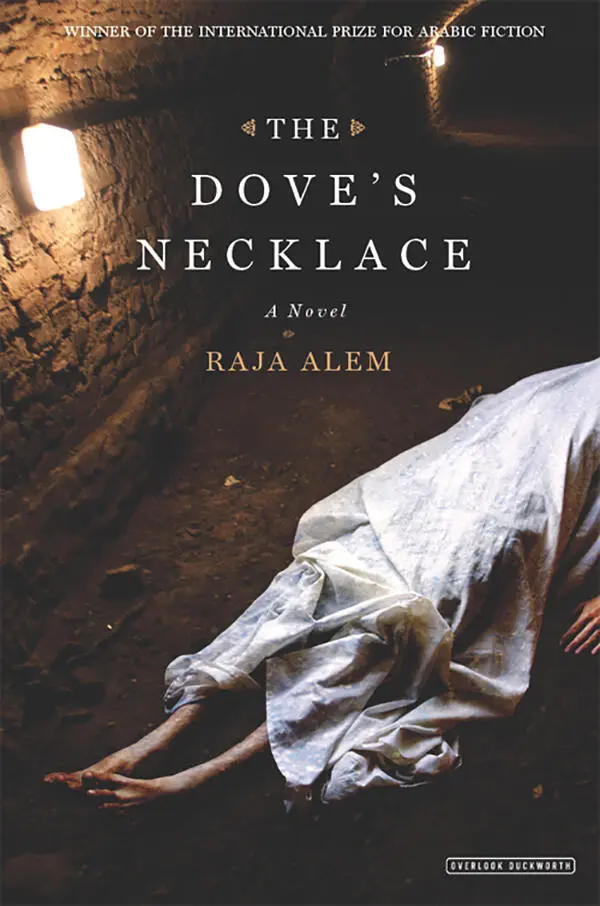
Raja Alem - The Dove's Necklace
Здесь есть возможность читать онлайн «Raja Alem - The Dove's Necklace» весь текст электронной книги совершенно бесплатно (целиком полную версию без сокращений). В некоторых случаях можно слушать аудио, скачать через торрент в формате fb2 и присутствует краткое содержание. Год выпуска: 2016, Издательство: The Overlook Press, Жанр: Современная проза, на английском языке. Описание произведения, (предисловие) а так же отзывы посетителей доступны на портале библиотеки ЛибКат.
- Название:The Dove's Necklace
- Автор:
- Издательство:The Overlook Press
- Жанр:
- Год:2016
- ISBN:нет данных
- Рейтинг книги:4 / 5. Голосов: 1
-
Избранное:Добавить в избранное
- Отзывы:
-
Ваша оценка:
The Dove's Necklace: краткое содержание, описание и аннотация
Предлагаем к чтению аннотацию, описание, краткое содержание или предисловие (зависит от того, что написал сам автор книги «The Dove's Necklace»). Если вы не нашли необходимую информацию о книге — напишите в комментариях, мы постараемся отыскать её.
Tackling powerful issues with beautiful and evocative writing, Raja Alem reveals a city-and a civilization-at once beholden to brutal customs, and reckoning (uneasily) with new traditions. Told from a variety of perspectives-including that of Abu Al Roos itself-
is a virtuosic work of literature, and an ambitious portrait of a changing city that deserves our attention.
The Dove's Necklace — читать онлайн бесплатно полную книгу (весь текст) целиком
Ниже представлен текст книги, разбитый по страницам. Система сохранения места последней прочитанной страницы, позволяет с удобством читать онлайн бесплатно книгу «The Dove's Necklace», без необходимости каждый раз заново искать на чём Вы остановились. Поставьте закладку, и сможете в любой момент перейти на страницу, на которой закончили чтение.
Интервал:
Закладка:
A stranger woke him up after he’d spent two days sleeping, hungry and forgotten on the beach, licked by the tide. “Brother, go find some shade from this sun!” He gradually became aware of the Arabic words and realized that someone was trying to coax him to consciousness. As soon as he had woken, Joseph pulled the drawing out of his pocket and thrust it at the stranger, gesturing toward the golden door. “This is what I’m looking for.”
Salt-soaked Arabic words flooded from his mouth, reminding him that it had been months since he’d spoken to another human being. Traveling in the infernal hold of one of the ships of the invading Portuguese fleet was like being incubated in a womb from hell.
“It came to me in a dream, a door between heaven and earth. I searched and searched and found that this city, Aden at the base of the Arabian Peninsula, is the gateway to the village of Solomon’s Seal, which contains every door on earth. That’s why your city is called ‘Aden’—because it leads to those doors …”
For days, Joseph ibn Nagrela traveled across the land of Yemen, repeating the story in an Arabic too heavy for the simple people he met to understand; still, the moment they set eyes on that drawing of the door, they realized that he was a man possessed by thoughts of a world other than theirs.
He kept repeating the story until one day he crossed paths with a beggar. “Happy Solomon at your service,” the man greeted him merrily. When Happy Solomon clapped eyes on the door, he fell silent, listening to his genies and subjecting Joseph to careful scrutiny, then said, “My tongue speaks the tongues of all those who believe, every language on earth spoken by men who breathe, even the speech of beasts, so accept my wisdom. I’m a miniature version of the prophet Solomon himself!” He examined the drawing with the help of his genies and explained, “What you are seeking is beyond the destiny of Eve’s sons. My genies speak of a mountain of doors, but there none of those doors will open for a living human.”
“Will they open for a dead person?”
“My genies know about life, nothing else. Don’t tire them out with your riddles about death.”
In the face of Joseph ibn Nagrela’s determination, Solomon the Happy assented to be his guide to the Hadramawt Valley. On foot, they crossed the happy mountains of Yemen, avoiding Seiyun and its famous market where craftsmen sold their products, including doors. Joseph nevertheless saw many Seiyuni women in their wide straw hats and brocade-embellished dresses, stopping travelers with songs and dances and inviting them to come to the market; they tried to tempt Joseph himself to buy one of their doors.
Happy Solomon also avoided al-Hajarayn, the town in the mountains famous for its beekeepers and their curative honey, warning Joseph, “You can say goodbye to your door if you drown in the honey of al-Hajarayn. The mountain’s like our mother Eve, who opened her legs to tempt Adam from Paradise.”
They avoided Shibam, climbing the mountains facing it so as to look across the Hadramawt Valley from their peaks. The city was filled with towering mud buildings of five, six, seven stories, which stood like a crowd of giants gathered in a space of no more than five hundred meters across, destruction masochists, so fragile was their position on the plain, which was constantly at the mercy of mountain floods.
“You must pass by the reservoir of underground water before you reach the temples,” advised Happy Solomon. He led Joseph ibn Nagrela to the outskirts of Ma’rib, a city that stood on the remains of the Great Dam and was known as the “city astride the two gardens of paradise.”
“I will leave you here to continue your journey,” said Happy Solomon. “If you’re fortunate, the lord of the genies and birds will permit you to enter the village of Solomon’s Seal.” He vanished then and there, as if he’d never existed.
Joseph ibn Nagrela found himself alone, standing between the two temples — Baran, temple of the sun, which was also known as the throne of Bilqis, Queen of Sheba, and Awam, temple of the moon, which was known as Bilqis’ Sanctuary. He looked out on the vast sand sea that was the Empty Quarter.
The first night fell pitch black, erasing Joseph’s features, forming deep pools of shadow in the valley and hovering over the temple of the moon, revealing to Joseph the place where lovers from all over the Arabian Peninsula came to die. As night proceeded, the nine-meter-high crescent-shaped temple wall, carved from a single block of stone, came to life. It emerged out of the great sand guarded by eight eastward-facing pillars inlaid with seashells or moonshells, which invited him to enter, luring him into the Holy of Holies whose translucent marble walls were woven out of silver and gold and precious stones.
Joseph spent his nights in a trance between the four columns of the Holy of Holies, listening to the two tableaux that stood seven meters above the ground on either side of the entrance, whispering prayers for love and prosperity, begging the Queen of Sheba to materialize out of the milky sand, naked and as lithe as the moonlight, which gleamed on the temple floor as she walked on tiptoe to take up her ceremonial gown of shimmering silver that left her shoulders and arms bare, two slits running from the top of her thighs to her bare feet. Wearing her crown, she then approached her seat among the stone seats that surrounded the stone table at the entrance of the Holy of Holies. The seats of mother sun and father moon and Venus were taken up as well as they all met to discuss how to lure back her lover Almaqa from Awam. The pale, translucent marble would light up with his presence, reflecting the faces of the resurrected lovers who had risen up from the graves that lay in row after row to the south and west of the temple.
Joseph spent his nights in a fever for Bilqis, listening and emptying his soul of everything but his longing for that door.
Finally, when the moon waned and withdrew, Joseph ibn Nagrela followed it, with the flood of lovers illuminated by Bilqis’ breaths, walking three kilometers to the west and crossing the plain of henna and coffee trees of the left garden of paradise, led by five pillars and a sixth broken pillar to the temple of the sun where he waded through the wide water channel to the south and then entered the gate to the main temple, crossing the vast courtyard, which was still alive with the echoes of feasts held in Almaqa’s honor. Inscriptions threatened curses on any thieves who dared to enter the sanctuary. He climbed the stairs in the courtyard to the huge dais to the Holy of Holies, where the bull planted its four-meter-high legs to fertilize the soil and the lovers.
Joseph spent his days deciphering pledges of love inscribed in cuneiform on the eastern columns of the dais and the offerings that lovers brought from the ends of the earth: jars of herbs, perfumes, incenses, silver that the lover-pilgrims laid along the length of the wall of the external courtyard and on both sides of the main gate. To Joseph the temple seemed a polished expanse of translucent alabaster, breathing in the sunlight and exuding a faint cinnamon-scented incense, a pool of goodness that healed his senses and filtered the light around him so that it magnified the image of the door inside him.
News of Joseph ibn Nagrela spread: they said he was a hermit who had brought to life the pilgrimages Bilqis and her lover Almaqa made to visit each other, traveling constantly between Baran and Awam, and had taken up residence in Almaqa’s Holy of Holies, where he received the lover-pilgrims who came to Almaqa seeking the moon’s spells and the farmers and shepherds who came seeking the sun’s. With the lust of a miser, Joseph ibn Nagrela devoted himself to receiving the pilgrims and collecting from their mouths and hearts their harvest songs and love poems, learning from their dances the primitive, animal, chest-splitting cries that begged a lover to be swayed, a plant to grow, a harvest to be enriched.
Читать дальшеИнтервал:
Закладка:
Похожие книги на «The Dove's Necklace»
Представляем Вашему вниманию похожие книги на «The Dove's Necklace» списком для выбора. Мы отобрали схожую по названию и смыслу литературу в надежде предоставить читателям больше вариантов отыскать новые, интересные, ещё непрочитанные произведения.





Обсуждение, отзывы о книге «The Dove's Necklace» и просто собственные мнения читателей. Оставьте ваши комментарии, напишите, что Вы думаете о произведении, его смысле или главных героях. Укажите что конкретно понравилось, а что нет, и почему Вы так считаете.