Raja Alem - The Dove's Necklace
Здесь есть возможность читать онлайн «Raja Alem - The Dove's Necklace» весь текст электронной книги совершенно бесплатно (целиком полную версию без сокращений). В некоторых случаях можно слушать аудио, скачать через торрент в формате fb2 и присутствует краткое содержание. Год выпуска: 2016, Издательство: The Overlook Press, Жанр: Современная проза, на английском языке. Описание произведения, (предисловие) а так же отзывы посетителей доступны на портале библиотеки ЛибКат.
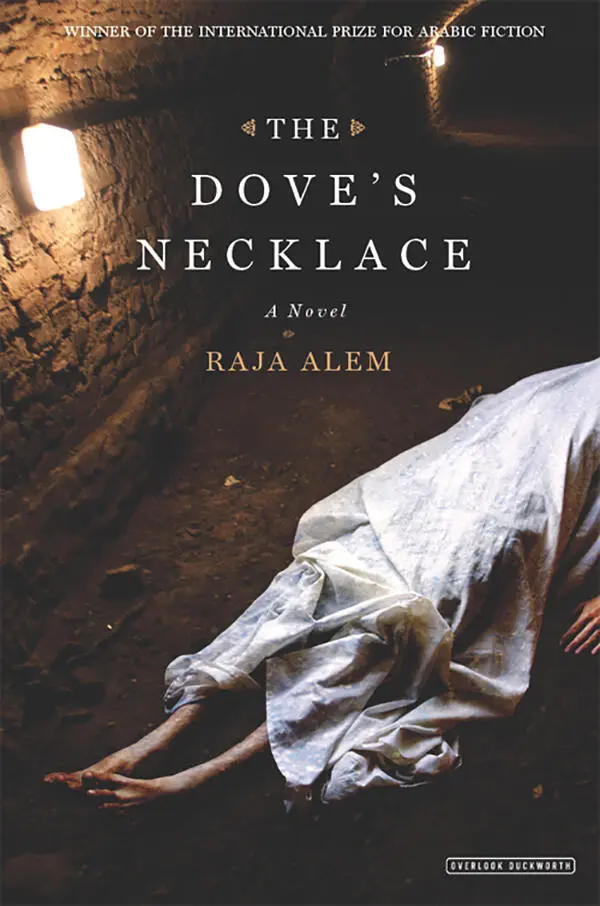
- Название:The Dove's Necklace
- Автор:
- Издательство:The Overlook Press
- Жанр:
- Год:2016
- ISBN:нет данных
- Рейтинг книги:4 / 5. Голосов: 1
-
Избранное:Добавить в избранное
- Отзывы:
-
Ваша оценка:
The Dove's Necklace: краткое содержание, описание и аннотация
Предлагаем к чтению аннотацию, описание, краткое содержание или предисловие (зависит от того, что написал сам автор книги «The Dove's Necklace»). Если вы не нашли необходимую информацию о книге — напишите в комментариях, мы постараемся отыскать её.
Tackling powerful issues with beautiful and evocative writing, Raja Alem reveals a city-and a civilization-at once beholden to brutal customs, and reckoning (uneasily) with new traditions. Told from a variety of perspectives-including that of Abu Al Roos itself-
is a virtuosic work of literature, and an ambitious portrait of a changing city that deserves our attention.
The Dove's Necklace — читать онлайн бесплатно полную книгу (весь текст) целиком
Ниже представлен текст книги, разбитый по страницам. Система сохранения места последней прочитанной страницы, позволяет с удобством читать онлайн бесплатно книгу «The Dove's Necklace», без необходимости каждый раз заново искать на чём Вы остановились. Поставьте закладку, и сможете в любой момент перейти на страницу, на которой закончили чтение.
Интервал:
Закладка:
She stared at the gold embroidery on the robes of the saints laying him to rest while the messengers of death themselves became obscured. Then Picasso’s painting Evocation, The Burial of Casagemas , which she’d seen in the Museo del Prado one morning, materialized before her eyes. The Burial of the Count of Orgaz was overlaid with Picasso’s painting, the blue of Evocation cast over the heavenly gloom of the angels descending to carry out the funeral rites. There was another body where the count’s body had been, but it wasn’t the body of Picasso’s friend Casagemas. It was someone else, someone Nora felt she knew. Naked women took the place of the angels, and there were two who stood out in particular. They were wearing sheer thigh-high stockings: one in red, the other in black. They both looked like they’d just walked out of a cabaret. They stood, watching the macabre scene below. Then, the two women turned to look at Nora. The woman in black stockings looked just like her; it was like looking at a mirror. When she turned to examine the woman in red, her heart stopped.
The Devil’s Horns
“THIS TRIBE IS LEGENDARY — people call them the Devil’s Horns,” al-Ghatafani cried out to us, “but they may be nothing more than a mirage created by our own fear …” We slowed down to interpret the terrifying sight: mountaintops pricked the sky like devils’ horns, blocking the horizon. The giants took the lead, urging our camels to hurry forward and penetrate the rocky slopes by way of narrow hidden passages carved out by goodness knows what. The camels rushed along in a frenzy, scratching themselves against the rock, so excitable that they threatened to throw us off. They were bloody by the time they reached the open space that materialized behind a wall of rock. There was an entire universe hidden behind that abominable rock face: palm trees, grazing animals, people — all the same sandy color — surrounding an enormous idol of blazing black. A shiver ran through the devil’s horns around it, adding to the stench of burnt flesh that it gave off. Our worst fear had risen up out of the sand.
Pages and pages of the parchment were missing, and Yusuf had to skip lines obscured by patches of blood or henna.
THEY PULLED ME FROM THE SAND and threw me at the feet of their leader, who watched me struggle. He caught hold of my right hand and examined my birthmark, a vein that ran across my palm from my index finger to my wrist, where it disappeared into the bundle of veins there.
Their leader’s body was a fierce sandstorm; it ravaged me for nights and days during which my eyes never closed once. I fulfilled that sheikh’s every desire, as the blood boiled in my eyes. My screams were even louder than those of al-Ghatafani coming from whatever hell they were subjecting him to.
“The woman who bears this birthmark will carry the demon who will inherit the earth. Through him, our spawn will penetrate all tribes and become ageless demons that roam the earth, breeding with the survivors of storm-struck caravans and ships on the shores of the Gulf of Suez and the Persian Gulf …”
Burial
“S OMETIMES I GET WOKEN UP BY A DEEP FEELING OF REMORSE. ABOUT WHAT, I don’t know … There’s always the same idea jammed in my head: ‘You’re a fighter,’ it says, but it sounds more like criticism than praise.” She fell silent, trying to hear the reproachful voice replay itself. The two paintings, the Picasso and El Greco, had fused in her mind, and it disturbed her. “I’ve never fought for anything. Not for principles, or a better life, or love of country. None of that matters to me. Now I’m fighting for the sake of my silly little whims. I embarked on a total of one battle — for love — and it vanquished me.” She waved the dream away with a flick of her hand.
“The only thing I ever fought for was the love of a man who was aging with frightening speed. His body grew weaker by the minute, everything except his heart, which was cast iron and sealed shut. It ticked assiduously but never to the bigger beats that cause hearts of flesh and blood to tremble. My father was proud to be a descendant of those striving men of rock-hard conviction who’d fought both for and against the unification of the Arabian Peninsula. I had to learn to live with that iron heart, to make important decisions on my own, without letting my emotions get in the way. The first emotion I ditched was fear, because nothing mattered.” Her voice quavered at the bruising words.
A tourist bent down, smiling politely, to pick up the book that had slipped from her hand and fallen in front of the grave, setting it beside her. She placed it gravely on her lap, open at The Adoration of the Shepherds , who were arrayed reverently around the child and his mother Mary. It was El Greco’s last painting; he’d intended for it to hang over his grave in the Church of Santo Domingo el Antiguo. Her words flowed, barely above a whisper, bringing the past to life, and Rafi strained to listen, not wanting to miss a word, as the infant in the painting cast a glow onto Nora’s face as well as those of the shepherds around him.
“Some mornings you wake up and you know it’s not like other mornings. You’re on top of the world, everything you dreamed of the night before is waiting for you just outside the door, you just need to push it open with your toes and everything will rush in, climb into bed with you, right into your lap. That morning, it was her lap that was overflowing. I froze; the moans she was suppressing were coming from my body. ‘Help me …’ she begged. Pleas, sweat, bloody-tasting tears: I had no idea what to do, and the contractions were coming thick and fast, there was no time to think.
“‘How did you hide this the whole time?!’ A spasm of pain and my reproach was batted away; her water broke at my feet. The stink of bloody water covered my limbs, blinding me. I could feel the heat of the fetus against my thighs as it swam in that water. I was pressed up against her thighs, face to face, as a storm tore through my body. I had no time to look for help; it was just me and that laboring belly and the world closing in on us.
“‘No one can know …’ The breaths she wasted on that plea closed the womb around the baby’s thighs. I don’t know how long the child had to wait on the threshold of the world like that until I slipped my fingers inside her. Even today, my hands tremble when I reach for something …” She raised her trembling fingers in the air.
“I can still feel her vagina and the baby drenched in water. I tried to free a tiny leg trapped by a tear in the vaginal wall, and I pushed the left leg, which was in a hurry to step over the threshold, back against the right so they could slip out together; I was afraid the frantic leg would tear the pelvises of both mother and child. In those hours, which felt to me like a single viscous second, I sank inside the woman who’d been my only friend; the only person who could read me like a silly poem memorized in school. I’d never been more than a flimsy imitation of the passion and tenderness that she imposed on the world around her through books and words … There, on the knife-edge between life and death, I lost the ability to communicate with her slow rhythm. She was in no hurry to push that child out, despite the fear of scandal; if anything, maybe she was hoping to keep the baby hidden inside her. But then a violent spasm in her womb decided the matter: the baby was out. He didn’t cry. With two bloody masses on either side of me, I waited: for her placenta and for the first breath to blow open his lungs. For a moment, I allowed her to die, worried that the walls of the womb had collapsed around the placenta, but then out of the corner of a terrified eye, I saw her belly contract as she squatted, and the placenta slithered slowly out on to the ground. I was conscious of nothing but the tiny, slippery, utterly mute body in my hands. I had nothing to cut the umbilical cord with, so I sealed it off near the belly with a bobby pin, and instinctively turned him upside down and rubbed his body between my palms so the lungs would open and drink air. For a few moments, time stopped: the tiny body in my hands watched me silently with closed eyes that peered through me, and then, in an instant, my lips were on his blue lips, my forefinger parted them, and I sucked deeply. The taste can’t be described in words — it wasn’t salty, it wasn’t bloody — it was the taste of life. The liquid filled my throat, and it still does; I often wake up coughing in the middle of the night, trying to spit it out. A last desperate suck at what was behind those lips and a shudder convulsed the little chest. He cried! Joy gripped me, but fear, too, fear that someone might hear, and he sensed it too and fell definitively, finally, silent. Living and dying in the space of a moment.
Читать дальшеИнтервал:
Закладка:
Похожие книги на «The Dove's Necklace»
Представляем Вашему вниманию похожие книги на «The Dove's Necklace» списком для выбора. Мы отобрали схожую по названию и смыслу литературу в надежде предоставить читателям больше вариантов отыскать новые, интересные, ещё непрочитанные произведения.





Обсуждение, отзывы о книге «The Dove's Necklace» и просто собственные мнения читателей. Оставьте ваши комментарии, напишите, что Вы думаете о произведении, его смысле или главных героях. Укажите что конкретно понравилось, а что нет, и почему Вы так считаете.