Raja Alem - The Dove's Necklace
Здесь есть возможность читать онлайн «Raja Alem - The Dove's Necklace» весь текст электронной книги совершенно бесплатно (целиком полную версию без сокращений). В некоторых случаях можно слушать аудио, скачать через торрент в формате fb2 и присутствует краткое содержание. Год выпуска: 2016, Издательство: The Overlook Press, Жанр: Современная проза, на английском языке. Описание произведения, (предисловие) а так же отзывы посетителей доступны на портале библиотеки ЛибКат.
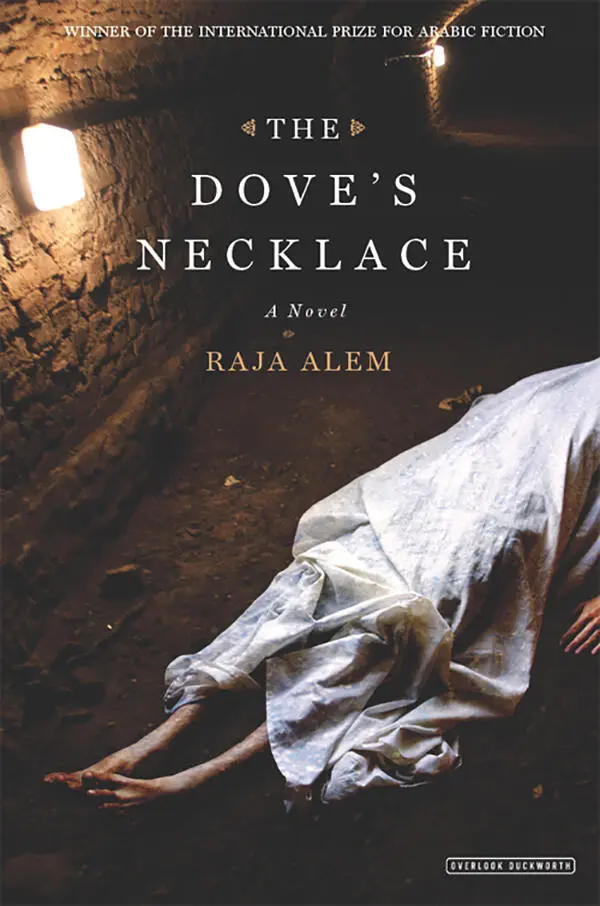
- Название:The Dove's Necklace
- Автор:
- Издательство:The Overlook Press
- Жанр:
- Год:2016
- ISBN:нет данных
- Рейтинг книги:4 / 5. Голосов: 1
-
Избранное:Добавить в избранное
- Отзывы:
-
Ваша оценка:
The Dove's Necklace: краткое содержание, описание и аннотация
Предлагаем к чтению аннотацию, описание, краткое содержание или предисловие (зависит от того, что написал сам автор книги «The Dove's Necklace»). Если вы не нашли необходимую информацию о книге — напишите в комментариях, мы постараемся отыскать её.
Tackling powerful issues with beautiful and evocative writing, Raja Alem reveals a city-and a civilization-at once beholden to brutal customs, and reckoning (uneasily) with new traditions. Told from a variety of perspectives-including that of Abu Al Roos itself-
is a virtuosic work of literature, and an ambitious portrait of a changing city that deserves our attention.
The Dove's Necklace — читать онлайн бесплатно полную книгу (весь текст) целиком
Ниже представлен текст книги, разбитый по страницам. Система сохранения места последней прочитанной страницы, позволяет с удобством читать онлайн бесплатно книгу «The Dove's Necklace», без необходимости каждый раз заново искать на чём Вы остановились. Поставьте закладку, и сможете в любой момент перейти на страницу, на которой закончили чтение.
Интервал:
Закладка:
“How long did we sit there, those two heaps, once living, now dead, lying between us? I felt guilty for the vitality that had come over me. I couldn’t bury him; he was still lying against my chest, his blood clotting on my nipples. When she got up, limping her usual slight limp, she pulled the placenta to her chest; I followed her, and we walked almost pressed side-by-side. Under the stairs, I dug with one hand and with the other held the baby firmly against my chest. All my longing to give birth was embodied in that pliant bundle of life, and when the hole was long enough I let her snatch him from me. I ignored his male organ, preferring to bury him gender-less, and turned and went upstairs before the soil could touch him.”
On those naked steps high in Toledo, Nora and Rafi sat in silence, the radiant energy of the painting of the child and shepherds animating the dance-like figures of the tourists around them. The striking contrast between the degrees of dark and light in the painting and the city heightened the drama of the scene. The long shadows of tourists, the laughter of a girl sitting on the shoulders of a young man with long hair, the babbling of an old woman who’d begun dancing, alone, to the melody of the violin played by a homeless man in colorful gypsy clothes. Nora’s voice blew toward them like wind from a distant time and place. She absentmindedly stroked the naked infant among the shepherds on the page.
Nora got up, as if fleeing from that birth, and Rafi followed her. They walked through the brilliance of the clashing darkness and light in the painting, and their feet led them to the fourteenth-century bridge of San Martín. The Gothic surroundings were the most beautiful setting for a sunset in all of Spain.
“I snuck under the stairs with my paper and charcoal, that night, and drew that baby in dozens of sketches, but none of them pulsed with the warmth of the tiny body that had died on my chest. None of them tasted like that water. I couldn’t bring myself to breathe a single word for months after that, it might have been seven months, or maybe more — I was afraid I’d lose the taste in my mouth, the taste of the inside of a woman from a child’s mouth. It was my secret taste, and without it the world would drop dead and abandon me. That child should have been born from my womb so he could shatter this worry of infertility. I never dared to ask what had made a married woman deny that she was pregnant.”
Around them the violin’s song blended with the crimson sunset and the bodies around them began dance, everything swayed as though drunk in the sunset, and Nora fell silent. It only added to the feeling that they were still walking through The Burial of the Count of Orgaz , the distorted proportions of human bodies that dominated the painting mingling ecstatically with the tourists on the bridge, whose faces had become exaggeratedly tragic or comic, their laughter shriller and their silences more profound, as longing floated in the air above like a blood smear that dissolved the city in the red peaks of the mountains.
The disc of the sun looked like an oil painting pinned to the horizon. Stone Toledo loomed above them, its head in the sky and its feet in the waters of the Tagus. Time froze. Nora was like a creature from a different era, stamped — no matter how she tried to shake it off — with features of primitiveness and imminent extinction. A voice inside her explained to her what she was seeing around her.
“There’s an eternal process of displacement, a constant concealment, in which people are forced to hide their religion, their loyalties, their pregnancy, their reality, their battles, even their gender. People disguise themselves as something other than what they are: man as woman, genius as idiot, Muslim as Jew as Christian, debaucher as prig, fundamentalist as liberator, so they can guarantee that they’ll be accepted, or so they can worm their way into people’s hearts or places or positions of power, or just so they’ll be left alone to live in peace.” The people around her, and Nora, herself, were part of that human flock, in a state of denial, hiding, masking. All those living creatures, minerals, humans were nothing but masks of the Divine Power, who became visible in extremes of infidelity and faith, piety and sin, moving away from Himself to practice His wholeness. The alley of her childhood was all about unmasking; that truth had come to her early, when she was still a child, though she may not have been able to translate it into words at the time. How many masks had been pulled off in that faraway alley? There, when a passerby felt certain that they were alone, silent and unseen, they would play out their reality, revealing their face for God alone to see without judgment or punishment. The difference between seeing and seen would dissolve. Tragic and comic storylines were acted out in that alley, and only the doves replayed the same act over and over when they answered the sound of her lover’s motorbike with a flutter of their wings and flew in a complete arc over the alley like passion flowing. Her heartbeats quickened, warning of exposure, and she stuffed the masks inside her breast though she longed to release them. The departure of the motorbike, more than that of the man, was what had caused her to feel a tyrannical urge — like exhaust fumes — to flee and spread.
The flow of her past was suddenly interrupted by the appearance of the woman from the morning. “O merciful Father, you’re here! I was worried you’d left!” she cried, still panting. Rafi couldn’t hide the shock from his face; some deep presentiment told him the woman’s appearance would bring evil.
“I’ve been all over Toledo looking for you. I knew this place was my last chance to find you.” When she took Nora’s hand, Nora didn’t start; the woman pressed it to her own, upturned so as to read the palm. With her left hand she dabbed the sweat from her temples and wiped it on her pants, passing its dampness on to Nora’s palm.
“Your face has been in my mind since I left the two of you. I knew I’d seen it somewhere before.” The movement around them stopped, and the red of the setting sun darkened, throwing sinister shadows across the walls and gargoyles. Neither Nora nor her companion uttered a breath; Rafi felt like he could do nothing to stop the fates that were being entwined around Nora.
“Come with me, I have something to show you.” She gave them no chance to object and set off, leading them back toward the Mosque of Cristo de la Luz. When they got there, they gazed up at the decorated brick facade and the series of arches that called to mind the mosque in Cordoba.
“This mosque dates back to the year 999, but it was converted into a church in the twelfth century. A statue of Christ that had been bricked into the wall to avoid profanation was re-discovered in the time of Alfonso the Sixth and El Cid.” She grasped them by the arm and stopped them in the threshold, where they could see both the watching silence inside and the redness of the setting sun, which was unable to penetrate into the mosque. “That was when this transept was added, and with it a Mudejar semicircular apse.”
The woman kept them there under the three arches of the door for what felt like a long while. The mosque felt totally deserted, like it was holding its breath. There wasn’t even a janitor or imam there. To Nora, it seemed like a toy mosque with its cuboid shape and fine decorations. Rafi retreated a few steps to read the Arabic inscription in the brick facade: “In the name of God, Ahmad ibn al-Hadidi built this mosque at his personal expense, desiring God’s reward. With God’s assistance, and that of the architects Musa ibn Ali and Sa’da, it was completed in the month of Muharram in the year three hundred and ninety-nine.”
Читать дальшеИнтервал:
Закладка:
Похожие книги на «The Dove's Necklace»
Представляем Вашему вниманию похожие книги на «The Dove's Necklace» списком для выбора. Мы отобрали схожую по названию и смыслу литературу в надежде предоставить читателям больше вариантов отыскать новые, интересные, ещё непрочитанные произведения.





Обсуждение, отзывы о книге «The Dove's Necklace» и просто собственные мнения читателей. Оставьте ваши комментарии, напишите, что Вы думаете о произведении, его смысле или главных героях. Укажите что конкретно понравилось, а что нет, и почему Вы так считаете.