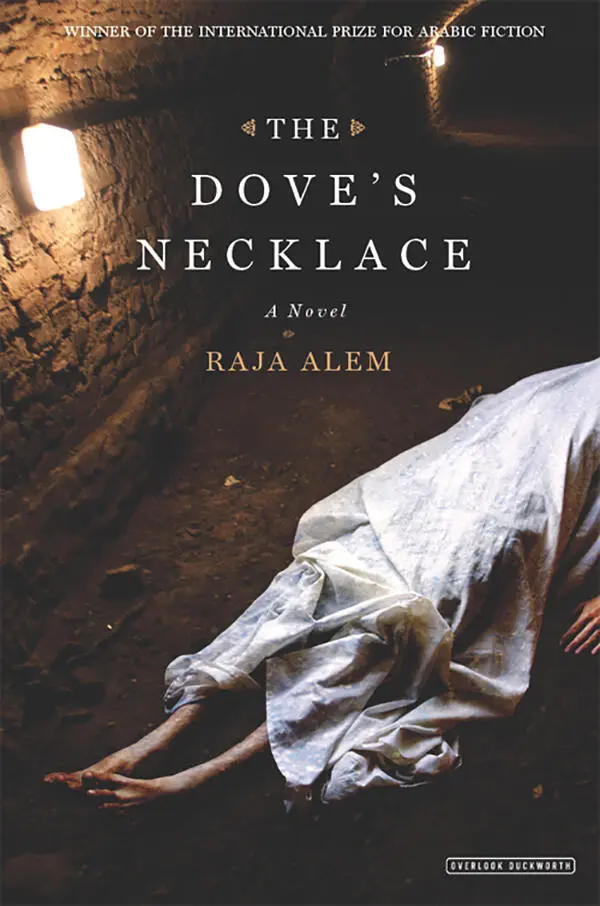
Raja Alem - The Dove's Necklace
Здесь есть возможность читать онлайн «Raja Alem - The Dove's Necklace» весь текст электронной книги совершенно бесплатно (целиком полную версию без сокращений). В некоторых случаях можно слушать аудио, скачать через торрент в формате fb2 и присутствует краткое содержание. Год выпуска: 2016, Издательство: The Overlook Press, Жанр: Современная проза, на английском языке. Описание произведения, (предисловие) а так же отзывы посетителей доступны на портале библиотеки ЛибКат.
- Название:The Dove's Necklace
- Автор:
- Издательство:The Overlook Press
- Жанр:
- Год:2016
- ISBN:нет данных
- Рейтинг книги:4 / 5. Голосов: 1
-
Избранное:Добавить в избранное
- Отзывы:
-
Ваша оценка:
The Dove's Necklace: краткое содержание, описание и аннотация
Предлагаем к чтению аннотацию, описание, краткое содержание или предисловие (зависит от того, что написал сам автор книги «The Dove's Necklace»). Если вы не нашли необходимую информацию о книге — напишите в комментариях, мы постараемся отыскать её.
Tackling powerful issues with beautiful and evocative writing, Raja Alem reveals a city-and a civilization-at once beholden to brutal customs, and reckoning (uneasily) with new traditions. Told from a variety of perspectives-including that of Abu Al Roos itself-
is a virtuosic work of literature, and an ambitious portrait of a changing city that deserves our attention.
The Dove's Necklace — читать онлайн бесплатно полную книгу (весь текст) целиком
Ниже представлен текст книги, разбитый по страницам. Система сохранения места последней прочитанной страницы, позволяет с удобством читать онлайн бесплатно книгу «The Dove's Necklace», без необходимости каждый раз заново искать на чём Вы остановились. Поставьте закладку, и сможете в любой момент перейти на страницу, на которой закончили чтение.
Интервал:
Закладка:
The woman took advantage of Rafi’s preoccupation with the inscription to whisk Nora inside the mosque and slam the door behind them, leaving Rafi outside. With devilish suddenness Nora found herself alone with that woman in the empty apse. The silence drowned out Rafi’s angry knocking.
Nora hesitated, wondering whether to escape. Was it the unhinged gleam in the woman’s eyes, or the newfound recklessness that had taken hold of her that had Nora so excited? Nora wanted to be swept to the very limit of danger. She followed the woman through the calm emptiness of the mosque silently.
The dark red sunset pooled in bloodlike darkness between the successive keyhole arches. Nora avoided looking up at them; they looked like open doorways leading to death. The woman’s besieging eyes could read her reaction to the call of the place and its spirits.
The nine square vaults on the ceiling followed their steps like the eyes of giants. The woman made Nora stop and listen beneath each vault; Nora stole furtive glances at the beautiful square structures, not daring to look closer for fear she’d be sucked into their darkness. Stopping Nora under a vault that featured a seven-pointed star, the woman forced her to look twice, and said, “Before we go any further, remember that what I’m about to reveal to you concerns the rivalry between our two great ancestors: mine, Samuel ibn Nagrela, and yours, Ali ibn Hazm. The Jew and the Muslim, who both believed that man’s fall did not take place when Adam and Eve fell from Paradise but when Cordoba fell and the centuries of harmony that had existed between the different religions was lost.” It dawned on Nora that the woman was speaking to her in fluent Arabic.
“You’re not imagining it. My Jewish ancestors used languages as the key to their fortunes, and one of those languages was your own. My ancestor Samuel displayed a remarkable talent for the Arabic language and calligraphy. That was what brought about the great change in his fortunes.” Nora sealed off her thoughts against this woman who seemed to be able to read them so easily.
“After the fall of the Berber kingdom and the wars between the party kings, the two men’s fates took different paths as they each searched for a door that would take them to the Paradise they’d lost here on earth. Ibn Hazm sought refuge near Seville, mourning Cordoba and its green revolution, and the destruction of its massive library, for which caravan-loads of books on astronomy, astrology, the sciences, and nature had been brought all the way from Baghdad. Ibn Hazm chased the dream of a resurrected Caliphate and the universal civilization it had nurtured. He believed that it was key to the door of Paradise and that was what made him side with the underdog in every conflict. He spent his life between exile and prison, an itinerant; after he was released, he isolated himself to write — on theology, matters of doctrine, and philosophy, trying to record the contents of that great lost library. He was way ahead of his time. He wrote a series of books comparing the three religions — the key to the faiths — which culminated in his book The Necklace of the Dove . Love was the only thing that could bridge the gaps between people, he discovered.
“Ibn Nagrela, on the other hand, was a physician from Cordoba, who was welcomed by the royal court in Granada, an Andalusian city that was home to the largest mixed community of Jews and Muslims. He lived two lives: one, in Arabic, as the ruler’s secretary and general of the Granadan army, leading campaigns against the neighboring kingdoms; and another in Hebrew, the language of his community in which he wrote poetry. Both men mourned the loss of their earthly Paradise in al-Andalus, the end of coexistence. They both spread the wisdom of eleventh-century Cordoba, whose scholars had been killed and whose library had been destroyed.”
The woman brought her face right up to Nora’s, engulfing her in heavy chamomile breaths.
“Both our ancestors left us their version of the key to Paradise: Ibn Hazm gave us The Necklace of the Dove and Ibn Nagrela his son Joseph, who inherited his father’s poetry and carried on his ideals and his obsession with Eden. He believed that translation was the solution to the puzzle of the absolute mind, or absolute Paradise. Translation would preserve the dialogue that had taken place between civilizations when Islamic rule flourished in al-Andalus. That gave us the Jewish Golden Age in the kingdoms of Northern Andalusia and the transfer of scientific knowledge to Europe. My ancestor Joseph’s translations opened the door to the world. I was obsessed with him when I was younger — this man who, it is said, was slaughtered along with thousands of other Jews in the streets of Cordoba when contact between religions became a crime known as heresy.” Half-hidden in the darkness, the woman led Nora forward, gradually but firmly, toward the apse, her chamomile-laden breaths intensifying Nora’s concealed longing for the place.
“Joseph provoked his enemies — he wasn’t as humble as his father — and people say that he was killed for it, crucified along with the members of a hundred and fifty Jewish families. The truth is, though, that Joseph managed to escape Granada. According to the story, he went in search of a door that had been revealed to him in a vision, in Aden, at the tip of the Arabian Peninsula.” The lights suddenly went out, and the woman pushed Nora into the apse, closing the door behind them. The darkness swallowed them.
“Sit on the ground. Lean back and look at the sky above and below …” Nora found herself being pushed down into the darkness, where she sat with her back against what felt like stairs carved into the wall. Meanwhile, the woman had vanished, and Nora began to think she’d been left there to die. Her body felt so drugged by the darkness she couldn’t even bring herself to get up to look for a way out.
The temple receded into deeper and deeper darkness, to the quickening thump of her heartbeats. The cold floor gnawed at her body through her light dress. Suddenly a shaft of light from the setting sun poured through a central window, illuminating the double rows of golden windows that went all the way around the wall of the temple. The round body of the temple came to life, flooding the space around Nora with rose-colored gold. Nora thought, for a moment, that the sunset was cascading into the temple like a waterfall, and she couldn’t be sure whether the temple was shooting upward into the sky or plummeting down into the earth to burst through to the sky on the other side of the planet. The inside of the temple was engulfed in a pink halo that revealed narrow steps carved in a spiral around the wall; they couldn’t have been there for climbing because they were too narrow and there was no banister. It took a while for Nora to make out the sunlit patches on the walls: from the ground to the sky, the wall was covered not with windows but with brightly colored doors that looked tiny from below and were covered in engravings that deceived the eye in the evening light, which was rosy in some places, bloody in others, and elsewhere absent, leaving an ominous pitch-blackness. Nora blinked, unsure of what she was seeing, and in that split second, the rectangular patches dissolved and whirled into the form of a single, huge door open to the sky above.
“This is what Joseph, who bore the dream of Samuel ibn Nagrela, saw when he finished his nighttime vigil outside Solomon’s Seal near Aden.”
The sun dipped behind the mountains and the temple was plunged into darkness, complete and thick, like a living thing; the darkness embraced Nora, who had no choice but to slump back, feeling the chamomile breaths flow from the fading church murals outside. A distinctive smell — from her childhood — filled Nora’s senses, bringing tears to her eyes. It was just like the smell of the qat the Yemenis chewed at sunset to get high — the woman was trying to drug her, she was certain of it. Her limbs felt heavy and sagged into the ground, and her vision was blurry. She could see through things, and through her own body, which was disintegrating and diffusing into the layers of darkness. It gradually become one with the darkness, and she began to hear distant voices speaking in Arabic; was it the woman resuming her story on the other side of the closed door, or was the story itself flowing through her, as if she were walking through an absolute mind that stretched into the past. Maybe it was the mind of Joseph ibn Nagrela as he stepped out onto the deck of the ship that plowed the Red Sea on its way to the tip of the Arabian Peninsula. Yemeni singing rose around him as the crew moored the ship. The waves lapped at Joseph ibn Nagrela’s feet as he stood alone on the seashore at the port of Aden, carrying nothing but the robe on his back, lost in thought and fingering in his pocket the damp, salt-encrusted scrap of paper that bore a drawing of the door.
Читать дальшеИнтервал:
Закладка:
Похожие книги на «The Dove's Necklace»
Представляем Вашему вниманию похожие книги на «The Dove's Necklace» списком для выбора. Мы отобрали схожую по названию и смыслу литературу в надежде предоставить читателям больше вариантов отыскать новые, интересные, ещё непрочитанные произведения.




Обсуждение, отзывы о книге «The Dove's Necklace» и просто собственные мнения читателей. Оставьте ваши комментарии, напишите, что Вы думаете о произведении, его смысле или главных героях. Укажите что конкретно понравилось, а что нет, и почему Вы так считаете.