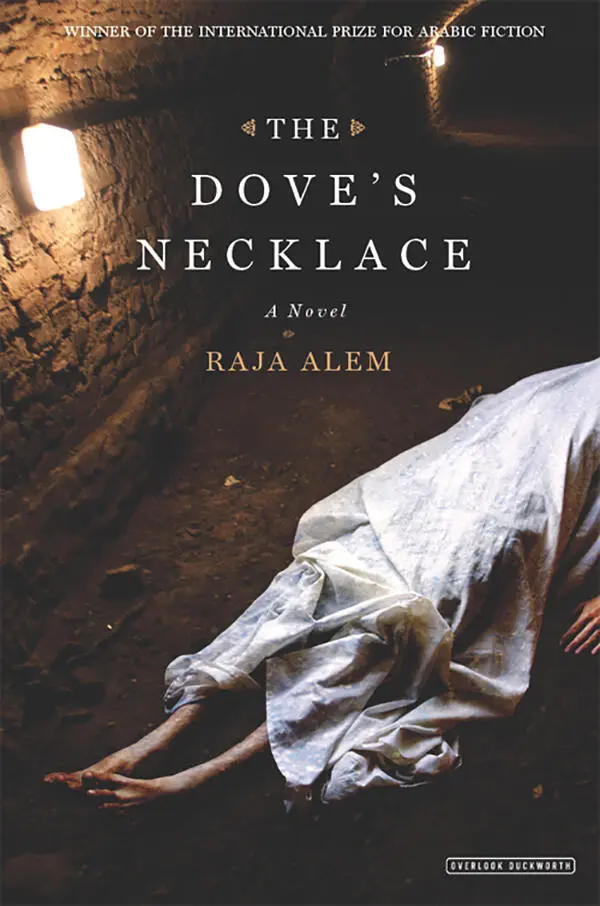
Raja Alem - The Dove's Necklace
Здесь есть возможность читать онлайн «Raja Alem - The Dove's Necklace» весь текст электронной книги совершенно бесплатно (целиком полную версию без сокращений). В некоторых случаях можно слушать аудио, скачать через торрент в формате fb2 и присутствует краткое содержание. Год выпуска: 2016, Издательство: The Overlook Press, Жанр: Современная проза, на английском языке. Описание произведения, (предисловие) а так же отзывы посетителей доступны на портале библиотеки ЛибКат.
- Название:The Dove's Necklace
- Автор:
- Издательство:The Overlook Press
- Жанр:
- Год:2016
- ISBN:нет данных
- Рейтинг книги:4 / 5. Голосов: 1
-
Избранное:Добавить в избранное
- Отзывы:
-
Ваша оценка:
The Dove's Necklace: краткое содержание, описание и аннотация
Предлагаем к чтению аннотацию, описание, краткое содержание или предисловие (зависит от того, что написал сам автор книги «The Dove's Necklace»). Если вы не нашли необходимую информацию о книге — напишите в комментариях, мы постараемся отыскать её.
Tackling powerful issues with beautiful and evocative writing, Raja Alem reveals a city-and a civilization-at once beholden to brutal customs, and reckoning (uneasily) with new traditions. Told from a variety of perspectives-including that of Abu Al Roos itself-
is a virtuosic work of literature, and an ambitious portrait of a changing city that deserves our attention.
The Dove's Necklace — читать онлайн бесплатно полную книгу (весь текст) целиком
Ниже представлен текст книги, разбитый по страницам. Система сохранения места последней прочитанной страницы, позволяет с удобством читать онлайн бесплатно книгу «The Dove's Necklace», без необходимости каждый раз заново искать на чём Вы остановились. Поставьте закладку, и сможете в любой момент перейти на страницу, на которой закончили чтение.
Интервал:
Закладка:
Her train of thought was interrupted by Señora Mirano’s laughter. “It’s no wonder, is it, that they included his Brandenburg Concerto No. 2 on the ‘golden record’ that they sent into outer space on one of the Voyager probes along with other examples of sounds, languages, and music from Earth.” If they’d sent that record to the city where she was born, would the people there recognize it as the sound of their Earth, Nora wondered.
“This is Beethoven’s Violin Sonata No. 5 in F major, the Spring Sonata. The difference between him and Bach is that Beethoven broke the rules, though that doesn’t mean that Bach wasn’t one of the most important rule-abiding composers.”
Nora knew that it would be a huge undertaking for her to absorb this encyclopedia of human achievements, and that she was embarking upon it at a relatively late age. The gypsy violinist outside had dropped a coin and was groping for it on the ground. It was only then that Nora had realized she was blind. Nora was blinded by her own pity.
“How do you feel about preparing for an exhibition? Not necessarily here — maybe in your own country?” Nervously, Nora fingered the edge of her scarf, looking at the gypsy woman’s tasseled shawl as the ninety-something Señora Mirano went on, “I came from a nomadic gypsy background too, and I learned that art in all its varieties can make the world a safer place for us. Art’s like a planet that grants us citizenship and gives us papers of its own, different from those of real nations.” Nora felt naked; the more this woman looked at her drawings, the more her internal life, which she herself didn’t dare confront, would be uncovered.
“But I don’t have the knowledge to produce anything that could match that kind of art,” murmured Nora, surprising even herself. “I didn’t learn to create art by studying it. I drew this”—she fingered her sketches—“because I needed to push the walls away and create some space. To create balance.”
“That might be the best description of what art is that I’ve ever heard: opening a place up into infinite spaces in the total creative consciousness! Maybe this need is what compels primitive peoples and children to create the art that has always been such an important part of human creativity. After he became famous, Picasso said he wished he could go back to drawing like a child. You must break through and exhibit something. Open up your innermost self to audiences and let them walk around in it, examining your deepest secrets …”
“I appreciate the suggestion. I’ll think about it,” she whispered into the corner of her scarf, and without thinking she tied the corner for the promise she’d made, twisting the fabric into a knot the size of a pigeon’s eye.
“Where did you learn this gypsy magic?” asked Rafi affectionately. Nora’s face shone. The features of the three people around her looked like part of the clay and ceramic tableau behind them, illuminated by the magic of the dim lights floating over the violin strings mixed with the longing of lute strings, which night drew toward the depths of the soul; there was her second mother’s hoarse voice and her headscarf with knots in each corner like a rabbit’s teats.
“The woman who raised me taught me to tie a knot in my scarf for each wish I made. We were supposed to make big wishes, and tie a knot for each one, and only undo the knot when the wish came true, as our joyous ululations rang out across the rooftops. The bigger the wish, the wider the votive knot and the more people who’d benefit from your offering. Never leave your headscarf without a knot, she said.”
There were so many knots in her second mother’s scarf, every one representing a different joy awaiting her down the road: Nora’s graduation from primary school, her first period, finally managing to memorize the Surah of Sovereignty, which warded off the approach of hell as one slept, learning to sew properly.
“Like this gypsy’s shawl, with hundreds of knots,” she observed. “Do you think each one of them is for a wish or a dream?”
“Sometimes one dream is enough,” ventured Rafi.
“One dream?!” she exclaimed. She thought for a moment, and then she added, “Yes, maybe — maybe even one would be too much.”
Señora Mirano stood up, excusing herself, “The question is how much space we create for the audience within the dream that consumes our life.”
A burst of music sent a flock of pigeons flapping down the alley and away into another alley in the distant basin of her memory; they returned like a wave of night directing the rhythm of her body.
“I came from an alley like this. Two walls …” Rafi listened as Nora’s mind wandered to the night when she’d been woken by an almighty gasping, banging, and scraping beneath her window. For a moment she’d thought someone was trying to break through the barred window, but then her consciousness began to distinguish the sounds, and a deep instinct impelled her to peep out of the window. She saw a man’s head below her window; he was unconscious, his eyes were closed, his head was rolling back and forth against the wall. She leaned further forward, thrusting her nose between the bars of the window, and was able to make out the black mass between his legs: it was a head in an abaya, glued mercilessly to the spot, gorging itself. When the epileptic spasms ebbed, the head detached from the body and out of the black appeared the face of a woman with dribbling lips. The epileptic man bent forward to kiss them quickly. “You cursed woman …” he murmured hoarsely.
The woman’s eyes widened, anticipating an equally epileptic response, but the man began to move away, cautiously tidying himself up before he left the secluded alley. The man’s face disappeared and Nora saw Rafi’s face again. “At night, our alley was a theater where the actors never got tired, a strange shadow play. I used to lie in my bed and listen, hearing but never seeing the actors — footsteps bursting out of nowhere and running, voices walking the length of the alley acting out angry or debauched amateur dramatics, spurred on by the sense of privacy that the narrow alley lent their performance. They all played their roles safe in the sense of secrecy that surrounded their climaxes and exhibitions. The voices of men arguing or talking with drunken slurring tongues or sharp angry tones; mumbles and pants, women clapping in upper-story windows to catch the attention of those lower down; in the background, laughter or crying, or the hurried footsteps of that woman coming home at dawn from her shift in the hospital. The only thing I knew about her was the smell of a day’s sweat, Dettol, and strong disinfectants as she dragged her exhausted body onward to the sweat-drenched future. I never saw her but I could picture her with her white gloves raised in the face of our alley’s indifference. The alley always picked itself up and kept going, never stopping save for the cries of women, or the call to prayer, or fathers, indoors mixing with outdoors in that unique mixture that was our daily bread, interrupted now and again by the applause of the audience outside …” Nora’s gaze shifted from the gypsy across the street to her assistant and from there to Rafi’s heavily lined face. Everything that was yet to come was also part of that obscure map of life.
Señora Mirano suddenly interrupted them. “Would you like to join our discussion of The English Patient ?”
Rafi declined politely, echoing Nora. “Have you actually seen The English Patient ?” she asked him as they made their way back to the hotel.
He nodded. “I thought it was wonderful, but there’s no way I could sit through it again. I’ve seen enough violence in real life, in the civil war, had enough shocks, experienced enough adrenaline rushes, that I’ve found I get pretty upset when I watch a sad film or read a sad poem. I think I’m getting worn out.”
Читать дальшеИнтервал:
Закладка:
Похожие книги на «The Dove's Necklace»
Представляем Вашему вниманию похожие книги на «The Dove's Necklace» списком для выбора. Мы отобрали схожую по названию и смыслу литературу в надежде предоставить читателям больше вариантов отыскать новые, интересные, ещё непрочитанные произведения.



Обсуждение, отзывы о книге «The Dove's Necklace» и просто собственные мнения читателей. Оставьте ваши комментарии, напишите, что Вы думаете о произведении, его смысле или главных героях. Укажите что конкретно понравилось, а что нет, и почему Вы так считаете.