Raja Alem - The Dove's Necklace
Здесь есть возможность читать онлайн «Raja Alem - The Dove's Necklace» весь текст электронной книги совершенно бесплатно (целиком полную версию без сокращений). В некоторых случаях можно слушать аудио, скачать через торрент в формате fb2 и присутствует краткое содержание. Год выпуска: 2016, Издательство: The Overlook Press, Жанр: Современная проза, на английском языке. Описание произведения, (предисловие) а так же отзывы посетителей доступны на портале библиотеки ЛибКат.
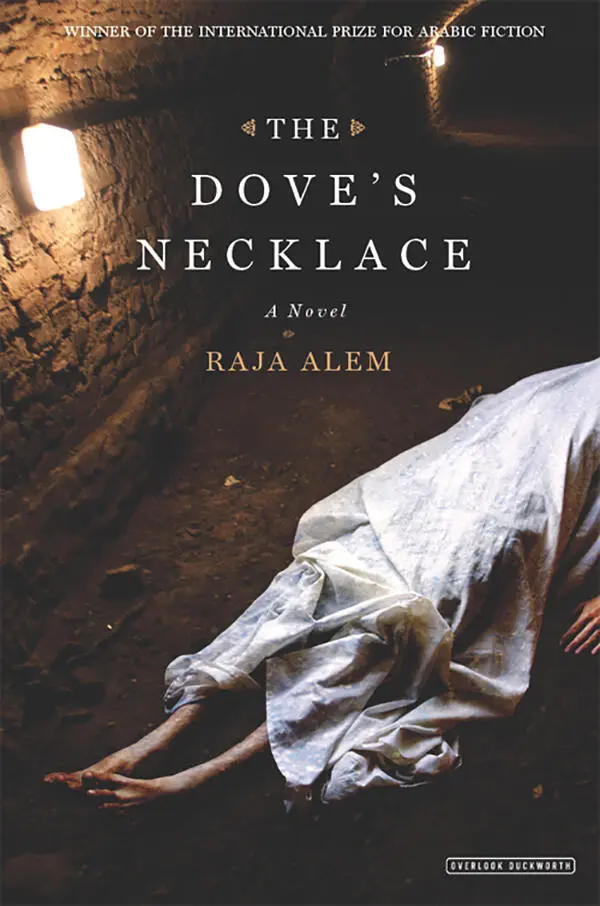
- Название:The Dove's Necklace
- Автор:
- Издательство:The Overlook Press
- Жанр:
- Год:2016
- ISBN:нет данных
- Рейтинг книги:4 / 5. Голосов: 1
-
Избранное:Добавить в избранное
- Отзывы:
-
Ваша оценка:
The Dove's Necklace: краткое содержание, описание и аннотация
Предлагаем к чтению аннотацию, описание, краткое содержание или предисловие (зависит от того, что написал сам автор книги «The Dove's Necklace»). Если вы не нашли необходимую информацию о книге — напишите в комментариях, мы постараемся отыскать её.
Tackling powerful issues with beautiful and evocative writing, Raja Alem reveals a city-and a civilization-at once beholden to brutal customs, and reckoning (uneasily) with new traditions. Told from a variety of perspectives-including that of Abu Al Roos itself-
is a virtuosic work of literature, and an ambitious portrait of a changing city that deserves our attention.
The Dove's Necklace — читать онлайн бесплатно полную книгу (весь текст) целиком
Ниже представлен текст книги, разбитый по страницам. Система сохранения места последней прочитанной страницы, позволяет с удобством читать онлайн бесплатно книгу «The Dove's Necklace», без необходимости каждый раз заново искать на чём Вы остановились. Поставьте закладку, и сможете в любой момент перейти на страницу, на которой закончили чтение.
Интервал:
Закладка:
“Maybe not — maybe you’re just learning to appreciate the value of a peaceful life.”
“Also, I can’t stomach this Western thing of watching real life through movies any more. Señora Mirano once told me that we’ve invented a duality, a second reality and I think I agree with her. Our mental world is a reflection of what we see around us, civilization is the shell that represents our inner spiritual selves. Without it, we’re just animals in search of food and sex. We want to exist on a higher plane, but we can’t get there or we can’t stay up there. Most of us never will. In the end, it’s just a dream …”
Reading Triangle
I N THE ENDLESS VOID OF THE CORRIDOR, AN EPOCH OF SAND STRETCHED BETWEEN the three men. The whole time they were in the corridor, Mushabbab had remained calm, and when at one point Nasser’s throat went dry, Mushabbab was poised and ready. Whenever Nasser’s doubts became too much for him and he looked like he was about to tumble from the nightmarish plane of reality they were exploring, Mushabbab quickly handed the will over to Yusuf so he could pick up where Nasser had stumbled:
EVERYTHING CHANGED WHEN WE ENTERED the heart of Najd. We left the soft sands saturated with the Hijazi breeze. Even the air tasted dry and harsh and began to dig into our skin. My body must have become stiffer somehow, as well. I have no idea how long we climbed, teetering on our camels, as we followed our Ghatafani guide across the ribs of great sand dunes on the edge of the Nafud Desert. It took us a while before we realized that we’d been surrounded by a group of men riding bareback on massive camels. In the burning sunlight, it wasn’t entirely clear whether they were men or mirages or demons. The men, and the camels they were riding, were the color of sand, even their eyelashes. There was no way we could’ve gotten away from them; it was hard enough to figure out what direction they were headed in. They were kicking up a sandstorm that either lashed at your back, or blinded you, or suffocated you. They tied us to our saddles by the feet and forced us to follow them. At one desperate moment, I thought the horizon was a sheet of molten copper rising up to the sky, propelling us forward with flames until we finally reached the top of the copper wall, where the wind rose up and began pelting us with what felt like sandstones. “Locusts!” Ayif al-Ghatafani shouted.
We had to protect our eyes and faces from the locust attack. It was well known among the Bedouin that locusts were so vicious that they ate humans alive. I raised my abaya over my head like a tent, while the giants faced the onslaught head-on and didn’t seem at all bothered. They didn’t even cover their faces and they laughed at al-Ghatafani as he tried desperately to keep the locusts off the terrified camels. I don’t know what caused it but my camel bolted and I could do nothing to control it. It was all I could do to hold on to the reins as locusts buzzed all around me and inside my abaya. The camel didn’t stop until we’d made it out of the locust swarm. When I opened my eyes, I saw the other camels were outrunning the last of the locusts and the giants appeared around me, riding alongside. It was as though I hadn’t crossed the locusts and the desert, rather that the desert had receded. I could see gouges on my camel’s neck and around her eyes; the locusts had left what looked like a tattoo across the belly of al-Ghatafani’s camel.
“We’re lucky we made it out of there.”
An oasis in the Rimmah Valley lay before us, looking like a ruin. The palm trees were stripped bare, the locusts having decimated their crowns and clusters, and as we neared the village, we could see the uncovered graves of the children and the elderly done in by smallpox, which the locusts carried.
The camels instinctively gave that hell a wide berth, looping around toward the southeast. It was as if the giants were leading us from one disaster to another more horrific as our detour continued. Smallpox ran alongside us, borne by the locust swarm, leaving oases of death in its wake until it disappeared inside the bones of the desert.
We ran past the tribes of Tayyi and Asad, and our captors drove us like a storm between the tribes of Hanifa and Tamim on the way to their oasis.
Delicacies
N IGHT FELL OVER MADRID AND THE ACTIVITY AROUND THE PRADO MUSEUM across the street began to die down. Nora listened closely as she’d grown used to doing in her distant alley:
She heard Nazik the Turkish woman emerging from the cluster of alleys and poverty. She was dressed in her navy blue coat, with embroidered sleeves, and she’d wrapped a white scarf around her head — she didn’t cover her face like the other women in the neighborhood. Her fiery locks fell over her forehead, attracting everyone’s gaze and quivering with every word she spoke to her companion the eunuch. He walked two steps behind her, following her every command like a loyal dog. Every Friday morning when Nazik appeared, the women of the lane would duck into entryways and teenage girls would bury their fingers inside their abayas.
“Nazik can capture a girl with just one finger!” The rumor came about because of how her eyes bulged and hovered above the girls’ hands like a hawk, examining them, picking out the finest, longest fingers. She was always negotiating with parents to get them to allow their daughters to work for her doing embroidery.
That Friday, the girl didn’t run away. She stood there among the pots of herbs, like a dove at rest, and watched the Turkish woman. When Nazik got closer, she walked out to the outer gate to get a whiff of her perfume, Paris Nights; it made the whole neighborhood sigh. Nazik had mummified that perfume bottle, which she’d inherited from her ancient grandfather, allowing herself only a single drop every Friday. Nazik didn’t waste a second. She grabbed the girl’s right hand and started checking out her fingers.
“These are good fingers. Real Turkish delight! If you send her to me, I’ll teach her how to sew, and trim, and fit, and drape, and pin … These fingers will feed you honey and ambergris.” The words wafted on ambergris into her father’s mind and the very next morning he lifted the siege under which she’d lived and sent her to Nazik’s workshop.
At the doorway, she was met by the scents of women. It was mostly sweat but there was a perfume which she couldn’t quite identify. It made the blood rush to her temples. There was nothing of Paris Nights about this place. For the first time in her life, she understood that she was an adult woman.
“Girl!”
Nazik greeted her like someone clinging to a lifesaver. It was a surprise to see the Turkish woman without her wig, her hair as white as a corpse-washer’s sponge. “Welcome to my kingdom, where the girls shake their asses but never break their backs!”
She led her to a row of sewing machines that faced the wall like schoolchildren being punished. A chubby girl sat there, engrossed in her sewing. Her arms were each the size of an infant. She was spinning the machine, a Singer, violently; it looked as if she might tear the wheel off at any moment.
Nazik handed Nora a heart-shaped embroidery hoop holding a piece of white cotton taut. “Should I teach you the fluffy satin stitch?” she asked. “We use it to embroider flowers on women’s dresses. A woman wearing a dress with that flower always turns heads …” When she said “flower,” it sounded like “flavor.”
Nazik began stabbing blindly, lewdly, at the fabric, creating the bright red heart of a flower out of her stitches; it was so suggestive that sweat broke out on Nora’s upper lip. Nazik watched her closely. When the girl tried to take the hoop and have a turn, Nazik tossed it aside. “Don’t waste your time with sweaty slaves’ work!” she cackled.
Читать дальшеИнтервал:
Закладка:
Похожие книги на «The Dove's Necklace»
Представляем Вашему вниманию похожие книги на «The Dove's Necklace» списком для выбора. Мы отобрали схожую по названию и смыслу литературу в надежде предоставить читателям больше вариантов отыскать новые, интересные, ещё непрочитанные произведения.



Обсуждение, отзывы о книге «The Dove's Necklace» и просто собственные мнения читателей. Оставьте ваши комментарии, напишите, что Вы думаете о произведении, его смысле или главных героях. Укажите что конкретно понравилось, а что нет, и почему Вы так считаете.