Raja Alem - The Dove's Necklace
Здесь есть возможность читать онлайн «Raja Alem - The Dove's Necklace» весь текст электронной книги совершенно бесплатно (целиком полную версию без сокращений). В некоторых случаях можно слушать аудио, скачать через торрент в формате fb2 и присутствует краткое содержание. Год выпуска: 2016, Издательство: The Overlook Press, Жанр: Современная проза, на английском языке. Описание произведения, (предисловие) а так же отзывы посетителей доступны на портале библиотеки ЛибКат.
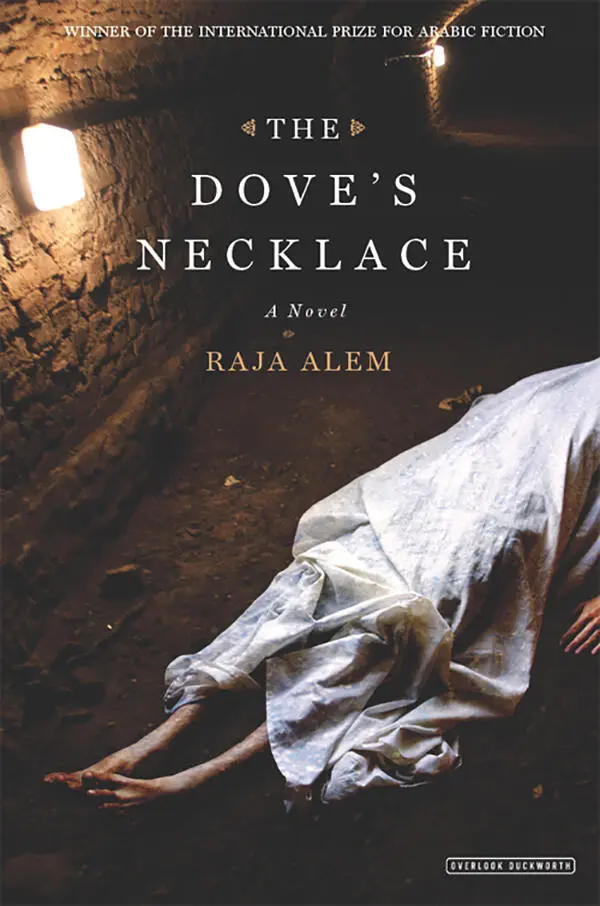
- Название:The Dove's Necklace
- Автор:
- Издательство:The Overlook Press
- Жанр:
- Год:2016
- ISBN:нет данных
- Рейтинг книги:4 / 5. Голосов: 1
-
Избранное:Добавить в избранное
- Отзывы:
-
Ваша оценка:
The Dove's Necklace: краткое содержание, описание и аннотация
Предлагаем к чтению аннотацию, описание, краткое содержание или предисловие (зависит от того, что написал сам автор книги «The Dove's Necklace»). Если вы не нашли необходимую информацию о книге — напишите в комментариях, мы постараемся отыскать её.
Tackling powerful issues with beautiful and evocative writing, Raja Alem reveals a city-and a civilization-at once beholden to brutal customs, and reckoning (uneasily) with new traditions. Told from a variety of perspectives-including that of Abu Al Roos itself-
is a virtuosic work of literature, and an ambitious portrait of a changing city that deserves our attention.
The Dove's Necklace — читать онлайн бесплатно полную книгу (весь текст) целиком
Ниже представлен текст книги, разбитый по страницам. Система сохранения места последней прочитанной страницы, позволяет с удобством читать онлайн бесплатно книгу «The Dove's Necklace», без необходимости каждый раз заново искать на чём Вы остановились. Поставьте закладку, и сможете в любой момент перейти на страницу, на которой закончили чтение.
Интервал:
Закладка:
It was he who sent me on this path; I had no choice but to obey and depart with this Ghatafani, who’d served in the temples of the Persians and Byzantines and learned the secrets of Petra and the Valley of the Kings in his search for immortality, and ended up an ascetic among the sand dunes.
“The mosque closes at ten,” the eunuch said, interrupting Nasser as he was reading.
Nasser looked up at the large green-belted body and effeminate face; he could hear the thin voice but he couldn’t understand. “On your way, please, the doors of the mosque will now be closing.”
Nasser folded the parchment into the amulet and got up stiffly. Seeing the distress in Nasser’s face, the eunuch added sympathetically, “Starting tomorrow, they’re going to break the tradition of closing the mosque, even though it’s been this way for fourteen centuries. They plan to keep the doors open all night.” He searched Nasser’s eyes for a reaction, then went on, “At the end of the day, this mosque is the Prophet’s house, and we eunuchs have sacrificed our bodies to guard the tranquility of this honored site so that the dead, peace be upon them, may sleep in peace until the dawn prayers are called and the doors are opened to worshippers who may stay until the night prayers are over.”
The eunuch contemplated the iron fence and the many barriers between them and the Prophet’s grave. He thought about his Ottoman-era predecessor, who would hurry, with due reverence, to open the door leading to the grave when the dawn prayer was called. He would place a pitcher full of water and a bowl polished with perfume and the Surah of Prostration on the edge of the stone so the Prophet and his companions could perform their ablutions. The young eunuch sighed, and Nasser echoed him, saluting and praying for the Prophet and his companions, and sensing the Prophet’s soul, which was resurrected to return his greeting, just as when any worshipper, be they at the very end of the earth, greeted the Prophet and said a prayer for him; a million thousand thousand thousand thousand resurrections took place inside that grave every second, not allowing the buried Prophet’s eyes to close for a moment’s death, even though he lay in his grave. The eunuch hid a shiver deep in the folds of his jubbah, beneath his wide belt, so that the reason for it wouldn’t offend the beloved Prophet to whom he’d devoted his life, and whose Rawdah, the area between his grave in Aisha’s house to his pulpit, he served. The eunuch gazed tenderly down at his palms, and then spread them out to show Nasser. They were yellowed with perfume.
“They exude a never-ending perfume. The more I wipe the grave, the more they perspire. I’ve grown lighter, too. I was a child in 1971, when I snuck in behind my father one morning before dawn, my teeth chattering from the cold, and hid behind the curtains to watch the workers replace the cloth hangings in the sacred burial room. As long as I live, dawn for me will always be associated with those layers of pure green silk lined with heavy cotton and crowned with a band of dark red embroidered with bright cotton threads and gold and silver wire, Quranic verses covering a quarter of the surface. Just from looking at it, you could hear the Surah of the Conquest being recited in the dim light of the noble chamber, where yellow decorated weavings showed the locations of the three graves. It was the first time I’d snuck into the burial room, among the scent of ancient prayers. I did it again on several consecutive nights to watch the workers who’d been chosen to carry out the renovations in secret.”
“They change the cloth on the sixth of Dhu l-Hijja every year, don’t they?” Nasser asked, but the young eunuch was too lost in his memories to reply. It was as though he could only hear and see what was before his mind’s eye.
“The cloth they took down was seventy-five years old, according to the date woven into the fabric — unchanged for three quarters of a century. I trembled in the dawn twilight when I looked toward the fourth, empty, grave. My father told me afterward that the prophet Jesus, peace be upon him, was to be buried in it when he descended to earth in his second coming. My father, the head eunuch, stood reverently under the shimmering star that appeared on the wall of the room that faced the Kaaba, above the head of the noble Prophet. He replaced the silver nail with a diamond the size of a pigeon egg, and beneath it another gem larger still; both were set in gold and silver. I seem to remember — whether I was awake or dreaming — a skinny young architect approaching the cloth that lined the room. He went round folding up the heavy, embroidered, perfumed fabric, then threw the bundle onto his shoulder and left the venerable chamber, placing it on the ground of the Rawdah outside, just a few steps from where I’m standing now. As I watched, the workers gathered around it to carry it to the truck; it was so heavy they couldn’t even lift it!” The eunuch sighed, looking Nasser in the face, then went on.
“The chamber stands over one of the rivulets that water the gardens of Paradise. The inside of the chamber belongs to a different time, bodies exist with a different energy, and whoever enters that chamber over the rivulet and pool is relieved of all infirmity and stripped of everything but their true nature, becoming a new species formed of all the prayers and salutations ever said over the noble grave of the beloved Prophet. As children, my predecessors slept on pillows that their parents had covered with a piece of that cloth, breathing in the scent of all those prayers, so our souls are connected with that immortal inner soul.”
The eunuch turned to leave, and Nasser followed him silently. He was thinking about Sarah, the Jewish woman, and her wedding, and how she had lain with her husband on those cotton sheets but had never eaten with him or approached him, how she’d been hidden away from strangers, fasting from everything but the food of her people. In his mind, he could see a long reel of images of extremists from the histories of the many religions: those who call anything that they don’t believe in “heresy,” those who declare themselves God’s chosen people, those who worship gold and accumulate vast wealth, who corner the market and determine people’s livelihoods, all so that they can take over the world some day and make everyone else their slave.
Nasser contemplated the fourteen centuries that separated him from that time. The grand plaza outside the Mosque of the Prophet opened out before him, and he lingered there in the hope that Yusuf or Mushabbab might seek him out. He had no idea how long he spent in that wide square in front of the mosque, but he began to feel hungry. A black woman was selling drinking yogurt from a mat spread on the ground at the edge of the plaza, ladling it from a large bowl into small clay ones. She was watching him, and when he approached her she immediately filled a clay bowl and held it out to him.
“Good health! That’s the last of today’s prosperity, with the Prophet’s blessings. Drink up, say grace, and send him your salutations.”
“God’s prayers, salutations and blessings be on our Prophet Muhammad.”
“And his family and companions,” she concluded.
Nasser thanked her, thrusting a hundred-riyal bill into her hand. Her hand trembled as she grasped the bill. He drank the bowlful in one go, and was deliriously filled with the faint but rich flavor of sweet woodruff. When he raised his eyes from the bowl, they fell upon a muscled back, and he felt as light as the short robe that covered it, the white waistcoat, the yellowish scarf thrown over the shoulder and the wide belt. Nasser felt like he was watching a character from a novel wandering, carefree, in his sleep; the man was headed to the market, and without hesitating Nasser followed him. He vanished into the covered market, with Nasser just behind him. Around them, the stores were saying goodbye to their last customers of the day and closing up, and the stalls were lowering their awnings over rows of prayer beads, prayer rugs, and cheap imported clothes. The man was in no hurry, and neither was Nasser, since any movement might have roused the man from his torpor; from a distance, it looked as if they were walking with a fine thread stretched between them, in their own sphere parallel to that of the people around them. They passed a Pakistani man with a straggly beard sitting at a stall selling prayer beads, miswak toothbrushes, and folded keffiyehs in bundles of three in boxes of cardboard, then an African woman standing propped against the damp, peeling wall. In front of her was a huge wooden cart laden with rows of small plastic bags containing red chili powder and deep scarlet hibiscus, and stacks of soft, but bitter, baobab fruit hiding inside white quartz-like exteriors. The woman didn’t look up as Nasser passed; she was dozing on her feet, hardly expecting customers. She was simply waiting the last short while until night came and she could say she’d made it through another day. The man Nasser was following seemed to be on an endless journey into the depths of sleep, until he took a sharp right into an alleyway next to a man selling sugarcane. Nasser had scarcely entered the alley when a body hit him with the weight of a rock. He hit the floor, crushed under his attacker’s weight; there was no use resisting. When he opened his eyes, he was in a hallway, and in front of him was a slim, dark face, watching him. Nasser didn’t need to ask to be certain it was Yusuf, and Yusuf’s words confirmed it.
Читать дальшеИнтервал:
Закладка:
Похожие книги на «The Dove's Necklace»
Представляем Вашему вниманию похожие книги на «The Dove's Necklace» списком для выбора. Мы отобрали схожую по названию и смыслу литературу в надежде предоставить читателям больше вариантов отыскать новые, интересные, ещё непрочитанные произведения.







Обсуждение, отзывы о книге «The Dove's Necklace» и просто собственные мнения читателей. Оставьте ваши комментарии, напишите, что Вы думаете о произведении, его смысле или главных героях. Укажите что конкретно понравилось, а что нет, и почему Вы так считаете.