Raja Alem - The Dove's Necklace
Здесь есть возможность читать онлайн «Raja Alem - The Dove's Necklace» весь текст электронной книги совершенно бесплатно (целиком полную версию без сокращений). В некоторых случаях можно слушать аудио, скачать через торрент в формате fb2 и присутствует краткое содержание. Год выпуска: 2016, Издательство: The Overlook Press, Жанр: Современная проза, на английском языке. Описание произведения, (предисловие) а так же отзывы посетителей доступны на портале библиотеки ЛибКат.
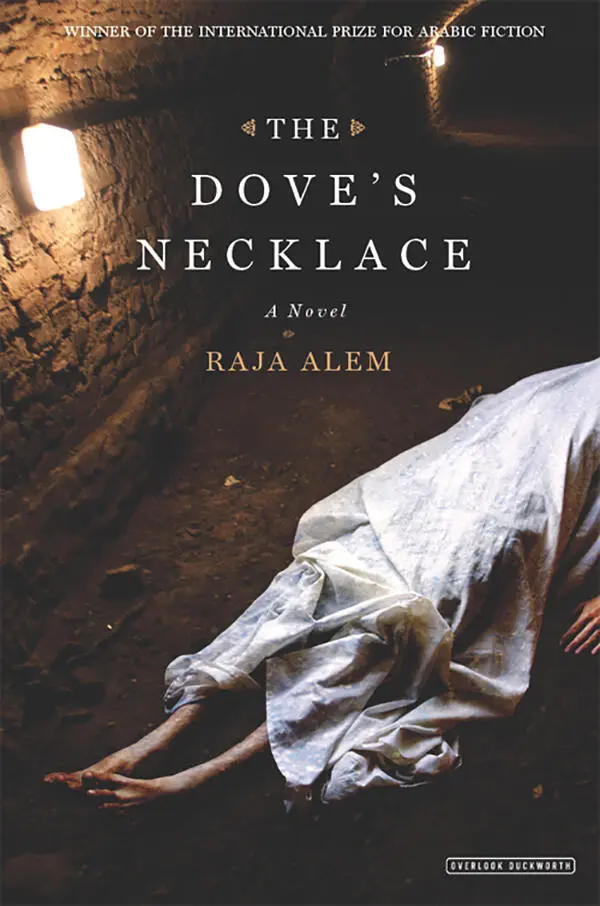
- Название:The Dove's Necklace
- Автор:
- Издательство:The Overlook Press
- Жанр:
- Год:2016
- ISBN:нет данных
- Рейтинг книги:4 / 5. Голосов: 1
-
Избранное:Добавить в избранное
- Отзывы:
-
Ваша оценка:
The Dove's Necklace: краткое содержание, описание и аннотация
Предлагаем к чтению аннотацию, описание, краткое содержание или предисловие (зависит от того, что написал сам автор книги «The Dove's Necklace»). Если вы не нашли необходимую информацию о книге — напишите в комментариях, мы постараемся отыскать её.
Tackling powerful issues with beautiful and evocative writing, Raja Alem reveals a city-and a civilization-at once beholden to brutal customs, and reckoning (uneasily) with new traditions. Told from a variety of perspectives-including that of Abu Al Roos itself-
is a virtuosic work of literature, and an ambitious portrait of a changing city that deserves our attention.
The Dove's Necklace — читать онлайн бесплатно полную книгу (весь текст) целиком
Ниже представлен текст книги, разбитый по страницам. Система сохранения места последней прочитанной страницы, позволяет с удобством читать онлайн бесплатно книгу «The Dove's Necklace», без необходимости каждый раз заново искать на чём Вы остановились. Поставьте закладку, и сможете в любой момент перейти на страницу, на которой закончили чтение.
Интервал:
Закладка:
When Khalil regained consciousness, he didn’t move but stayed where he was, prostrate in the dust of the Lane of Many Heads, watching everything from the superman-like perch his cancer had elevated him to. He was always a degree above the alley, looking down on its simple people from above, the only hero on the scene, with deeds to all those endowed properties that the passenger had taken him to. He — with his naïveté and the seal-dies stuffed into his pillow, was the tool that had given all those documents credence, and now the cancer had eaten Mecca.
Khalil needed time to regain his balance; by some miracle, he was able to drive his car. After the first bend in the road, he wanted to stop and get out to check the contents of the trunk: a bunch of Hollywood movies (among them the mangled reel of the dinosaur film), three yellowed robes, and a pillow in shreds, but not a single pair of shoes amidst those tattered disguises (though his own face was a better disguise sadly) …
Was he really leaving with all his belongings and taking this path? And under the gaze of this ghost-like being … “This is a nightmare, isn’t it?” he wanted to ask the passenger, but his voice was coming out a weak croak. “Of course it is,” he muttered to himself. “What do you expect? Best be careful. Make a wrong turn or doze off at the wheel and you and this creature you’re driving will be sent to oblivion …”
The car suddenly sped up, and even though he was stamping on the brakes with the full weight of his foot, it refused to slow down, screeching through a stream of cars and buses headed to al-Rusayfa. Khalil hoped he could make it to the ring road, where he could drive at full speed without any danger; a voice was urging him to get to Mount Mercy, in Arafat, where Eve had met Adam after their descent from Paradise, in the hope that the game this ghost was playing would lose its danger in Arafat’s empty, never-ending roads. But the car took the old Mecca — Jeddah road, making for the site of the denouement of al-Hadrami’s history, and nothing could stand in its way.
“You were planted in the Lane of Many Heads to torture me. You’re the cancer that was brought to life to toy with me … But you know I’ll defeat you. You can’t kill me — I’ll simply race you and beat you to my own death.”
When he reached Umm al-Joud, a neighborhood of munificence, which had once been Umm al-Doud, a neighborhood of worms, Khalil began to miss his father’s voice, his words uttered with care and affection. Love opened up in all directions and pulled him in, and at the spot where the rocks were piled over the corpse of his ancestor, at that very millisecond, a huge tanker appeared, a dinosaur, making a turn across the road; it was met by a splatter of blood on Khalil’s lips as he coughed. The cancer had finally penetrated his heart at that exact same millisecond, clutching both ventricles in its claws; Khalil the pilot’s body flew — with four engines, autopilot, and manual — into the body of the petrol tanker, which stretched out like a screen showing a dinosaur made of fire, while Ismail’s singing face filled the rearview mirror: “Meccan folks are doves, Medinans turtledoves, and the people of Jeddah are all gazelles …” An obelisk of white flame leapt up, penetrating the impassive, watchful sky.
Death of a Prophet
T HE EUNUCH WATCHED HIM FROM BEHIND THE COLUMN OF REPENTANCE. The more he stared, the more he felt the lines of age creeping over his own smooth face, which hadn’t aged a day since he was castrated. Emptied of all desire, he was removed from the cycle of time; his body grew larger but his face remained that of a child, and his mind was filled with the memories of childhood. Nothing that entered his head ever faded; it was a patch of childhood innocence. But his face was being reflected in the face of the man leaning against the Column of Repentance, turning it into a frown, so the eunuch turned away, and moved toward the old man who was reciting from the Quran, tossing his head from side to side as he read, and allowed the old man’s gentle movements to smooth the frown from his face.
Nasser stumbled over obstacles in the worn parchment, especially those places where the ink had faded completely. Whether he was a waking reader or a dreaming one, he could feel the changes in tempo caused by the interrupted sentences, and he had to skip over lines with the agility of a gazelle so as not to let the thread of meaning disappear before his eyes, like sand dunes shifting constantly across the page:
THE PEAKS OF MOUNT BATHA appeared in front of us, looking like ghouls’ heads in the darkness of the dawn twilight. It was there that our guide, Ayif al-Ghatafani, left us and went to track the troops of Ghatafan, who we were expecting would march to our aid; the Jews of Khaybar were their allies. We used to give the sheikh of the Ghatafan tribe, Uyinah ibn Hisn, half of our date harvest in exchange for his protection.
In the shade of a rock I sank into a pile of sand to rest, hoping to calm the ache that gnawed at my bones after the long ride, but I was so eager to see our guide return with news of victory, news that would mean we could return to Khaybar, that I couldn’t close my eyes.
Instead when he did return, the guide confirmed our worst fears. Ayif al-Ghatafani told us he’d seen no sign of any Ghatafani troops coming to our assistance, and that Khaybar would have to defend itself against the onslaught. No one he’d met along the way expected Khaybar to hold out long against two hundred Muslim warriors who were eager to be martyred and who’d already proven their strength with the victories they had won at Badr and the Trench and the truce they’d concluded with the Quraysh in Hudaybiya.
From Mount Batha we made our way eastward. That turn to the east was the end of our entire existence, like a death to be followed only by a rebirth. We had to move in secrecy, and we also had to forget: we had to hide everything that could tie us to Khaybar and its Jews. We dressed like Bedouin of Ghatafan, in attire our guide had given us; I could sense a warning in his gaze — until then, I had only known men’s looks of lust, and I attributed it to the miserable shape I was in from the journey. We were forced to walk through the night, only resting for a short while at the hottest hours of the day. Behind us, the defeat of besieged Khaybar became fact, and it didn’t take long for a flood of Jewish survivors, who’d been expelled from Khaybar and Medina, to cover these deserts, seeping into other tribes. I had to keep my distance from the survivors, to carry you into a new existence and a religion that would reign over Canaan and spread far beyond it.
I spent the first nights of my flight defending images of my rapidly receding childhood, of the girl who was carried in a solid gold howdah in the procession of her marriage to the knight chosen to impregnate the most beautiful girl in all Khaybar and ennoble its Jewish blood. I was the girl who succeeded in claiming that honor; it happened one day when he saw me racing grown men up the trunks of palm trees. He spotted that mixture of animal, ghoul, and bird in the mound of my breasts and in my nose, which pointed to the darkest springs lying underground. The gurgling streams of basil-scented forest in my laughter delighted him.
To the rhythm of the camel’s footfalls, I recalled every face and beard that came out to greet the wedding procession and shower us with Medinan roses. Every last fortress we passed on our journey came out to congratulate and bless us. And with every step we took, the caravan — with the camel of my father Ka’b ibn al-Ashraf at the head, and the howdah of my Ghatafani servant bringing up the rear — grew bigger. We crossed the plains, passing the citadels of the tribes of Qurayza, Qayniqa, and Waqif, who all blessed my marriage to Khaybar’s spiritual leader. Throughout the journey, I was haunted with doubts about the sudden change in my life and my dreams: I’d been plucked from the plains that were my home and sent to live in my husband’s fort, the all-powerful nucleus of the rural Hijaz where, my nanny assured me, I would not be treated merely as mistress of the fort, but as a prophetess. As a fifteen-year-old, the thought terrified me and my terror came to a head when a horseman with a short robe and long beard appeared, cutting through the ranks of the caravan, and headed straight for my howdah as our men did nothing to stop him. He snatched me from my howdah in his strong arms and put me in front of him on his saddle; we made it to Khaybar in the blink of an eye, my heart thumping wildly. There, he lay me back on the white cotton sheets of his bed and crushed roses on my neck, drinking me through their petals. His breath smelled of grease and firewood, and he roused whirlpools in my body to receive him; I opened and contracted with unflagging violence, until it was night and the cotton sheets around us began to unravel. It wasn’t until the following morning that I became sure of his identity — he was my husband, the man who would plant the seed of you inside me — up until the moment you were born, I wasn’t sure whether you came from his loins or from the sandstorms that would later receive me in my flight.
Читать дальшеИнтервал:
Закладка:
Похожие книги на «The Dove's Necklace»
Представляем Вашему вниманию похожие книги на «The Dove's Necklace» списком для выбора. Мы отобрали схожую по названию и смыслу литературу в надежде предоставить читателям больше вариантов отыскать новые, интересные, ещё непрочитанные произведения.



Обсуждение, отзывы о книге «The Dove's Necklace» и просто собственные мнения читателей. Оставьте ваши комментарии, напишите, что Вы думаете о произведении, его смысле или главных героях. Укажите что конкретно понравилось, а что нет, и почему Вы так считаете.