Rupert Thomson - Divided Kingdom
Здесь есть возможность читать онлайн «Rupert Thomson - Divided Kingdom» весь текст электронной книги совершенно бесплатно (целиком полную версию без сокращений). В некоторых случаях можно слушать аудио, скачать через торрент в формате fb2 и присутствует краткое содержание. Год выпуска: 2012, Издательство: Bloomsbury UK, Жанр: Современная проза, Фантастика и фэнтези, на английском языке. Описание произведения, (предисловие) а так же отзывы посетителей доступны на портале библиотеки ЛибКат.
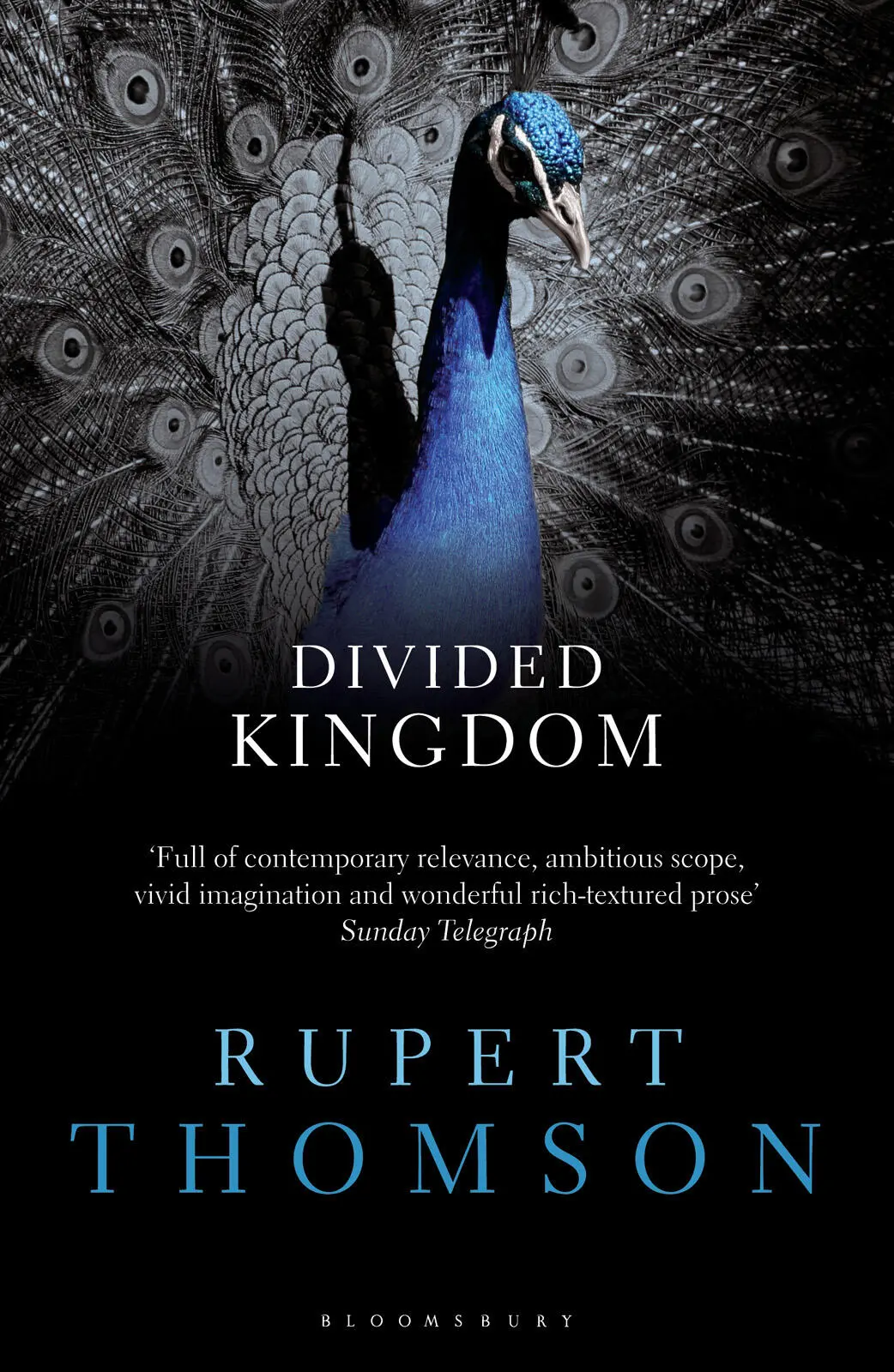
- Название:Divided Kingdom
- Автор:
- Издательство:Bloomsbury UK
- Жанр:
- Год:2012
- ISBN:нет данных
- Рейтинг книги:5 / 5. Голосов: 1
-
Избранное:Добавить в избранное
- Отзывы:
-
Ваша оценка:
Divided Kingdom: краткое содержание, описание и аннотация
Предлагаем к чтению аннотацию, описание, краткое содержание или предисловие (зависит от того, что написал сам автор книги «Divided Kingdom»). Если вы не нашли необходимую информацию о книге — напишите в комментариях, мы постараемся отыскать её.
Divided Kingdom — читать онлайн бесплатно полную книгу (весь текст) целиком
Ниже представлен текст книги, разбитый по страницам. Система сохранения места последней прочитанной страницы, позволяет с удобством читать онлайн бесплатно книгу «Divided Kingdom», без необходимости каждый раз заново искать на чём Вы остановились. Поставьте закладку, и сможете в любой момент перейти на страницу, на которой закончили чтение.
Интервал:
Закладка:
Thoughts came to me one at a time, with no great urgency.
At midday I was taken to a room that resembled a laboratory. There were no windows here either, just pale-green walls and the steady rush of air through ventilation grilles. A technician asked me to remove my shirt, then she proceeded to wire me up to a number of machines. I was being put through various psychological tests, she said, but they would be monitoring my physiological responses at the same time, everything from heart rate and blood pressure to galvanic skin response, muscle tension and brain activity. Data of this kind added to the clarity of the picture that emerged.
I nodded.
‘We do pretty much the same where I come from.’
Though she gave me a smile, she didn’t seem remotely interested in the fact that I’d been involved in work that was similar to hers.
I spent most of the day in that room. To start with, I took a test designed to map out the basic structure of my personality. This was followed by a written paper, comprising several hundred true/false statements, which would allow the authorities to make predictions about my future behaviour. Later came the visual tests. In responding to a series of pictures, I would unconsciously reveal the kinds of ways in which I interacted with the world around me. In the middle of the afternoon I was allowed an hour’s break, during which I ate lunch in the Ministry canteen.
After the break, my levels of fear, anxiety and depression were assessed. Finally, towards seven o’clock, I was moved to a different room. I noted the seascapes on the walls, the scatter cushions, the stacks of monthly magazines. The atmosphere had been carefully constructed so as to prevent subjects feeling nervous or threatened. In the subsequent ‘diagnostic’ interview I was required to react to a sequence of questions and statements which were intended to tap into my emotions. My responses were so full of anger that I felt transparent. I couldn’t pretend the anger wasn’t there, though, and I couldn’t seem to disguise it either.
By the time I had completed everything that was asked of me, it was late in the evening and I could hardly keep my eyes open. They took me back to my room. I didn’t have much of an appetite, but they brought me supper anyway. Not long afterwards I went to bed. My tests would be processed overnight, they had told me, then I would see a psychological assessment officer who would inform me not only of the findings but of any action that might be taken as a result.
Since they had such a dramatic effect on people’s lives, and since they dealt with these people face to face, psychological assessment officers were routinely subjected to considerable levels of pressure and stress, and it was no wonder, perhaps, if they were prone to delusions of grandeur, and no wonder if, from time to time, they became brittle and over-sensitive. Like plants growing in rarefied conditions, they tended to assume unusual or even distorted forms, and Dr Maurice Gilbert, whom I saw at five o’clock the following afternoon, was no exception. He had the doughy, etiolated look of someone who seldom ventured outdoors. Only his hair had flourished: glossy, thick, oxblood in colour, he wore it swept back and a little too long, a sure sign that it was a feature of which he was inordinately proud.
‘It’s not often,’ he mused from behind his desk, ‘that somebody leaves the Red Quarter for the Blue Quarter. I mean, why would anyone do that? Life’s supposed to be so harmonious over there, so full of purpose and good cheer — so perfect …’
I let my eyes drift past him to the window. The blinds had been lowered, though, and the slats were tilted shut. There was no view.
‘But perhaps it’s too perfect,’ Gilbert continued. ‘Perhaps one craves a little discord, a little mess. Perhaps, in the end, we tire of harmony.’ He adjusted one of his gold cufflinks, then leaned back in his chair. ‘You know, I’ve often thought that I belonged in the Red Quarter, but the results never came out quite right. It’s almost as if the tests we use aren’t capable of picking up the nuances that make us what we are, as if our methods of assessment simply aren’t fine enough. Have you ever had that feeling, Mr Parry, that our procedures, our techniques, are failing us?’
I thought at first that he might be trying to trick me into admitting something, but then I realised that the question had been rhetorical. Wholly preoccupied with himself, Gilbert was in love with the sound of his own voice, and he would need nothing from me except an occasional prompting.
‘It sounds strange to say it,’ he went on, ‘possibly even a touch arrogant’ — and his eyes veered towards me, and he let out an abrupt, abbreviated sound, not unlike a dog’s bark — ‘but we know ourselves, don’t we? Surely we know ourselves better than all this’ — and he looked around the room — ‘all this cumbersome machinery with which we surround ourselves?’
I smothered a yawn, but once again I chose not to reply. My patience was running out. I didn’t know how much more of Gilbert I could stand.
‘However,’ he said, and he rose to his feet with a finger raised, as if warning me not to jump to any conclusions, and then began to pace up and down in front of the drawn blinds, ‘the machines, the tests, the inventories — they’re all we have at the moment, poor creatures that we are. At times, you know, I can’t help feeling that we live in an impossibly primitive age, and that future generations will look back at us and laugh.’ Staring at the carpet, he shook his head and smiled ruefully. ‘Still, that’s the way the system works — at this point in history, anyway — and if I find it primitive, well, who am I? Who’s going to listen to me?’
‘Nobody,’ I said.
Gilbert’s head came up sharply, and his eyes narrowed a fraction as he peered across the room at me. Until that moment, for reasons I didn’t completely understand, he had been treating me as an accomplice, a kind of ally, but now he saw that I was actually the enemy. I watched him return to his desk and flip through my case notes. I could restrain myself no longer.
‘Look, it’s obvious you’re going to send me to the Yellow Quarter,’ I said, ‘so why don’t you stop playing games and just get on with it?’
Gilbert had paused with the corner of a page between finger and thumb, and he was looking up at me. The lower half of his face appeared to have swollen slightly, as though he was concealing an entire plum inside his mouth.
‘The Yellow Quarter?’ he said. ‘Oh no. We’re not sending you there.’
Chapter Six
They had ushered us on to a coach, fourteen of us, all adults, and we were heading east along the Orbital, an old motorway which circled the four capitals and which was only used by vehicles in transit. Sitting across the aisle from me was a woman of about my own age, perhaps a little older, her clothes expensive but severe, like those of a solicitor. In the bus station she had cried openly, her whole body shaking, but there had been another woman with her, a counsellor of some kind, and I hadn’t wanted to interfere. Though she didn’t appear to be crying now, she had one hand over her eyes. The other was loosely closed around a tissue.
I leaned towards her. ‘Are you all right?’
Keeping her hand where it was, she nodded.
I faced the window again. They had classified me as a melancholic, which was ludicrous, of course, but what did you expect from a bunch of Blue Quarter officials, known as they were for their endless vacillation and incompetence? Though I was beginning to question the way things were organised, there were times, I noticed, when I fell back on prejudice. I remembered what Fernandez had said about the system, how it was rooted in a form of racism and how it drew all its strength from our weaknesses, and I thought he might well be right about that. That doctor had really tried my patience, though. When he finally deigned to let me know where I was being sent — and he did it smugly, oh so smugly — I completely lost my temper, calling him all sorts of names. This outburst only confirmed his diagnosis, and he was almost nodding and smiling as he watched me, which infuriated me still further. I kicked my chair over, then I grabbed my file and hurled it across the room. Gilbert lowered his eyes and shook his head, as if he had just received news of the death of a distant relation. The only time I brought him up short was when I started telling him how vain he was, and how I’d like to cut off his hair, hack it all off and set fire to it. He had looked quite shocked for a moment. Then the security guards arrived.
Читать дальшеИнтервал:
Закладка:
Похожие книги на «Divided Kingdom»
Представляем Вашему вниманию похожие книги на «Divided Kingdom» списком для выбора. Мы отобрали схожую по названию и смыслу литературу в надежде предоставить читателям больше вариантов отыскать новые, интересные, ещё непрочитанные произведения.





Обсуждение, отзывы о книге «Divided Kingdom» и просто собственные мнения читателей. Оставьте ваши комментарии, напишите, что Вы думаете о произведении, его смысле или главных героях. Укажите что конкретно понравилось, а что нет, и почему Вы так считаете.