Stephen Dixon - His Wife Leaves Him
Здесь есть возможность читать онлайн «Stephen Dixon - His Wife Leaves Him» весь текст электронной книги совершенно бесплатно (целиком полную версию без сокращений). В некоторых случаях можно слушать аудио, скачать через торрент в формате fb2 и присутствует краткое содержание. Год выпуска: 2013, Издательство: Fantagraphics, Жанр: Современная проза, на английском языке. Описание произведения, (предисловие) а так же отзывы посетителей доступны на портале библиотеки ЛибКат.
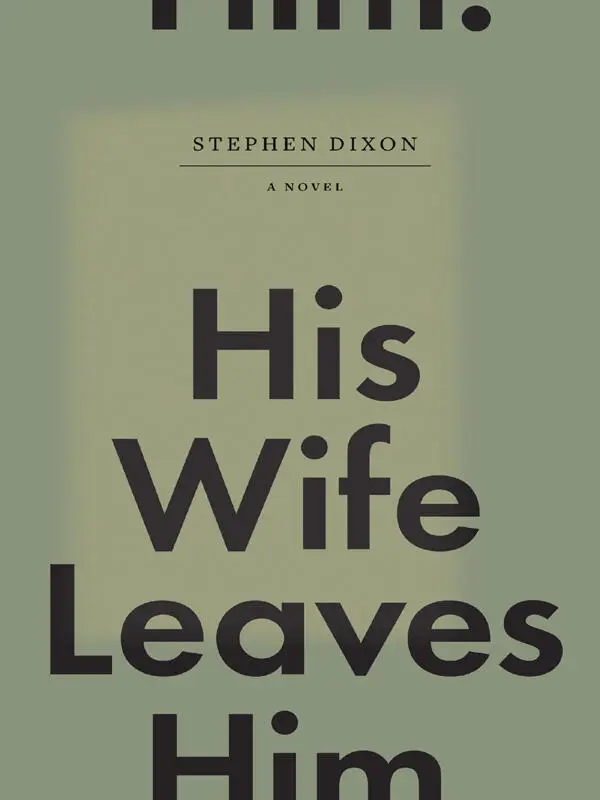
- Название:His Wife Leaves Him
- Автор:
- Издательство:Fantagraphics
- Жанр:
- Год:2013
- ISBN:нет данных
- Рейтинг книги:4 / 5. Голосов: 1
-
Избранное:Добавить в избранное
- Отзывы:
-
Ваша оценка:
His Wife Leaves Him: краткое содержание, описание и аннотация
Предлагаем к чтению аннотацию, описание, краткое содержание или предисловие (зависит от того, что написал сам автор книги «His Wife Leaves Him»). Если вы не нашли необходимую информацию о книге — напишите в комментариях, мы постараемся отыскать её.
, a long, intimate exploration of the interior life of a husband who has lost his wife.
is as achingly simple as its title: A man, Martin, thinks about the loss of his wife, Gwen. In Dixon’s hands, however, this straightforward premise becomes a work of such complexity that it no longer appears to be words on pages so much as life itself. Dixon, like all great writers, captures consciousness. Stories matter here, and the writer understands how people tell them and why they go on retelling them, for stories, finally, may be all that Martin has of Gwen. Reminders of their shared past, some painful, some hilarious, others blissful and sensual, appear and reappear in the present. Stories made from memories merge with dreams of an impossible future they’ll never get to share. Memories and details grow fuzzy, get corrected, and then wriggle away, out of reach again. Martin holds all these stories dear. They leaven grief so that he may again experience some joy. Story by story then, he accounts for himself, good and bad, moments of grace, occasions for disappointment, promises and arguments. From these things are their lives made. In
, Stephen Dixon has achieved nothing short of the resurrection of a life through words. When asked to describe his latest work, the author said that “it’s about a bunch of nouns: love, guilt, sickness, death, remorse, loss, family, matrimony, sex, children, parenting, aging, mistakes, incidents, minutiae, birth, music, writing, jobs, affairs, memory, remembering, reminiscences, forgetting, repression, dreams, reverie, nightmares, meeting, dating, conceiving, imagining, delaying, loving.”
is Dixon’s most important and ambitious novel, his tenderest and funniest writing to date, and the stylistic and thematic summation of his writing life.
His Wife Leaves Him — читать онлайн бесплатно полную книгу (весь текст) целиком
Ниже представлен текст книги, разбитый по страницам. Система сохранения места последней прочитанной страницы, позволяет с удобством читать онлайн бесплатно книгу «His Wife Leaves Him», без необходимости каждый раз заново искать на чём Вы остановились. Поставьте закладку, и сможете в любой момент перейти на страницу, на которой закончили чтение.
Интервал:
Закладка:
The first time she saw him cry. They were eating dinner in her apartment. A particularly sad part of a Corelli concerto grosso was playing on the record player. It was still light out and the windows were open and they were both in short-sleeved T-shirts. So it was late spring or early fall, around or a couple of months more than a half year after they met, when the phone rang. She answered it, and said “It’s for you — Pearl Morton,” and he said “Pearl? Rob Heimarck’s old girlfriend? Uh-oh; bad news,” and he took the phone and said “Hi, Pearl. How are you?” and she said “Not good. And I’m sorry for disturbing you at your friend’s place. I originally wanted to get you at home. You’re not listed?” and he said “No, I’m listed,” and she said “Well, I couldn’t find it. Roberto had an address book on a chair by his bed, it had an old number of yours — must have been from when you were still living with your mother, because that’s who I spoke to and she gave me this number and your apartment’s but said chances were you’d be here. As you probably guessed by now—” and he said “He died?” and she said “Had a heart attack in bed when he was trying to call someone, probably for help. The phone was off the hook when they found him and the address book was open to the letter G. But that doesn’t mean anything. The pages may have turned themselves. You know he had diabetes,” and he said “I knew he was sick with something but I didn’t know with what.” “I’m surprised,” she said. “It wasn’t as if he kept it a secret, and you two were once pretty close. Had it for twenty years. Gave himself an insulin shot twice a day, or did when I was living with him. Lately, because he was getting so weak, he had a visiting nurse or a friend do it for him. The diabetes is what gave him the heart attack.” “I’m sorry, Pearl. Very sorry. I know what you meant to him and what he meant to you,” and she said “Yeah, well, I thought you should know. Happened three days ago. His body’s been given to science, as was his wish and because he knew he had no money to be cremated, and his ashes will be scattered around Mt. Tamalpais, which is what he really wanted. But there will be a memorial, and I’ll let you know. He liked you, you know — your fortitude and your work,” and he said “Thanks for telling me that, and of course, same goes from me to him.” “That’s not what Roberto told me, and it sort of hurt him. But okay, he’s dead, so we won’t go into it. Will you be able to say something at the memorial? I’m lining up people now. I figured, you being a writer for so many years, you’d be able to scratch a minute or two out and read it.” “I’ll try. As you might not know, nonfiction doesn’t come easy to me,” and she said “So lie, what the hell. Now I’ve got to make some other calls,” and she said goodbye. He sat back at the table. “You heard,” he said. “Roberto was a good friend of mine. Met him summer of ’61 at a writers’ conference we went to at Wagner College. Saul Bellow was the fiction teacher. Then, the late sixties, we stopped meeting as often, I forget why. I think it was more on my part than his. I know he lived so slovenly that I hated going to his apartment because I thought I’d come home with cockroaches in my clothes. I actually used to shake out my coat after I left his place. Later on I only met him for coffee or beer once, at the most, twice a year, and for the last few years, not at all. But we should finish dinner.” He picked up his knife and fork, started crying, and put them down. She took his hand and put it to her cheek. “I don’t know why I’m crying. I never would have thought I would. The music’s not helping, meaning, it’s helping,” and he got up and shut it off, and sat back down. “He was such a nice guy and always a big booster of my work. One time, I remember, he came over to my apartment when I lived on East 88th Street. I told him I was going to send my new novel to New Directions or Grove Press — anyway, one of them near where he lived in the Village — and he said ‘Don’t trust the mail with your manuscript,’ and volunteered to drop it off there instead. Next day he calls and says he started reading my novel on the subway, couldn’t put it down, read it till four in the morning, could he have another day to finish it? He calls the next day and says he finished it that afternoon and made the delivery. ‘It’s fantastic,’ he says. ‘They have to take it, and that’s what I told the receptionist I gave it to,’ and went on and on with his praise. I should have done the same thing with him, after I read a story of his in a magazine, and then his only published novel, which he gave me, rather than being stingy with my praise and a bit nitpicky. That could have been what stopped us from meeting as much. That he thought I didn’t like his work. And he’d be right — he wasn’t a good writer, at times he was even a lousy writer, but I never said anything close to that. Was I jealous that he got a book out before me? Not with the book he got out, but I got to admit I was a little sore. So maybe the falling-out was mostly my fault. But too late to smooth things over and make amends. And what a way to go. In bed, trying to phone someone for help, Pearl said. A very decent guy and a much better friend than I was, and I’ll miss him, even though I didn’t see him for so many years,” and he started crying again. And the first time he saw her cry? At the same table. He’d finished wiping his eyes with his handkerchief or table napkin and saw her crying. “What are you crying about?” he said, and she said “You. I hate seeing you sad.” “C’mere,” he said, and he moved his chair closer to hers without getting up from it and hugged her and she hugged him. Then he started crying again and she started crying again. So also the first time they cried together.
It makes him think of another time he said something that made her cry. Maureen, no more than four at the time, ran into the room and said “Mommy, Mommy, don’t cry. What’s wrong? Does something hurt?” and Gwen stopped crying and said “No, it’s nothing, my darling.” “It’s something,” Maureen said. “People don’t cry for nothing. Is it something Daddy said?” and Gwen shook her head. “I was angry,” he said, “and said something I shouldn’t have,” and Maureen said “You have to say you’re sorry to her.” “I’m sorry, Gwen,” he said. “I was wrong,” and she nodded. “Don’t make Mommy cry again, Daddy. Listen to me. Don’t get angry anymore,” and he said “You’re right, I won’t,” and looked at Gwen and started shaking his head and then laughing at what Maureen had said, and she smiled and mouthed “I know.” “Good,” Maureen said. “Now I can go away,” and she left the room. “God, that kid is great,” he said. “Both of them. Two great kids. And I got off easy,” and he made a move to try to kiss or just hold her, but she opened and turned the pages of the book she was reading a minute before she began crying.
He doesn’t know why but he suddenly thinks of her Cuisinart, which she had even before they first met. One of only three food appliances they used, the others being a toaster and coffeemaker. Of course a stove and refrigerator, but he means the ones that sit on a kitchen countertop. Maine, that’s it. They used to send it there every summer by UPS, and at the end of their stay send it back the same way, at first to her New York apartment and then to their Baltimore apartment and next to their house in Baltimore and finally to this one in Ruxton. It’s a big Cuisinart, so no room for it in the car and later in a succession of vans, what with his two manual typewriters, which he didn’t trust sending up, and her electric typewriter and then her computer and printer. And her two cats to one carrier and her parents’ two cats in theirs. And their manuscripts and some writing supplies to start off with before the UPS boxes arrived. Also, for a while, a kid’s stroller and whatever that infant carrier’s called that he used to carry the kids in on his back. And a case of good wine. Wouldn’t send that up and didn’t think he could by law. Would have taken two if he had the room. And a suitcase and boat bag or two of clothes and some of her mother’s things for when she came up, since she didn’t like to carry too much on the plane, and necessary books. Dictionary, thesaurus, French and Italian dictionaries and scholarly works she was writing. Cat supplies: litter box and ten-pound bag of kitty litter for the overnight motel stay in Kennebunk and then Kennebunkport and for the house in Maine. Cotton linen for the motel — Gwen had trouble sleeping on polyester pillowcases and sheets. Blankets and quilts and pillows and other things, like a four-cup coffeemaker, which they didn’t send up by UPS but often sent back. Plus they needed room in the car for three to four shopping bags of food and other goods, which they’d buy at the Bucksport Shop ’n Save thirty or so miles from their destination, for their first night and morning in the Brooklin cottage they rented for seven summers and the Sedgwick farmhouse for close to twenty. Gwen taught him how to use the Cuisinart. Which blade did what, and so on, but he only used the sharp metal one for things like hummus and pesto and chopped salad and smoothies and to puree soups. They had about four toasters and maybe as many coffeemakers in the time they had this one Cuisinart. The toasters and coffeemakers were cheap and always broke down in a few years, while the Cuisinart never stopped working or needed fixing. About a year ago she said “Do you think we should get the Cuisinart serviced before we send it up to Maine again?” and he said “Why, it’s not running well?” “No, it’s just that we’ve had it for so long, altogether for more than thirty years,” and he said “We’ll see; we’ve plenty of time. It must have been a big investment for you when you bought it,” and she said “It was. I didn’t think I could afford it at the time. I was just a graduate student, barely getting by. But it’s proven to be worth every cent I spent on it. But what do you think if we bought a much smaller one for Maine — the one we have was the only model they sold then — and leave it at the farmhouse every summer? If it’s not there when we come up the next summer, and I don’t see why it wouldn’t be, at least we’d know it didn’t cost much — Cuisinarts of all kinds are much cheaper than they used to be. And think how much we’d save by not shipping it back and forth every summer, especially so because UPS rates have gone way up.” He said “Good idea — we don’t need one so big up there — and the box you originally bought it in is on its last legs. We can buy it at Wal-Mart in Trenton on our way to Acadia Park. Might as well get it at the cheapest place possible, and while there we’ll buy a couple of reams of copy paper for your printer and my typewriter. That way we’ll also be creating a little extra space in the van by not bringing all that paper up with us.” “You think we need that much paper?” and he said “There hasn’t been a summer that I remember, except two of them when you were still using your typewriter and we had to cut our vacation short to get back early to have our babies, when we haven’t gone through as much as that. I alone use a ream and half.”
Читать дальшеИнтервал:
Закладка:
Похожие книги на «His Wife Leaves Him»
Представляем Вашему вниманию похожие книги на «His Wife Leaves Him» списком для выбора. Мы отобрали схожую по названию и смыслу литературу в надежде предоставить читателям больше вариантов отыскать новые, интересные, ещё непрочитанные произведения.









Обсуждение, отзывы о книге «His Wife Leaves Him» и просто собственные мнения читателей. Оставьте ваши комментарии, напишите, что Вы думаете о произведении, его смысле или главных героях. Укажите что конкретно понравилось, а что нет, и почему Вы так считаете.