Stephen Dixon - His Wife Leaves Him
Здесь есть возможность читать онлайн «Stephen Dixon - His Wife Leaves Him» весь текст электронной книги совершенно бесплатно (целиком полную версию без сокращений). В некоторых случаях можно слушать аудио, скачать через торрент в формате fb2 и присутствует краткое содержание. Год выпуска: 2013, Издательство: Fantagraphics, Жанр: Современная проза, на английском языке. Описание произведения, (предисловие) а так же отзывы посетителей доступны на портале библиотеки ЛибКат.
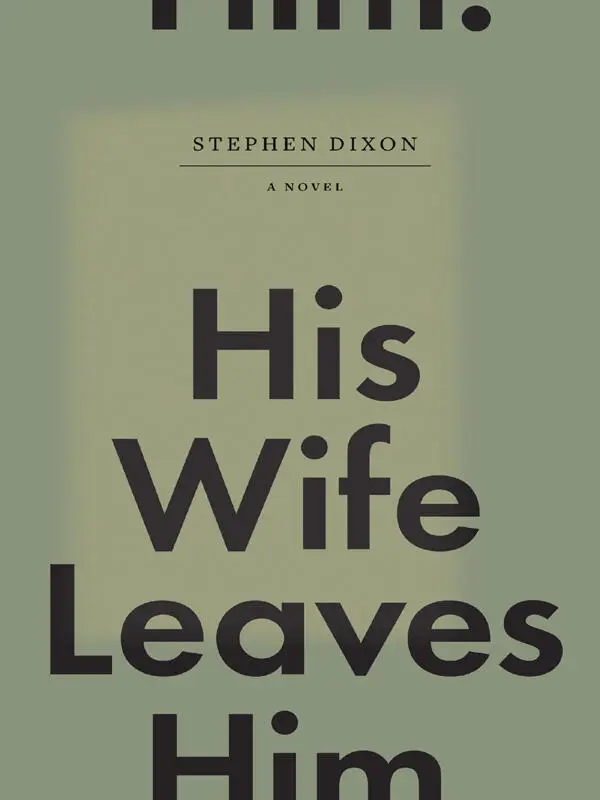
- Название:His Wife Leaves Him
- Автор:
- Издательство:Fantagraphics
- Жанр:
- Год:2013
- ISBN:нет данных
- Рейтинг книги:4 / 5. Голосов: 1
-
Избранное:Добавить в избранное
- Отзывы:
-
Ваша оценка:
His Wife Leaves Him: краткое содержание, описание и аннотация
Предлагаем к чтению аннотацию, описание, краткое содержание или предисловие (зависит от того, что написал сам автор книги «His Wife Leaves Him»). Если вы не нашли необходимую информацию о книге — напишите в комментариях, мы постараемся отыскать её.
, a long, intimate exploration of the interior life of a husband who has lost his wife.
is as achingly simple as its title: A man, Martin, thinks about the loss of his wife, Gwen. In Dixon’s hands, however, this straightforward premise becomes a work of such complexity that it no longer appears to be words on pages so much as life itself. Dixon, like all great writers, captures consciousness. Stories matter here, and the writer understands how people tell them and why they go on retelling them, for stories, finally, may be all that Martin has of Gwen. Reminders of their shared past, some painful, some hilarious, others blissful and sensual, appear and reappear in the present. Stories made from memories merge with dreams of an impossible future they’ll never get to share. Memories and details grow fuzzy, get corrected, and then wriggle away, out of reach again. Martin holds all these stories dear. They leaven grief so that he may again experience some joy. Story by story then, he accounts for himself, good and bad, moments of grace, occasions for disappointment, promises and arguments. From these things are their lives made. In
, Stephen Dixon has achieved nothing short of the resurrection of a life through words. When asked to describe his latest work, the author said that “it’s about a bunch of nouns: love, guilt, sickness, death, remorse, loss, family, matrimony, sex, children, parenting, aging, mistakes, incidents, minutiae, birth, music, writing, jobs, affairs, memory, remembering, reminiscences, forgetting, repression, dreams, reverie, nightmares, meeting, dating, conceiving, imagining, delaying, loving.”
is Dixon’s most important and ambitious novel, his tenderest and funniest writing to date, and the stylistic and thematic summation of his writing life.
His Wife Leaves Him — читать онлайн бесплатно полную книгу (весь текст) целиком
Ниже представлен текст книги, разбитый по страницам. Система сохранения места последней прочитанной страницы, позволяет с удобством читать онлайн бесплатно книгу «His Wife Leaves Him», без необходимости каждый раз заново искать на чём Вы остановились. Поставьте закладку, и сможете в любой момент перейти на страницу, на которой закончили чтение.
Интервал:
Закладка:
They were in Aix-en-Provence, had just attended an organ concert in an old church, were walking out of the church when he saw what looked like notices, a couple with drawings of hearts on them, pinned to a message board on the wall. “What are these?” he asked her, and she said “Banns — public notices of the couples announcing their engagements.” “What a nice idea. Let’s post one,” and she said “You can’t, unless you’re going to get married.” “Let’s get married, then: here, in Aix,” and she said “Are you crazy?” “Why? Linda and Lewis will be here in two days. So before we all drive up to Paris together, they can be our witnesses as well as best man and maid of honor.” “You’re really talking foolish, Martin. If we ever did marry, I’d want my parents to be there and I’d think you’d want your mother and a number of our friends there too. But the point is, if I’m to take you seriously, that I’m not ready to marry you,” and he said “Too bad — but think of it, though. Married in this sweet-smelling ancient city, birth and burial place of Cézanne and I think just the birthplace of Milhaud. A quiet simple ceremony. A delicious dinner that night of just the four of us, with the best wine and champagne and maybe an accordionist to play a few traditional Provençal tunes. Chartres and Paris and various chateau towns along the way for our honeymoon. And then flying home as new bride and groom and, if you want, a wedding reception we’ll give in our apartment for family and friends. And you say you eventually want children, so we could even arrange your being pregnant before we get back. I wish we didn’t have to pass up this opportunity,” and she said “We have to. Sweet an idea as it is, it’s ridiculous.” “When can I propose to you then, where you’d most likely say yes?” and she said “We’ll talk about it in four to five months. If we’re still a compatible couple and we feel about each other the way we do now, it’s possible I’ll accept. But, you know, you might change your mind by then,” and he said “Never. You’re the only girl for me.”
It was their second summer together. They were driving back from Maine, on the Belfast road to Augusta. She was driving and he was trying to pick up either the Bangor or Portland public radio stations, when a dog ran out on the road and she hit it. The dog flew over the right side of the car and landed on the shoulder. She pulled over, was crying, saying “Oh, my God, I killed a dog. I didn’t mean it. I was driving carefully, but it jumped out on me,” and he said “I know; it wasn’t your fault; take it easy.” He unfastened their seatbelts, put his arms out and she went into them and he hugged her. “It’ll be all right. Don’t think you’re responsible. The dog’s probably done this with cars a number of times and this was the only time it was hit. But we have to deal with it. You’re too upset, so you stay here. I really don’t want to look at it, but I’ll go see how it is. Though at the speed we were going — and it wasn’t excessive — and hitting it front on — I’m sure it’s dead.” Other cars had stopped on both sides of the road. There were already a few people around the dog when he got out of the car. “I saw it all,” a woman said. “You’re not to blame for it. It’s its owner for letting it roam free like that.” A girl of about fourteen sat beside the dog, rested its head on her lap and petted it and felt its nose and chest and said “It’s not breathing, poor thing.” “My friend was at the wheel,” he said to the woman. “She was driving well below the speed limit. She’d be out here now but she’s too upset over it.” “I can imagine,” a man said. “I saw it too, but from the other way. The dumb dog just zoomed in front of your car as if he wanted to kill himself. I’ll vouch for your friend too, when the trooper comes.” “How will we get one?” and the man said “I’ll turn around and call from the convenience store no more than a mile from here. But you see, if you kill an animal on the road — even a deer but not something like a skunk or fox or raccoon — you got to stay with it till an official report’s made.” “Will that take long?” and the man said “It could. Not a top priority for a trooper to attend to, especially during vacation season. I hope you don’t have someplace you have to get to right away.” Then the dog stirred. “It’s alive,” someone shouted. Raised itself on its front legs and then stood on all fours, wobbly at first and then straight, and ran into the woods. “Well, what do you know,” the man said. “Here we were about to conduct funeral services for it, and it scoots away. Smart fella. Didn’t want to be buried alive.” “Did it look okay?” he said, and the man said “I didn’t see wounds or blood. I’d say you and your friend are off the hook. I know I feel good about it, and nobody has to wait around.” “Thank you all,” he said. “You’ve been very kind.” They went back to their cars. He checked the car they’d rented to see if there was any damage. There was some shit on the front bumper, but no dents or anything. He told himself he’d wipe it off the next time they stop for gas or to pee, if it didn’t fall off first. He got in the driver’s seat. She’d moved to the passenger seat. “Did you see?” he said, and she said “I saw. I’ve never been so relieved in my life. The dog must have been in shock. Did it seem all right when it ran away?” and he said “A bit slower, which is to be expected after such an accident, but everything else looked okay. Resilient little cuss. Gave us quite a scare and could have kept us here for hours.” “You were wonderful,” she said, and he said “Thank you,” and she took his hand and kissed it.
New Year’s Eve. They had three parties to go to. The first was at her parents’ apartment in the West Seventies. “They give it every year,” she said, “and it’ll be nice for you to first meet them in a festive setting.” The second was at the SoHo loft of her best friend and her friend’s husband, both artists. “There’ll be lots of music and fine wine and champagne. Vincent, and I know you’ll want to say it’s an appropriate name for him because of what I’m about to tell you, is a wine maven of the most extravagant sort. He has a wine cellar in their building with more than two thousand bottles, and the best of them will be out tonight.” The third, a few blocks from her apartment, he was invited to yesterday by the host whom he’d bumped into on Broadway. She was once married to a very old friend of his. “I don’t really see the point of our going to her party,” she said, “as you’re not friendly with her anymore and you haven’t seen her in years. But since you’re going to two of mine, I can go to one of yours, but can we make it short?” “If we feel we’re over-partied by then,” he said, “or just over-champagned and over-kissed, we can even skip it.” Going up the elevator to her parents’, she said “We’ll stay no more than an hour, have some kippers and herring and lox to minimize the effects of too much to drink later on — the Russians swear by the pickled and smoked fish antidote — and then head downtown.” One woman there — a research scientist; in fact, they were all, woman and men, professionals — said to him “May I steal you for a while to question you as to who you are? So far, you’re an unknown quantity, and we’re all curious about you.” She led him to the kitchen and asked where he was raised and educated and were his parents born here and what does he do for a living and what are some of the titles of his books and in what magazines may she find his stories. “I belong to a good library, and when it doesn’t have what I want, there’s an excellent bookstore in my neighborhood. This is a reading crowd we have here, all very intelligent and high-minded about literature, so if you’re a serious author, I think we can sell some of your books.” He said he only had three titles and they’re short ones and easy to remember, and gave them. “Now I’d like to ask you a personal question,” she said. “What are your intentions to Gwendolyn? You have to understand, we are all former refugees, almost all of us Holocaust survivors, met in New York City after the war, and are like family to one another to replace the ones we lost, and Gwendolyn is like our own child.” “We’ve only known each other a month,” he said, “though for the last week and a half have seen each other almost every day. So I’d say I like her a lot and enjoy her company, and that what I find particularly appealing about her is her gentleness and intelligence and warmth,” and she said “Does it go deeper than that? I can say that for most of us here, outside of our own, she is our favorite child, so we would be greatly upset if any hurt was done to her.” “You don’t have to worry. Women usually end up hurting me, which I’d think is better than the reverse. But you should speak to her and see what she thinks,” and she said “I plan to, but not tonight. So, my opinion, after speaking to you, is that you are a pleasant, serious and honest person, with a good sense of humor, so I can only hope that something long-lasting materializes between the two of you. As you might know, and if not, will surely learn, her one marriage was a catastrophe.” That night he met her best friend and her husband for the first time too. As with her parents at their crowded party, he didn’t get to talk to them much. “Another time,” her father had said. The food, wine and champagne were very good. But the music was too loud and the living room where the dancing took place too dark and the cigarette and cigar and pot smoke were stifling and smelling up his clothes and probably his hair and the strobe lights hurt his eyes. After an hour, he said to her “Do you think we could go?” and explained why. “If you want to stay longer and dance with someone — music’s too fast for me and I’d look silly dancing dances I don’t know, and there seem to be a couple of guys who want to dance some more with you — I’ll stay in the kitchen and nurse a glass or two of wine. You were right; it’s really good stuff — everything they served.” “No, I’m ready to go. Four times on the dance floor are enough for me. Do you want to go to your friend’s party?” and he said “We don’t have to if you don’t want. We could go to a nice bar around here, order champagne and toast the new year in there.” “That’d be depressing. Let’s go to your friend’s, and it’s close to home. New Year’s isn’t important to me.” “Except for whom you’re with,” and she said “I like being with you tonight, but who I’m with on New Year’s Eve isn’t that important too.” It was a small party. Maybe eight people. They sat on chairs or the floor in the living room — there was no couch — and talked about the middle school in the Bronx they all seemed to teach at and how angry and tough so many of the students were and incompetent the administrators. Food was a few leftover pastries, and the only things to drink were hard cider and cheap wine. “Don’t go into the kitchen,” someone warned. A while before, someone from the SRO building that faced the women’s kitchen shot a bullet through the window. “Fortunately, everyone was in the living room at the time,” the woman said. They found the slug in the wall—“From a.22, a gun expert here said, which is why it only made a tiny hole in the window, with little cracks around it.” “I don’t know how you can live here after that,” Gwen said, and the woman said “At the rent I’m paying, I can’t afford not to.” “Did you call the police?” and she said “I was advised it’d be an exercise in futility. For what are they going to do — go through every room facing my window? There must be a hundred.” “Wouldn’t they be able to tell which window it came from by the trajectory of the bullet?” and the woman said “You’ve been watching too many TV shows,” and Gwen said “I don’t watch any.” “Maybe you’re right,” she said. “But I’ll just keep my kitchen shade down for a few weeks and the kitchen dark when I’m not in it, and hope the shooter moves out — the turnover in these flophouses is very high.” Soon after, Gwen got him alone and said “Please let’s leave. This place gives me the willies, and I don’t want to have my first kiss of the new year here. I’m also afraid one of the guests — the one with the Hebro; he’s been eyeing me — is going to use the New Year’s excuse to kiss me.” “What time is it?” she said on the street, and he said “Three minutes till twelve.” Just then they heard horns blowing and cars honking and people shouting “Happy New Year,” and he said “I guess my watch is a little slow.” She took her hand out of his and said “Well?” and he kissed her. When they got back to her apartment, he said “Not a great evening, except for meeting your parents and friends, however brief, but New Year’s Eves never were.” “I had a good time, other than for the bullet through the window and, I’m hesitant to say, your friend and her friends,” and he said “And I very much enjoyed being with you. I can’t imagine what kind of evening it would have been without you. I probably would have gone to that last debacle and left after half an hour, claiming I had some other place to go to or didn’t feel well, and gone home and opened a good bottle of wine, or let’s say one of my two bottles of wine, and read the newspaper. But I couldn’t have gone to that party if I didn’t know you. I was only in the Columbia neighborhood, where I bumped into her and we got to talking and she invited me to her party, because of you. So I just would have visited my mother around eight, instead of six, which I did, and had two or three drinks, instead of one, from the bottle of Jack Daniels I brought her, and then gone home too early to buy the next day’s Times . While you, you might have met a new fellow at your friends’ party. Some of them were handsome and spiffily dressed and quite polished looking, and good dancers and more your age than I am, and New Year’s Eve parties tend to bring out the mating instinct in unattached people,” and she said “There could always be that chance — I think I’ve met half my boyfriends and also my future husband at parties — but I doubt I would have gone if I didn’t have a date. It’s not a good night to be a single woman riding the subway.” “You could have taken a cab,” and she said “I could have, but who’s to say I would have been able to get one coming home.” “Did any other men call you to go out tonight?” and she said “To be perfectly honest, yes, two — men I’ve been close to — but I said I was taken.” “That’s nice to hear — the last part. But you wouldn’t have even gone to your parents’ party?” and she said “For an hour…for that one I could take the bus. They’d be disappointed if I didn’t come, and I love all their friends. After, I would have taken the bus or a cab home long before midnight, when they’d still be available.” “Incidentally,” he said, “did one of the women there — I think her name was Riva, or Eva — talk to you about me?” and she said “Riva Pinska…yes, and I know she talked to you about me. We don’t have to tell each other what we told her. I hope you liked her and didn’t think her questions were too nosy. As she must have told you, as with my parents they all lost most to all of their families in the war, so they’re extremely protective of me.” “I told her I would never kick you down a flight of stairs. No, that’s a bad joke. First of the year, and a lulu. I’m sorry. I don’t know where it came from. No, I wanted to tell her I think I’m falling for you, but didn’t think she should be the first to hear that,” and she said “A good recovery from a rather strange gaffe. Now, do you want a nightcap — I don’t — or should we just wash up and go to bed? I’m very tired.” “But what else do you have to say?” and she said “I’m thinking about it.”
Читать дальшеИнтервал:
Закладка:
Похожие книги на «His Wife Leaves Him»
Представляем Вашему вниманию похожие книги на «His Wife Leaves Him» списком для выбора. Мы отобрали схожую по названию и смыслу литературу в надежде предоставить читателям больше вариантов отыскать новые, интересные, ещё непрочитанные произведения.








Обсуждение, отзывы о книге «His Wife Leaves Him» и просто собственные мнения читателей. Оставьте ваши комментарии, напишите, что Вы думаете о произведении, его смысле или главных героях. Укажите что конкретно понравилось, а что нет, и почему Вы так считаете.