Svetislav Basara - The Cyclist Conspiracy
Здесь есть возможность читать онлайн «Svetislav Basara - The Cyclist Conspiracy» весь текст электронной книги совершенно бесплатно (целиком полную версию без сокращений). В некоторых случаях можно слушать аудио, скачать через торрент в формате fb2 и присутствует краткое содержание. Год выпуска: 2012, Издательство: Open Letter, Жанр: Современная проза, на английском языке. Описание произведения, (предисловие) а так же отзывы посетителей доступны на портале библиотеки ЛибКат.
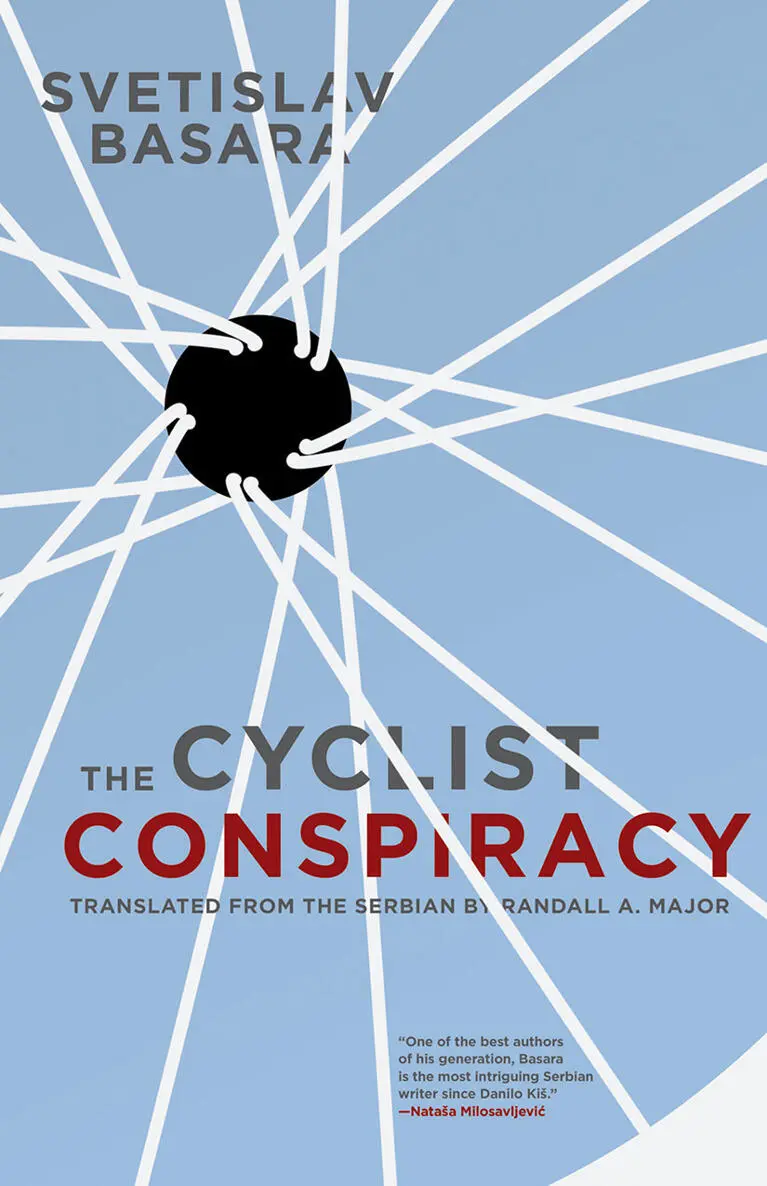
- Название:The Cyclist Conspiracy
- Автор:
- Издательство:Open Letter
- Жанр:
- Год:2012
- ISBN:нет данных
- Рейтинг книги:4 / 5. Голосов: 1
-
Избранное:Добавить в избранное
- Отзывы:
-
Ваша оценка:
The Cyclist Conspiracy: краткое содержание, описание и аннотация
Предлагаем к чтению аннотацию, описание, краткое содержание или предисловие (зависит от того, что написал сам автор книги «The Cyclist Conspiracy»). Если вы не нашли необходимую информацию о книге — напишите в комментариях, мы постараемся отыскать её.
Masterfully intertwining the threads of waking and dreams into the fabric of the present, the past, and the future, Svetislav Basara’s Pynchon-esque The Cyclist Conspiracy is a bold, funny, and imaginative romp.
The Cyclist Conspiracy — читать онлайн бесплатно полную книгу (весь текст) целиком
Ниже представлен текст книги, разбитый по страницам. Система сохранения места последней прочитанной страницы, позволяет с удобством читать онлайн бесплатно книгу «The Cyclist Conspiracy», без необходимости каждый раз заново искать на чём Вы остановились. Поставьте закладку, и сможете в любой момент перейти на страницу, на которой закончили чтение.
Интервал:
Закладка:
After that I go home
Resolute
To read nothing at all
Sunday
Holy Sunday
Fat roasted turkeys
Fly over the streets
Greasy Sunday lunches
Swollen greasy stuffed cabbage leaves
Lazily napping
On the dead backs
Of solemn tables set for guests
In Sunday guest rooms
Fathers counsel children
I’m waiting for you in front of the butcher shop
In solemn Sunday
First person singular
And so wonderfully
I do not exist
You don’t have to come
Anyway you don’t exist
I don’t have to wait
Anyway you won’t come
Let the Earth turn aimlessly
Around its sun
I am empty
Like the universe
This Sunday afternoon is
Longer than the smooth meridian
That severs me lengthwise
Thus there exists
An eastern and western
Joseph Kowalsky
An east and west heart
An east and west hand
An east and west waiting
And all of it divided
By a thin lengthwise line
Into an eastern NOTHING
And a western NOTHING
And in the middle
Holding my breath
I wait for you frantically
(1923)
AMEBAS (1957)
At night, as soon as I fake going to sleep so
I could rest from pretending to be awake, my red boots
would set out. They would check to see if my eyes
were closed, and if my breathing was rhythmical and then
they would go out into the street.
I would follow them barefoot and bareheaded in my nightshirt. Without success. A few streets over they would lose me and there was always a cop there who was bored and liked to ask a lot of
questions.
Who knows with whose feet they went, where they went, what they
did I never managed to find out where
they go
those boots of mine.
And still, I forgave their unfaithfulness, took them to the cobbler,
shined them with whale oil until they finally fell apart.
~ ~ ~
…
It is impossible to simultaneously feel and not feel them
How uninvited they find refuge in the shallow seas of marrow
And blood
Named after kinds of ravings
Bloated shapeless Amebas
Look… two baby Cancer amebas
In your tear duct they are weeping
Jangle the rattles of your bones
Go on let them play
Let their soft mouths chew on you
Bring them mother’s milk
Bring them yourself
In the right pocket of Cancer
~ ~ ~
…
In the left pocket is a trite emptiness
Dedicated to the waters; below the sun shatters into
Tiny boulders
Below is their home and ours
A large village of silence
And we shall
Return Cancer
The one and only Cancer
Look, two baby amebas on the corner sobbing
Break off the hands
Break off the head
Feed the insatiable hunger
Feed the amebas
Of Cancer
~ ~ ~
…
If they gently enter the whites of the eye and become cataracts
What word should you softly say so they don’t become enraged
And deform even these pitiful contours
And these pilfered shapes
And these airy constants
How do you tell them to come to their senses when they do not even
Have themselves and when they don’t know
In which direction and how far they spread
Into which of the unstable senses
Into which of the floppy ears
~ ~ ~
…
Watch out Cancer
One of them slipped unnoticed into your ear
Across your hand
Maybe it will tell you a lie
Maybe it will pierce your eardrum
Fly away, fly
~ ~ ~
…
They are at times in my outstretched palms
and again at midnight they stick to the blind window panes
all by the way from childhood to this telephone booth
in the hospital wing of the madhouse
They call on the telephone: let us into your eyes
let us into your lungs
let us into your veins
let us into your glands
let us into you
Static in the lines
They naturally are not anything but they are also not stars
they twinkle though they barely exist usually around
zero-zero
(when the senses change shifts)
They flicker on the restless boundary between
semi-darkness and…
Static in the lines
PROSE
BICYCLISM AND THE THEOLOGY OF WITOLD KOWALSKY
1.
I will speak about my father Witold Kowalsky. About his conversion from being an atheist into a true mystic and Cabbalist. He is in the adjoining room. His cheeks are flushed. He is drinking vodka and writing the treatise Theology and Bicyclism dedicated to His Holiness the Patriarch of the Georgian Orthodox Church. Until a few years ago, my father never drank. Then he suddenly grew ill and fell into his deathbed. The doctors gave him two weeks at best to live. After four weeks, my father had not died, and the director of internal medicine, Dr. Wagner, lost patience with him and threw him out of the hospital for being undisciplined, and so that he would not occupy the place of someone who had more respect for medical science, someone ready to die by the determined deadline.
2.
In his Confessions , my father commented on that episode in the following way:
“It is a lie that they threw me out because I didn’t want to die even though, according to all the findings, I was practically dead. They ousted me because, while I was sick, in a coma, I repented and returned to the saving grace of Christianity. It was not the doctors’ fault. They did so unaware. The world order is such that Christians are persecuted and they are persecuted no matter how often the official policies, history and so on, claim that the persecutions of Christians are a thing of the distant past.”
3.
Upon his discharge from the hospital, my father bought an icon of Jesus Christ and a used velocipede. He took down the picture of the Kaiser and hung the icon above the desk that he never ever worked at; at that time, he still had not started corresponding with His Holiness the Patriarch of the Georgian Orthodox Church. But, a mistake slipped by him: while making the frame, the glass-cutter put the picture-hook to the side of the symmetrical axis and therefore Jesus hung crooked, as opposed to the Kaiser who had hung perfectly, his stance at ease. My father tried, using cobbler’s paste (exceptionally hard) to bring the icon into balance. In vain. The icon hung crooked as if it wanted to let him know that it was supposed to be crooked. One day, my father burst into my room and shouted, “ Felix error! I realized what the icon wanted to tell me: Jesus is not hanging crooked, the rest of the world is; the world stands off the vertical axis of the Logos by 13°, no less…”
4.
From that day forward, my father began to be enthralled by mistakes. He said that mistakes are the steps to perfection. I did not understand him; at the time, I was not a mystic, I was a communist.
“Take the train schedule as an example,” he explained to me, “the train schedule is the thing that introduces disorder. Trains always arrive on time, whenever they can and when that meets the goals of Providence. The whim of a transportation engineer, that train number 170 must be every day at 14:03 at a certain station, makes us get an illusion of disorder if the train is late. Yes, that’s the way it is: in countries where the trains arrive exactly according to the schedule, lawlessness is greatest. In a similar, mystical way, to the way the schedule creates lateness, so does the law create crime. Listen, if you have ears…”
Читать дальшеИнтервал:
Закладка:
Похожие книги на «The Cyclist Conspiracy»
Представляем Вашему вниманию похожие книги на «The Cyclist Conspiracy» списком для выбора. Мы отобрали схожую по названию и смыслу литературу в надежде предоставить читателям больше вариантов отыскать новые, интересные, ещё непрочитанные произведения.











Обсуждение, отзывы о книге «The Cyclist Conspiracy» и просто собственные мнения читателей. Оставьте ваши комментарии, напишите, что Вы думаете о произведении, его смысле или главных героях. Укажите что конкретно понравилось, а что нет, и почему Вы так считаете.