Svetislav Basara - The Cyclist Conspiracy
Здесь есть возможность читать онлайн «Svetislav Basara - The Cyclist Conspiracy» весь текст электронной книги совершенно бесплатно (целиком полную версию без сокращений). В некоторых случаях можно слушать аудио, скачать через торрент в формате fb2 и присутствует краткое содержание. Год выпуска: 2012, Издательство: Open Letter, Жанр: Современная проза, на английском языке. Описание произведения, (предисловие) а так же отзывы посетителей доступны на портале библиотеки ЛибКат.
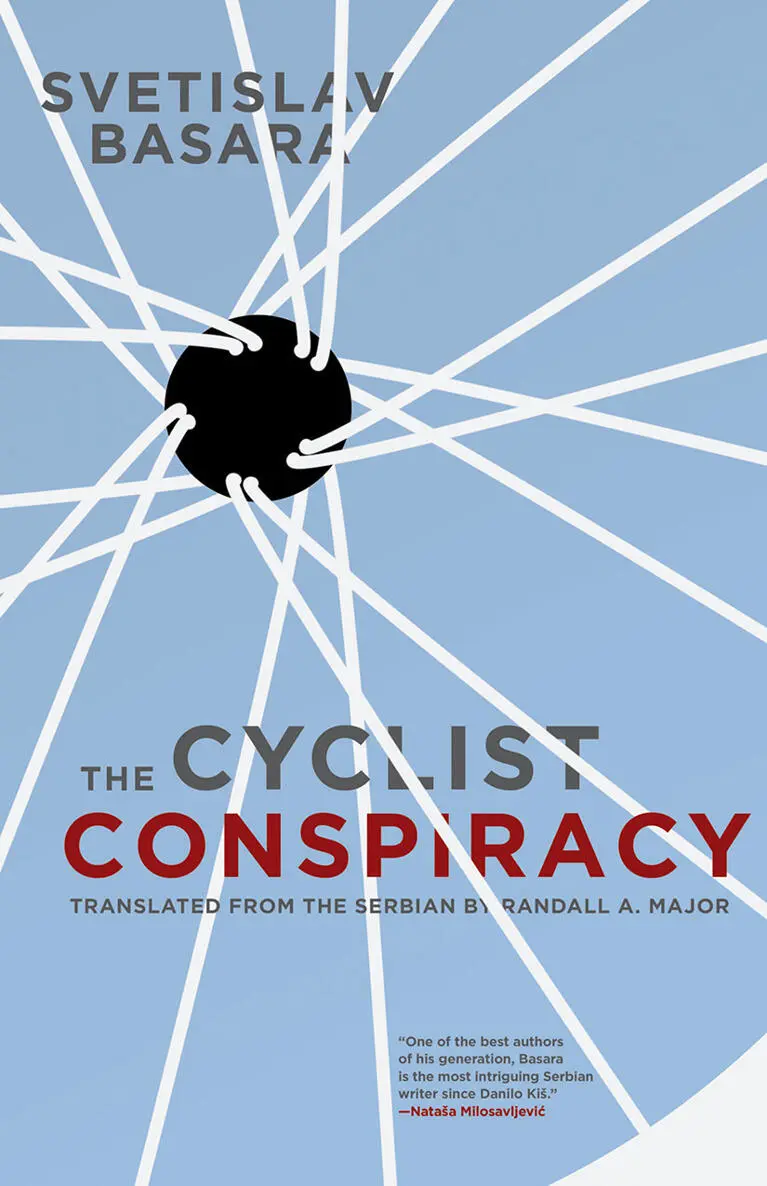
- Название:The Cyclist Conspiracy
- Автор:
- Издательство:Open Letter
- Жанр:
- Год:2012
- ISBN:нет данных
- Рейтинг книги:4 / 5. Голосов: 1
-
Избранное:Добавить в избранное
- Отзывы:
-
Ваша оценка:
The Cyclist Conspiracy: краткое содержание, описание и аннотация
Предлагаем к чтению аннотацию, описание, краткое содержание или предисловие (зависит от того, что написал сам автор книги «The Cyclist Conspiracy»). Если вы не нашли необходимую информацию о книге — напишите в комментариях, мы постараемся отыскать её.
Masterfully intertwining the threads of waking and dreams into the fabric of the present, the past, and the future, Svetislav Basara’s Pynchon-esque The Cyclist Conspiracy is a bold, funny, and imaginative romp.
The Cyclist Conspiracy — читать онлайн бесплатно полную книгу (весь текст) целиком
Ниже представлен текст книги, разбитый по страницам. Система сохранения места последней прочитанной страницы, позволяет с удобством читать онлайн бесплатно книгу «The Cyclist Conspiracy», без необходимости каждый раз заново искать на чём Вы остановились. Поставьте закладку, и сможете в любой момент перейти на страницу, на которой закончили чтение.
Интервал:
Закладка:
III
The relatively small number of his works is in disproportion with Kowalsky’s almost supernatural energy. However, the explanation for that is not hard to find; it is known that he thought that poems and stories were not written once for all time, but that they change like everything else in history, and that is why we have some thirty or more versions of some of his poems and stories; there is a prototype, a version each for winter, spring, summer and autumn; a version for the upcoming year with the accompanying variations, etc. Thus, his collected works take up eight entire volumes, and it is said that “Edition Minuit” is preparing a critical edition of the poems, stories, essays and copies of the journals of Joseph Kowalsky.
Just as he allowed time to affect his writings, he was also indifferent toward changes that time did to him. Comparing the signatures of Kowalsky from season to season, from year to year, we can see how his handwriting followed the internal changes in him. It might be interesting to hear the opinion of a graphologist on that subject:
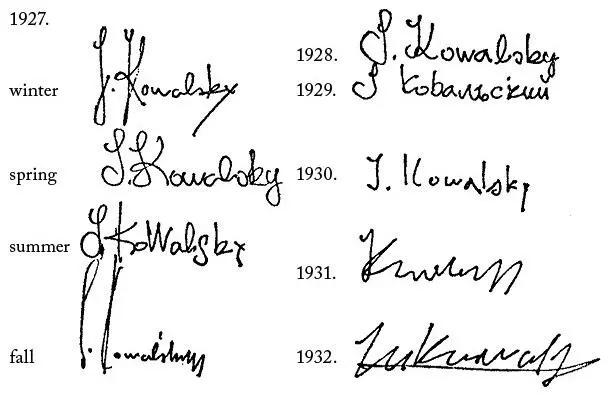
Similar to his handwriting, Kowalsky also changed his appearance. Although everyone who knew him agrees about one thing, that he was tall and thin, the other descriptions are sometimes diametrical opposites. Some describe him as bloated, wrinkled, with a bad complexion; others as spiritual and good-looking; some as a striking example of manhood; others as being homely, even ugly. They do not even agree about the color of his hair. Kowalsky himself used to say, “You can take on any appearance you like, because anyway a man’s appearance is irrelevant. The main thing is to remain indifferent to it.”
The Bicycle Marathon Belgrade-Dharamsala began at midnight on September 21, 1930. Officially a sporting event, the marathon had quite different goals by all accounts. The route Belgrade-Ras-Thessalonica-Mt. Athos-Sardis-Jerusalem-Babylon (which was taken by the first group of marathoners) indicates that Kowalsky had other goals in mind as well. Sava Djakonov, one of the participants in the marathon, in the partially preserved pamphlet Pilgrimage to Dharamsala , describes the events of the journey in a notably poetic way, although the criticism that he allows in too much fantasy are not without foundation. D. H. Grainger finds profound symbolism in the date of the start of the marathon, in the starting point and in the route. Reducing the year of departure to units, he first gets the number thirteen (1 + 9 + 3 + 0 = 13), and then 4 (1 + 3 = 4), which is written in Hebrew as ד (daleth), and is pronounced as “D,” like Dharamsala. However, daleth is also the archetype of material existence in the tradition of the Caballah. According to Grainger, departing from Belgrade on a date that is the product of two holy numbers (3 x 7 = 21), in a year under the sign of daleth, the bicyclists were symbolically leaving the West, history and the obsession with material things, returning (via Babylon where history began) to the irrational, which is symbolized by the East.
Though they left in a group, the marathoners returned individually, and some never returned at all. Followed by quite a lot of publicity at the beginning, the marathon was soon pushed into the background by the events of the day, which eventually obscured it completely.
Kowalsky did not return from Dharamsala before 1936. Those six years of his life are veiled in complete darkness. In the abovementioned pamphlet, Sava Djakonov claims that Kowalsky was working on versions of his poems, and that he spent the last two years with ascetics in a cave, which sounds likely; that, and this is not very likely, he occasionally had himself covered with dirt in a grave where he would spend some time, twenty-four hours at the beginning of his training, up to twenty days near the end. The hagiographic style and tone of Sava Djakonov’s writings are doubtless the consequence of the time he spent in India, with an affinity for fantasy and exaggeration, in addition to his powerful feelings of loyalty toward Kowalsky.
Returning from the East, Kowalsky settled in Belgrade and that was, till the end of his life, the farthest west he ever went. By then, the commandos of the Traumeinsatz had begun their relentless search for him, but he hid in the dreams of the ascetics of Dharamsala, into which the members of the Traumeinsatz , primitive and aggressive dreamers, did not have access. In terms of his literary work, Kowalsky put out his novella Bicyclism and the Theology of Witold Kowalsky with the Belgrade bookstore and publisher G. Kon; in it he discretely explained some of the theses of the secret document of the Evangelical Bicyclists, Theology and Bicyclism . Somehow at that time came another in the series of turnabouts in Kowalsky’s convictions. Formerly a revolutionary, a participant at the Second Congress of the Comintern, he now became an ardent royalist and thereby attracted the resentment of the intellectual leftists.
However, the real scandal was yet to come. Kowalsky pronounced himself to be a viscount. He published a proclamation in which he explicated the reasons for his act, and caused a flood of the most contradictory possible reactions. At one extreme were those who thought him a fool, on the other those who were enthralled with him, and in between were the moderate (who considered Kowalsky’s self-proclamation as a viscount to be an act of artistic exaltation), and the embittered leftists with their accusations that Kowalsky’s act was the very peak of bourgeois decadence.
During that time, Kowalsky held receptions in his luxuriously furnished apartment which often ended up as orgies, and that can be connected to the fact that our hero claimed that the Marquis de Sade was one of his spiritual forbears. With the reservation, according to the testimony of S. Djakonov, that the orgiastic destruction was not intended for others, but for himself. Semi-fantastic descriptions follow of such situations in which the viscount washes the feet of prostitutes, spends hours with his friends wearing hair-shirts, their bodies wrapped in barbed-wire. And indeed, in one place, Kowalsky himself writes: “There are two paths: to destroy others, or to destroy yourself, but the organization of the world is such that whoever does not want to destroy others gets destroyed, unless he is courageous enough to destroy himself.”
In those years of general drunkenness and dissipation (which foretell the upcoming war), the coach of the “viscount” Kowalsky seemed grotesque in the streets of Belgrade, among the Balkan hovels, and that impression was magnified by the liveried coachman and pages.
IV
On the life-line of Joseph Kowalsky, it is said, there was a small line that was, in collusion with the stars — after his brilliant successes — supposed to send him off into a concentration camp, and then into death. He was notified of this, by the mediation of an emissary in his sleep, and Kowalsky underwent an operation that very autumn. A certain Dr. Daud Çulabi arrived in Belgrade and performed plastic surgery on the life-line in a private clinic — an insignificant and harmless procedure which still took several hours because he had to find the most suitable position for the changed line in relation to the future position of the stars. In spite of all the effort of Dr. Çulabi, the only possible outcome for Kowalsky’s fate was for him to become a railroad worker. And that is what happened. Kowalsky spent the next year and the war years as the station head in Stalać. In that foggy little town on three rivers (the West Morava and South Morava join into the Great Morava there), Kowalsky wrote what is certainly his most significant and farseeing work — the Dictionary of Technology . Based on the claim that language has fossilized and become a means of deceit, not of mutual understanding, Kowalsky attempted to study some of the key words of western civilization, to return meaning to those which have lost their value and to put in their rightful place those that have taken on undeserved importance.
Читать дальшеИнтервал:
Закладка:
Похожие книги на «The Cyclist Conspiracy»
Представляем Вашему вниманию похожие книги на «The Cyclist Conspiracy» списком для выбора. Мы отобрали схожую по названию и смыслу литературу в надежде предоставить читателям больше вариантов отыскать новые, интересные, ещё непрочитанные произведения.









Обсуждение, отзывы о книге «The Cyclist Conspiracy» и просто собственные мнения читателей. Оставьте ваши комментарии, напишите, что Вы думаете о произведении, его смысле или главных героях. Укажите что конкретно понравилось, а что нет, и почему Вы так считаете.