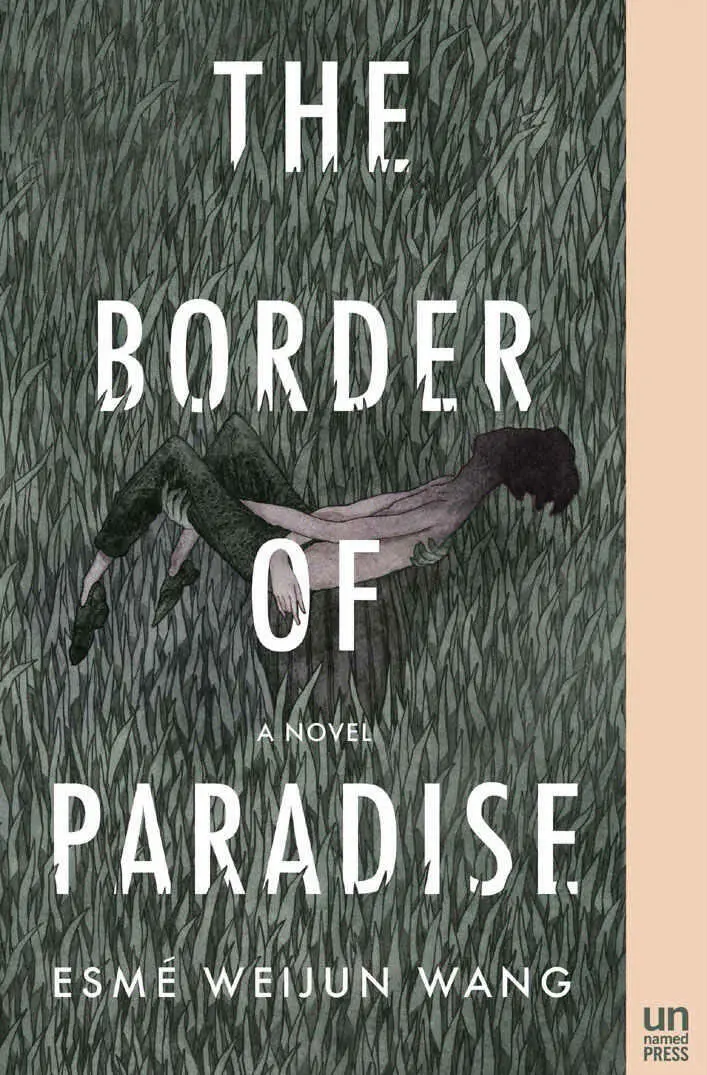
Esmé Wang - The Border of Paradise
Здесь есть возможность читать онлайн «Esmé Wang - The Border of Paradise» весь текст электронной книги совершенно бесплатно (целиком полную версию без сокращений). В некоторых случаях можно слушать аудио, скачать через торрент в формате fb2 и присутствует краткое содержание. Год выпуска: 2016, Издательство: The Unnamed Press, Жанр: Современная проза, на английском языке. Описание произведения, (предисловие) а так же отзывы посетителей доступны на портале библиотеки ЛибКат.
- Название:The Border of Paradise
- Автор:
- Издательство:The Unnamed Press
- Жанр:
- Год:2016
- ISBN:нет данных
- Рейтинг книги:3 / 5. Голосов: 1
-
Избранное:Добавить в избранное
- Отзывы:
-
Ваша оценка:
The Border of Paradise: краткое содержание, описание и аннотация
Предлагаем к чтению аннотацию, описание, краткое содержание или предисловие (зависит от того, что написал сам автор книги «The Border of Paradise»). Если вы не нашли необходимую информацию о книге — напишите в комментариях, мы постараемся отыскать её.
transports readers into the world of an iconoclastic midcentury family.
In booming postwar Brooklyn, the Nowak Piano Company is an American success story. There is just one problem: the Nowak’s only son, David. A handsome kid and shy like his mother, David struggles with neuroses. If not for his only friend, Marianne, David’s life would be intolerable. When David inherits the piano company at just 18 and Marianne breaks things off, David sells the company and travels around the world. In Taiwan, his life changes when he meets the daughter of a local madame — beautiful, sharp-tongued Daisy. Returning to the United States, the couple (and newborn son) buy an isolated country house in Northern California’s Polk Valley.
As David's mental health deteriorates, he has a brief affair with Marianne, producing a daughter. When Marianne appears at their doorstep, the couple's fateful decision to take the child as their own determines a tragic course of events for the entire family. Told from multiple perspectives,
culminates in heartrending fashion, as the young heirs to the Nowak fortune must confront their past and the tragic reality of their future.
The Border of Paradise — читать онлайн бесплатно полную книгу (весь текст) целиком
Ниже представлен текст книги, разбитый по страницам. Система сохранения места последней прочитанной страницы, позволяет с удобством читать онлайн бесплатно книгу «The Border of Paradise», без необходимости каждый раз заново искать на чём Вы остановились. Поставьте закладку, и сможете в любой момент перейти на страницу, на которой закончили чтение.
Интервал:
Закладка:
Daisy turned to me. “Shall we,” she said, and I loved the word shall in her mouth, its formality, “listen?”
“What do you want to listen to?”
“Mmm,” she said, pressing her lips together, “you have what?”
“Well, let’s see. I have,” I said, “see here, I have a lot of classical music, like Mozart and Beethoven and Bach, but especially Beethoven. I love Beethoven. Have you heard Beethoven?”
“Beethoven?”
I hummed, as best as I could, the opening bars of the Fifth Symphony. She shook her head. The notion of someone having never heard the Fifth Symphony surprised me. Then again, I reminded myself, we were fundamentally different. I went to the record player and I took the requisite record, tilted the sleeve, and let the black vinyl slip into my hand, and as I arranged the system to play I could feel Daisy watching from behind me, so close that her head was almost resting on my shoulder. I felt electricity flickering between us in that small space, and my back went hot and prickly sensing it.
The symphony began. I turned to look at Daisy and saw that she was curled up on her side, with her wrists positioned such that her paws pressed against her chin. With her eyes closed, she looked even more like a child, even with her lip color and rouge. And after ten minutes had passed, and after she had still not moved, I wondered if I’d made the wrong decision in having this girl come over. I was no Don Juan, and she was making no attempt at being a seductress. I was about to ask her if she liked the music when she exhaled suddenly in a rush, and then snored very lightly, but it was still a snore, and I was annoyed in the way that a young man is annoyed when a beautiful girl prefers falling asleep to Beethoven over unbuttoning his strained pants. But what could I do? I removed the needle from its groove. Still, she did not move. I wondered if she was deprived of sleep. The bruise at her neck, exposed, stared up at me like a black eye. As I went to my bed to fetch her a sheet, I realized that she couldn’t sleep there; the mosquitoes would eat her alive.
So I tapped her on the shoulder, and then I shook her lightly. Her eyes opened.
“You’ll be bitten by mosquitoes,” I said. “Sleep underneath the tent.”
“Mosquitoes?”
I mimicked an insect, flapping my arms and making a whimpering, whining sound, and then I pointed at the bed. I parted the curtains of the tent and climbed inside, and then I said, “Come here.”
She did, and then she fell asleep again. I lay beside her, aching, and put my arm around her, which she didn’t seem to mind. I tried not to touch her with my body from the waist down. I pressed my face against her arm and breathed the scent of her skin, which smelled like nothing, but felt warm. Even though she was asleep, I already felt less alone, and I think this is how I began to fall in love with her. You feel alone and something comes to take away the knife-edge of your loneliness. The more mysterious, the better; there’s less to prove you wrong. I lay next to her for hours before falling asleep myself, and in that time I felt myself coasting on waves of anxiety that dipped down into black relief, and then I floated gently onshore. I rested. In the morning I awoke, and I was unsurprised to see that she’d left without saying good-bye. But instead of feeling angry or annoyed, as I had before, my flesh was suffused with tenderness for her. For her, I was no ordinary man, but someone whom she felt comfortable enough with to sleep beside. I evoked no anxiety in her. She’d slept like a child. It was a revelation, and I was moving on.

My relationship with Catholicism had fluctuated to a low ebb in my time overseas, but when I discovered the beauty of St. Joseph’s Church I immediately loved its charming stained-glass windows and modest pews, which were not unlike the ones in St. Jadwiga back home, and I told Daisy that I would like to take our family to church on Sundays, which she only vaguely seemed to understand, but agreed to nonetheless. The morning before we went to church we sat at the kitchen table, where I attempted to summarize Catholicism in the simplest way possible. As I began to deliver my explanation I realized that Catholicism was, in fact, difficult to explain to a non-Westerner without verging on ridiculousness. Daisy nodded gravely at everything I said, but I wouldn’t have blamed her if she thought I was spouting gibberish.
When we arrived at St. Joseph’s, Daisy seemed bewildered by the rituals. She tried to mimic everything that I did, though she crossed herself in the wrong order, and was slow to realize when we were to stand and sit; I strained to appreciate her efforts. William sat in her lap with Goodnight Moon in his, ignoring the ceremony and rites until it was time for Communion, and when I stood to approach for the wafer and wine, he reached for me, the book sliding to the floor with a bang.
“No,” I whispered, hoisting him by the armpits to sit him back down again, “you two stay here.”
“I want,” William said, and he wasn’t loud about it, but people began to look at us — which they did anyway, because of the kind of people we were.
“No,” I said, panic rising hot behind my breastbone, and I told Daisy, “Keep him in his seat,” before I hurriedly exited the pew and into the line. I looked back, and my family was the only one still seated; I flushed at seeing their dark faces, including William’s miserable one. He looked like he was about to shout. As I took the host upon my tongue I closed my eyes and saw, behind my lids, young, smiling Marianne patting the pew beside her.
After Mass had concluded, and we exited St. Joseph’s into the frigid air with our coats on, Daisy said, “We do this every week, Ba?”
“I hope so,” I replied. We were in a small crowd of Polk Valley denizens who chattered about potlucks, none of which we were invited to, and my wife looped one arm through mine while holding William with her other. She asked, within earshot of everyone, “How there is so many of Jesus’s body to eat?”
I opened my mouth, and then I closed it. I drew my family away from the crowd. “It’s very complicated,” I said. We made our way to the car. “It’s — it’s very complicated. When your English is better, I’ll explain it to you.”
Later that night, as we settled into bed and I turned off the bedside lamp, Daisy said, “I like church.”
“Yes, lamb?”
“Yes.”
“What do you like about it?” I asked.
She didn’t say anything more, and in the dark I thought she’d fallen asleep. Finally she said, “Many times, I do not understand you. Church helps me.”
“It helps you to understand me?”
“A little bit.”
“How?” I asked, but the question would be fruitless before it was even planted. I couldn’t imagine how she’d be able to explain.
“I see you love something,” she whispered. She reached for my hand, and we intertwined our fingers, and we said good night.
I admit that I was, and am, an elitist. I didn’t want my son to wait until he was seven to begin his schooling when I felt that he was smart enough to begin serious learning when he was four or five; after all, it’s not uncommon for expert pianists to begin their lessons so early, and yes, William did learn to play a scale when he was three, when I began to teach him what I knew on an upright at home. I didn’t dare attempt to have a Nowak shipped out to us from the factory; there was no way that I’d slip past undetected. So I’d found our homey, well-worn secondhand Nowak upright in the city paper for a perfectly reasonable price.
Читать дальшеИнтервал:
Закладка:
Похожие книги на «The Border of Paradise»
Представляем Вашему вниманию похожие книги на «The Border of Paradise» списком для выбора. Мы отобрали схожую по названию и смыслу литературу в надежде предоставить читателям больше вариантов отыскать новые, интересные, ещё непрочитанные произведения.











Обсуждение, отзывы о книге «The Border of Paradise» и просто собственные мнения читателей. Оставьте ваши комментарии, напишите, что Вы думаете о произведении, его смысле или главных героях. Укажите что конкретно понравилось, а что нет, и почему Вы так считаете.