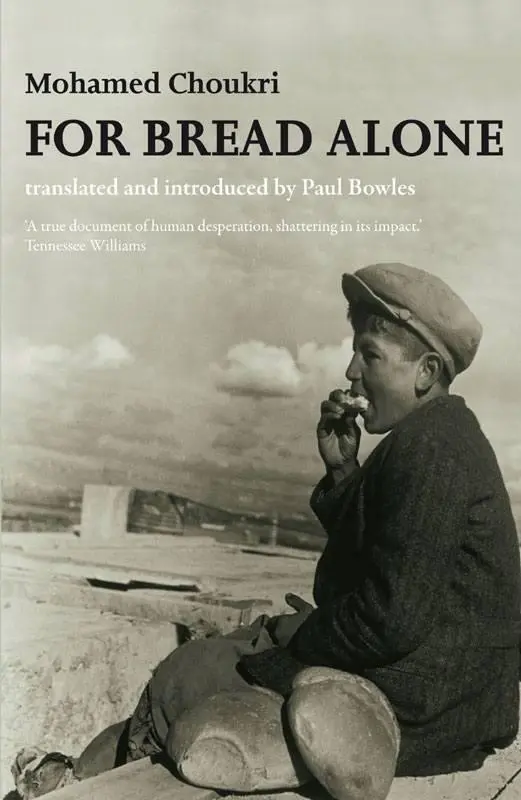
Mohamed Choukri - For Bread Alone
Здесь есть возможность читать онлайн «Mohamed Choukri - For Bread Alone» весь текст электронной книги совершенно бесплатно (целиком полную версию без сокращений). В некоторых случаях можно слушать аудио, скачать через торрент в формате fb2 и присутствует краткое содержание. Год выпуска: 2012, Издательство: Telegram Books, Жанр: Современная проза, на английском языке. Описание произведения, (предисловие) а так же отзывы посетителей доступны на портале библиотеки ЛибКат.
- Название:For Bread Alone
- Автор:
- Издательство:Telegram Books
- Жанр:
- Год:2012
- ISBN:нет данных
- Рейтинг книги:5 / 5. Голосов: 1
-
Избранное:Добавить в избранное
- Отзывы:
-
Ваша оценка:
For Bread Alone: краткое содержание, описание и аннотация
Предлагаем к чтению аннотацию, описание, краткое содержание или предисловие (зависит от того, что написал сам автор книги «For Bread Alone»). Если вы не нашли необходимую информацию о книге — напишите в комментариях, мы постараемся отыскать её.
On moving to another province Mohamed learns how to charm and steal, and discovers the joys of drugs, sex and alcohol. Proud, insolent and afraid of no-one, Mohamed returns to Tangiers, where he is caught up in the violence of the 1952 independence riots. During a short spell in a filthy Moroccan jail, a fellow inmate kindles Mohamed's life-altering love of poetry.
The book itself was banned in Arab countries for its sexual explicitness. Dar al-Saqi was the first publishing house to publish it in Arabic in 1982, thirty years after it was written, though many translations came out before the Arabic version.
Translated by
.
Mohamed Choukri Paul Bowles
The Sheltering Sky
For Bread Alone
The story of Choukri's life is continued in
.
For Bread Alone — читать онлайн бесплатно полную книгу (весь текст) целиком
Ниже представлен текст книги, разбитый по страницам. Система сохранения места последней прочитанной страницы, позволяет с удобством читать онлайн бесплатно книгу «For Bread Alone», без необходимости каждый раз заново искать на чём Вы остановились. Поставьте закладку, и сможете в любой момент перейти на страницу, на которой закончили чтение.
Интервал:
Закладка:
It was at this hour that we used to go out into the vineyards to work. The old man complained without stopping, and the sound of his voice made my hands tighten on the reins. If it had not been for my attack on the beautiful boy in the field, I should still be there working. I remembered my mother’s face, my aunt’s face. I now understand why my aunt treated me with such tenderness. She had no children of her own. And I believe it was her husband who made her send me home in order to avoid possible trouble.
Look! said Boussouf. The ship’s coming into the harbour.
I’m looking, I said.
He stopped rowing, pulled one oar out of the water, and dropped the oarlock into a hole beside the plank where I sat. We began to row together.
The ship’s full of soldiers, he said.
As we drew near the side of the ship a Frenchman in uniform called down to us: Hé! Qu’est-ce que tu as là-dedans?
I signalled to him to wait a minute. Boussouf pulled out the coil of rope and got it ready to throw.
Catch it! I shouted.
Several hands reached out to grab the end of the rope, which was weighted with knots. Boussouf tossed up the coil with force, and a black soldier caught it.
Tie it tight! I called to him in French.
Come on. Climb up! cried several soldiers.
I started to climb up the rope, hand over hand.
That’s right! Keep it up! Bravo! Good! shouted the voices. A Senegalese soldier helped me onto the deck. Boussouf had tied the basket onto the tail end of the rope once I was aboard. I leaned over the railing and began to pull it up. Another black soldier approached me and said: What have you got for sale, brother?
Without turning my head towards him I answered: Swiss watches, shawls, Japanese handkerchiefs and cigarette-lighters.
It was a French soldier who helped me get the basket over the railing and onto the deck. Allez! Laisse voir ce que tu as là-dedans .
I took out the carton of watches, leaving everything else in the basket. Here are the watches, I told them.
How much is this one?
Five thousand francs.
It’s not a fake?
What do you mean? I don’t sell fake watches.
Three thousand.
Four thousand, I said.
No, no! I’ll give you three thousand.
Take it. It’s yours. I was thinking: If one of them buys something, they’ll all begin.
The watches were disappearing from my hands one after the other, and my pockets were filling up with banknotes. Suddenly a soldier appeared and planted himself in front of me. Give me back my money, he said.
If I do that, I thought, they’ll all start asking for their money back. I can’t.
Why? I asked him.
They say your watches are no good.
Listen, I told him. Whoever told you that didn’t have enough money to buy a watch, that’s all.
Are you going to give me back my money?
You picked out the watch yourself. Nobody made you buy it.
Dozens of pairs of eyes were staring doubtfully at me. I heard throats being cleared. The blond French soldier spoke: Mine’s all right. I’m going to keep mine.
I went quietly down to the steerage deck where the Jews were travelling. It smelled of mildew and vomit.
What have you got, boy? asked a Jewish woman in a tired voice.
Japanese shawls and handkerchiefs, I told her.
Several other women gathered around me. Let’s see what you’ve got in your basket, the first one said.
What a pretty colour that one is! a girl exclaimed to a woman who was probably her mother. How much is this?
A thousand francs.
Seven hundred.
I was thinking: I’ve got to sell everything fast and get out of here.
A pot-bellied old man with a pointed grey beard suddenly cried: It’s cheap material! Wash it once and the whole thing is gone. No more colour.
The woman beside him turned to him. What do you know about it? she cried. These things are for women.
I know the stuff, the old man said. The Hindus sell it wholesale all over Tangier.
It’s always hard to sell to old people, I kept telling myself. They always pride themselves on knowing everything.
The Jewish women around me went on buying, without paying any more attention to the old man. From time to time he cried at them: You’re crazy! You’re buying the worst quality! The lowest!
The shawls and scarves were disappearing, but the sharp smell of the vomit was still there in my nostrils. There was a sudden jolt and the boat stopped moving. I pocketed the money for the last handkerchief and began working my way through the shouting women. Bring more stuff! they were crying.
As I came up on deck a Senegalese soldier some distance away caught sight of me and began to call out: Hey, you! Wait for me there!
He probably wants me to take back the watch I sold him, I thought. I hurried through the crowd to the other end of the deck.
There was a circle of soldiers around Rami. That drunken brute, who practically never gets out of his bed, must be selling them watches for half the price I charged. I went over to him.
You’re the same old pimp, aren’t you? I said.
Who do you think you’re talking to?
You. Who did you think I was talking to?
Wait till we’re in town. I’ll show you, he said.
I’ll spit up your ass-hole, I told him.
I could see Boussouf rowing rapidly towards the ship. I waited until he was below, and tossed the basket into the rowboat. Then I began to climb down the rope, letting myself slide as I went. The rope took the skin off the palms of my hands. As I went, the taut end of the rope above me was suddenly cut, and I fell the rest of the way, landing in the middle of the rowboat.
Pftu! cried Boussouf. This is no way to earn money. You want to break the boat?
That Senegalese son of a whore must have cut the rope, I said.
To hell with this fucking work, he went on angrily.
Row hard, I told him. They may throw things at us. It wouldn’t be the first time. I know those soldiers, the sons of whores!
Look out! shouted Boussouf. He and I both ducked as a beer bottle came down at us.
Take one of the floorboards and ward them off, he told me.
I did what he suggested.
The black man was screaming insults after us, and squeezing an invisible neck between his two hands. It was as if I could feel him strangling me. Then two bottles came at once, and I parried them with the floorboard.
Ow! My hand! Inaal dinhoum! I threw the board far from the rowboat, and began to lick and suck my wound. It was a wound that pleased me. Not for a long time had I so enjoyed watching my blood run out. And the mixture of salt and sweet is pleasant in my mouth. But I began to feel painful pricklings in the spot on my hip where I had landed. Boussouf stopped rowing. We were far enough away from the ship now. He stood up, seized his crotch, and waved it wildly at those standing by the rail.
What’s that for? I said. Who’s interested in what you’re doing now? The current’s against us.
We began to row together.
After a moment he said: But what did you do to them?
Nothing. It’s all Rami’s fault.
And what did he do?
He always sells his watches at half price. The next time I see him in town I’m going to piss on him.
You didn’t talk about the war in Algeria?
Of course not. Are you crazy?
And with the Jews?
No, no. Nothing. What would I tell them? Should I tell the French and Senegalese soldiers not to go to Algeria and fight? Or tell the Jews not to emigrate to Palestine?
The tide and the current were very strong, and the wind was coming up. Suddenly Boussouf’s oar cracked in half. Only the handle remained.
Now we’re in trouble, I said.
Pfu! All this for your three thousand francs! he cried.
Читать дальшеИнтервал:
Закладка:
Похожие книги на «For Bread Alone»
Представляем Вашему вниманию похожие книги на «For Bread Alone» списком для выбора. Мы отобрали схожую по названию и смыслу литературу в надежде предоставить читателям больше вариантов отыскать новые, интересные, ещё непрочитанные произведения.












Обсуждение, отзывы о книге «For Bread Alone» и просто собственные мнения читателей. Оставьте ваши комментарии, напишите, что Вы думаете о произведении, его смысле или главных героях. Укажите что конкретно понравилось, а что нет, и почему Вы так считаете.