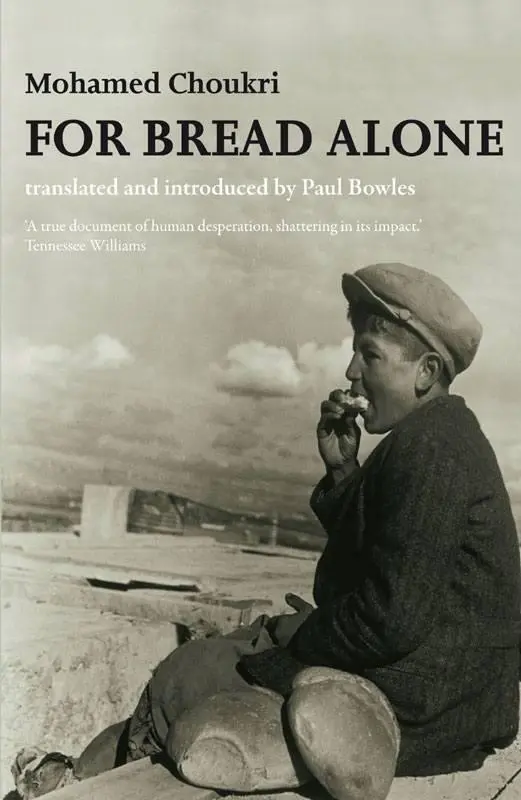
Mohamed Choukri - For Bread Alone
Здесь есть возможность читать онлайн «Mohamed Choukri - For Bread Alone» весь текст электронной книги совершенно бесплатно (целиком полную версию без сокращений). В некоторых случаях можно слушать аудио, скачать через торрент в формате fb2 и присутствует краткое содержание. Год выпуска: 2012, Издательство: Telegram Books, Жанр: Современная проза, на английском языке. Описание произведения, (предисловие) а так же отзывы посетителей доступны на портале библиотеки ЛибКат.
- Название:For Bread Alone
- Автор:
- Издательство:Telegram Books
- Жанр:
- Год:2012
- ISBN:нет данных
- Рейтинг книги:5 / 5. Голосов: 1
-
Избранное:Добавить в избранное
- Отзывы:
-
Ваша оценка:
For Bread Alone: краткое содержание, описание и аннотация
Предлагаем к чтению аннотацию, описание, краткое содержание или предисловие (зависит от того, что написал сам автор книги «For Bread Alone»). Если вы не нашли необходимую информацию о книге — напишите в комментариях, мы постараемся отыскать её.
On moving to another province Mohamed learns how to charm and steal, and discovers the joys of drugs, sex and alcohol. Proud, insolent and afraid of no-one, Mohamed returns to Tangiers, where he is caught up in the violence of the 1952 independence riots. During a short spell in a filthy Moroccan jail, a fellow inmate kindles Mohamed's life-altering love of poetry.
The book itself was banned in Arab countries for its sexual explicitness. Dar al-Saqi was the first publishing house to publish it in Arabic in 1982, thirty years after it was written, though many translations came out before the Arabic version.
Translated by
.
Mohamed Choukri Paul Bowles
The Sheltering Sky
For Bread Alone
The story of Choukri's life is continued in
.
For Bread Alone — читать онлайн бесплатно полную книгу (весь текст) целиком
Ниже представлен текст книги, разбитый по страницам. Система сохранения места последней прочитанной страницы, позволяет с удобством читать онлайн бесплатно книгу «For Bread Alone», без необходимости каждый раз заново искать на чём Вы остановились. Поставьте закладку, и сможете в любой момент перейти на страницу, на которой закончили чтение.
Интервал:
Закладка:
The youth lay quite still, with the blood coming out slowly from his cuts. The men went out and shut the door, leaving the window open.
A quarter of an hour later they came back, bringing two attendants with a stretcher. They lifted the young man onto the canvas and carried him out, still unconscious. There were puddles and smears of blood where he had lain. Again the door shut and the window remained open.
There must be something the matter with him, I said.
Let him do what he likes, said Zailachi. He’s either an alcoholic or he smokes too much kif .
The young man who had been critical added: Or Allah has put a curse on him. Or his father has.
Of course, said the other. You get punished for whatever you do.
We were silent. Our cigarettes had given out. The butts we had thrown away were extremely short. I picked one up, however, and smoked it.
We awoke Monday morning completely exhausted. The two others merely sat, bent over, and Zailachi did not do his morning exercises. In spite of the ugly grey pallor his dark skin had taken on as a result of hunger, he seemed in better condition than the rest of us. I felt only like vomiting, and I was certain that I should, if anyone used the latrine. I thought of that noon I had spent on the docks, when the idea of bread mixed with excrement first flowered in my mind.
The guard threw open the door and called out my name. I stood up, and found that I was dizzy and that my knees were trembling. I said goodbye, even though I had no idea whether I was going to be let out or not. I went along with the guard, and as I climbed the stairs my laceless shoes flapped. Being out of that hateful cell was like being half-free. We went into a room where a large camera was set up in the centre, with a chair in front of it. The guard withdrew, and the photographer told me to sit down. The room was heated. To remember the cell was like remembering being shut into a refrigerator. The man came over to me and arranged my pose. Then he went behind the camera and told me to look into the lens. He took one full-face picture and two profiles. This must be for their records, I thought. He asked my name, and showed me how to push my fingers, one by one, onto the ink-pad and make their marks on a piece of white paper.
A secret policeman entered and began to speak in French and Spanish with the photographer, who was a Moroccan. When the work was finished, the photographer ran his eyes over the paper and asked me if I knew how to sign it. I said no.
Most of them are like that, said the policeman.
Of course, the photographer said.
Next they asked me to push my thumb again into the ink-pad, and make my sign with it at the bottom of the paper. I did not dare ask them what was written on the paper, but I did tell them that I had done nothing.
I have nothing to do with that, said the photographer. Now go down and report to the guard who brought you up here.
Then the secret policeman, speaking in Spanish, asked me what kind of work I did. I told him I had no work.
And so what do you live on, if you have no work?
I don’t know. I just live. I do whatever work I can find, wherever I find it.
I see, he said. Well, go on downstairs.
I left them talking together, and went out, shuffling in my open shoes. On the floor below I looked in vain for the guard. I stood in the corridor, with the door into the street open before me. I could see the people going past. Two men dressed in civilian clothes entered and walked in front of me. Secret policemen, I supposed. Zailachi was right when he said they would release me on Monday or Tuesday. It looks as if it were going to be today. A guard came out of an office.
Have you finished with the photographer? he asked me.
Yes.
Come with me. He took me into his office. There were two other men inside, both dressed in civilian clothes. They had me put my thumb-print on another sheet of paper covered with words. I told them my name and they gave me back my money, belt and shoelaces.
I wondered what they had written about me on this piece of paper. They can write whatever they want, since I have no idea what the ink marks mean. Nor do I dare ask them to bring someone who will read it to me before I sign it.
Get out of here, said one of the secret policemen.
I turned and stepped out of the office, having completely forgotten my fatigue and my nausea. As I went through the doorway I ran into a man wearing civilian clothing, and excused myself. He shoved me violently aside, so that I hit the wall.
Look where you’re going, you halfwit! he said. He went on, and I stooped to pick up one of my shoes, which had fallen off.
He must be a policeman. Only a policeman could behave like that.
When I got into the street I put the laces into my shoes and attached my belt to my trousers. It was a clear cold day with a bright sun overhead, and I breathed deeply as I walked along.
I went into Harouch’s restaurant in the Zoco de Fuera. He sold bean soup. I was thinking about the money Kandoussi had said he would leave for me with the owner of the Café Raqassa. And I also was casting about in my head for an idea for some sort of work. I must find a new way to live.
13
The alarm clock began to ring. I reached out into the darkness and shut it off. Then I got up and turned on the light. It was five o’clock. I could feel sleep still hanging there deliciously close, just inside my eyes. The boat will come into port in an hour, I was thinking. I glanced at Naima. She was sleeping quietly. I hate to live with a girl who never works. All she ever has to do is open her legs, to me or someone else. Does she expect me to marry her, the way BouChta did Faouziya? I haven’t gone that crazy yet.
I dressed rapidly, picked up the market basket, and snapped off the light. Then I went softly out of the room. Downstairs I washed my face in water that was like melted snow. I was careful when I woke the night-watchman. He began to pummel the air with his fists, as he always did when anyone woke him, and then he stared wildly at me, saying nothing.
Abdeslam! I said. It’s Choukri. I want to go out.
He gave a great sigh and got wearily out of bed. I followed him to the front door of the hotel. As I went out, he said: May Allah be kind to you this morning. I nodded at him and went down the silent alley. The day was violet-coloured now. The signs of poverty, blotted out by night, were becoming visible once again. The lucky ones are at home in bed at this hour. They don’t get up to work. They lie there, comfortable as excrement enfolded in the belly. There are many things for them to rely upon: Allah, their own personalities, love, power. But I can rely only upon my own health and the fact that I am young.
I stopped just inside Bab el Assa and looked out over the harbour. I could see that the water was rough.
When I got down to the waterfront I found Boussouf standing by a kiosk having a bowl of bean soup. I said hello, and ordered a bowl for myself. Between us we arranged the price. He would do the work for me for 3,000 francs.
I heard yesterday that the steerage is going to be full of Jews on their way to Palestine, said Boussouf.
I’m more interested in the French and Senegalese soldiers on their way to Algeria, I told him. They don’t bargain so much. But Jews! Most of them are businessmen themselves. Even the ones who aren’t know just how much everything is worth.
But they’re leaving Morocco for good, and they’ll be sure to want souvenirs from the last port of call.
We’ll see.
We walked out onto the breakwater and got into the rowboat. He began to row slowly. Watching the oars cut the water put me in mind of the time when I had been working in the vineyard at Oran with the old man, I ploughing the earth, he yelling and scolding. Come on! Watch where you’re going! To the left, you good-for-nothing Riffian! Come on! You’re still half asleep! I’m going to get Monsieur Segundi to put you in the kitchen peeling potatoes. Hit the mule harder! That’s all you’re good for, peeling potatoes and washing dishes.
Читать дальшеИнтервал:
Закладка:
Похожие книги на «For Bread Alone»
Представляем Вашему вниманию похожие книги на «For Bread Alone» списком для выбора. Мы отобрали схожую по названию и смыслу литературу в надежде предоставить читателям больше вариантов отыскать новые, интересные, ещё непрочитанные произведения.












Обсуждение, отзывы о книге «For Bread Alone» и просто собственные мнения читателей. Оставьте ваши комментарии, напишите, что Вы думаете о произведении, его смысле или главных героях. Укажите что конкретно понравилось, а что нет, и почему Вы так считаете.